Vegetable · Asteraceae
Sunchoke
Helianthus tuberosus
One planting, years of harvest, provided you give it a corner of its own.
Full sun
Every 7–10 days
120–150 days
USDA 3–9
Overview
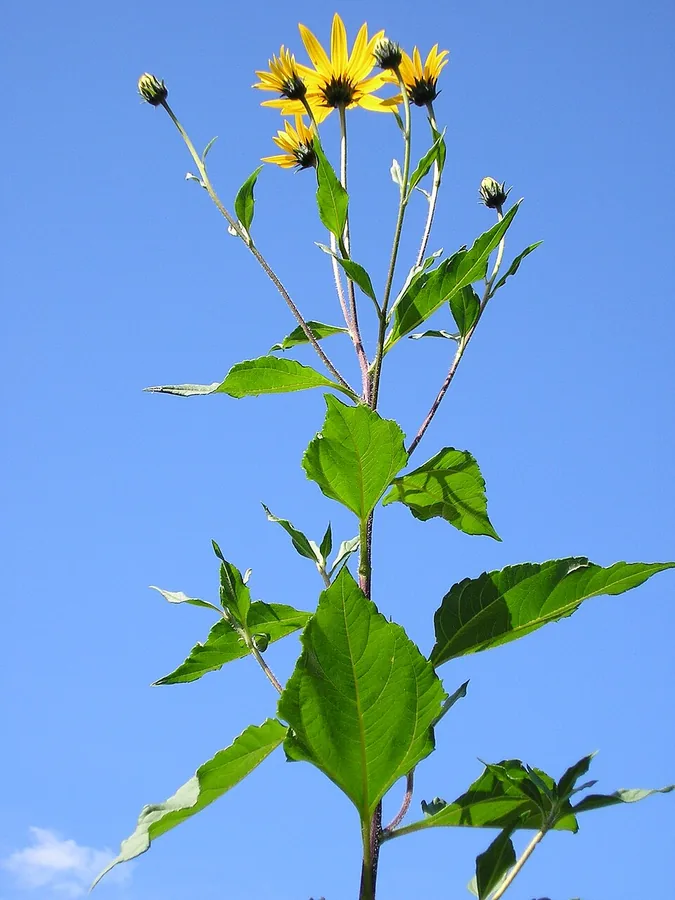
Behind the curious name sits a North American sunflower, grown for its roots rather than its show of bloom. The Jerusalem artichoke label is pure misdirection, since the plant claims no kinship with the artichoke and no origin in Jerusalem. It is Helianthus tuberosus, a tall perennial that lifts warm yellow, sunflower-like flowers over the late-summer garden while its harvest quietly forms below.
Part of the appeal is how gracefully sunchokes fit a low-effort life. They stand through cold as deep as -22°F (-30°C), ask nothing of poor soil, and still deliver a dependable crop. That same ease carries a caveat, since one overlooked tuber will quietly found a new stand the following spring, a habit best planned for rather than fought.
Style them as a permanent feature rather than a bed to redo each season. Let them anchor a far corner where their height reads as a living green screen, or hold them within a buried barrier or a generous container, and they repay the gesture with tubers that keep in the ground straight through winter, ready whenever the kitchen calls.
Care
The short version: full sun, easygoing well-drained soil, and a deep drink through dry stretches, all held within a contained bed or buried barrier that keeps their spread part of the plan.
Light
Give them full sun and they answer with the tallest stalks and the fullest harvest. A place in partial sun or light shade still yields a crop, only a leaner one, so reserve the brightest corner of the plot for them.
Water
A deep drink every 7 to 10 days carries them through dry weather, with a little extra attention in late summer and fall as the tubers fill out. Settled plants take drought in stride, yet it is steady moisture that turns a modest crop into a generous one.
Soil
They are unfussy about ground and thrive in loose, loamy soil that drains with ease. Keep the pH between 5.8 to 6.8, and pass over the soggy low corners, where wet roots invite tuber rot.
Temperature
Resilience is part of their charm. They weather winters as cold as -22°F (-30°C) and carry on through summer warmth up to 86°F (30°C), at home across a broad sweep of the country.
Humidity
Everyday outdoor humidity of 40% to 60% suits them without any thought. Air movement matters more than the figure, since the still, close air of a crowded late-season planting is what ushers in powdery mildew.
Feeding
Restraint serves them best. A single balanced feed in spring is all they want, and anything heavier only draws up leggy, top-heavy stalks that lean at the first strong wind.
Pruning
They are content left alone, though cutting the tall flower stalks in late summer tempers their reseeding and steadies the stems. Clear the spent stalks once frost has passed, and mow back any stand that begins to overstep its bounds.
Repotting
Containers are rarely their setting. Where they do live in a bordered bed or a large pot, lift and divide the tubers each season to refresh the planting and ease the crowding.
Size & spacing
Plan for scale, as the stalks rise to 6 to 10 feet (1.8 to 3 m) and each clump broadens to 2 to 4 feet (60 to 120 cm). The height casts genuine shade, so set them where they will frame rather than eclipse the shorter plantings nearby.
When to plant
Sunchokes keep an unhurried seasonal rhythm that is easy to build a year around. Tuber pieces go out in early to mid spring once the soil loosens, the tall stalks bloom through late summer, and the harvest opens after the first hard frost, carrying on through winter into early spring whenever the ground stays soft.
Northern hemisphere
Southern hemisphere
Typical months for a temperate climate: start earlier in warm zones, later where spring frosts linger.
- Plant: Early to mid spring, once soil can be worked, by planting tuber pieces 10-15 cm deep
- Harvest: Yellow sunflower-like blooms in late summer to fall; harvest tubers after the first hard frost and through winter into early spring
Hardiness
USDA hardiness zones: 3–9
Temperature: down to -40°C
Troubleshooting
Sunchokes ask little in the way of rescue, and most of their moments of drama are simply the exuberance of a vigorous grower. Keep a casual watch over the tubers, the towering stalks, and the ground where new shoots appear. Read the notes below against what you see and step in while the moment is small.
New shoots appearing well beyond their intended corner
This is the sunchoke's aggressive spread at work, carried by tuber pieces left behind at harvest and by rhizomes wandering out from settled clumps. A single missed fragment overwinters and rises again in spring to begin a fresh stand. Lift every fragment you can find, keep the planting within a bordered bed or buried barrier, and mow back stray shoots before they gather into new tubers.
Fix:
- Dig and remove every tuber fragment repeatedly over several seasons
- Confine plantings to a bed bordered by buried barriers or grow in large containers
- Mow or cut emerging shoots before they store energy in new tubers
Soft, watery tubers wrapped in cottony white growth
The culprit is sclerotinia soft rot, a fungus that settles into soggy, poorly drained ground and into any spot where a tuber was bruised at digging. It leaves the tubers watery and discolored, gaining ground wherever the soil stays saturated. Discard whatever is affected, mend the drainage, and store the sound tubers somewhere cool and barely moist rather than wet.
Fix:
- Discard affected tubers
- Improve soil drainage and avoid waterlogging
- Cure and store harvested tubers cool and slightly moist, not wet
A dusty white veil across the upper leaves
Late in the season, a crowded and humid stand tends to gather powdery mildew. The pale film drifts over the leaves, which yellow and dry ahead of time, though by then the harm is mostly a matter of looks. Thin the stems to let the air move and clear away any foliage heavily coated.
Fix:
- Improve air circulation by thinning stems
- Remove and dispose of heavily infected foliage
Tall stalks leaning or falling after a storm
Rising to 6 to 10 feet (1.8 to 3 m), sunchokes carry a height that leaves them prone to lodging in open sites and rich soil. Top-heavy stems tip from the base or snap partway up the moment wind and rain arrive. Offer staking or the shelter of a fence, and cutting the stalks back partway in midsummer keeps them from growing so top-heavy.
Fix:
- Provide staking or grow against a wind-sheltered fence
- Cut stalks back partway in midsummer to reduce height
Toxicity
This is a crop to relax around. Every part of the sunchoke is safe for people and pets, with no toxic compounds hiding in the leaves, stems, or tubers. The lone footnote is inulin, a fiber that leaves the tubers rich but a little gassy when a person or animal indulges, a quirk of digestion rather than any danger.
Safe for
People · Cats · Dogs · Horses · Rabbits · Livestock · Birds
Cats None
A safe companion for cats, since the leaves, stems, and tubers hold nothing toxic. A curious nibble at a stalk might bring a mild, fleeting stomach upset, and no more than that.
Dogs None
Nothing here to trouble a dog. One that unearths and eats a tuber may pass a little extra gas from the inulin, which settles on its own.
Horses Safe
Horses graze the foliage without harm, and the tubers make a wholesome, starchy treat offered in moderation.
Rabbits Safe
Rabbits take the leaves and tubers in stride. Introduce any new food gently, as with any fresh green, so their digestion stays even.
Livestock Safe
Cattle, goats, sheep, and pigs all take to sunchoke tops and tubers, and the crop is sometimes grown on purpose as forage.
Birds Safe
Backyard poultry and wild birds visit the plant without trouble, and the seed heads draw them once the blooms have gone by.
People Safe
The tubers are a long-loved food, fine raw or cooked. They carry plenty of inulin, a fiber we do not fully digest, so a generous helping can leave a person gassy, a quirk of digestion rather than poisoning.
No special handling precautions for toxicity; tubers are high in inulin, which can cause gas and digestive upset if eaten in quantity by people, but this is a dietary effect and not poisoning.
Varieties
A short list of named sunchokes rewards the effort of seeking them out, most chosen for smoother tubers that make light work of the kitchen sink. These are the names worth knowing.
Stampede
An early type with large, white-fleshed tubers that crops handsomely even where the season is brief.
Red Fuseau
Bears long, smooth, red-skinned tubers that come clean at the sink far more readily than the knobby kinds.
Mammoth French White
A tall, vigorous grower that turns out big, knobby white tubers in real abundance.
Fuseau
Favored for smooth, elongated tubers with few knobs, a quiet luxury at prep time.
How to propagate
Few plants make starting a patch so effortless. Sunchokes multiply of their own accord, and a handful of buried tubers is all it takes to set the whole thing in motion.
Bulbs & cormsEasy
Early to mid spring · One growing season to a harvestable colony
Set whole tubers or pieces, each with at least one bud or eye, about 4 to 6 inches (10 to 15 cm) deep in early to mid spring, much as you would place a bulb or corm. They take hold quickly and fill out a harvestable colony within a single season, then spread with real appetite, so choose a place you will be glad to keep them for good.
Myths
Jerusalem artichokes are a variety of artichoke that hails from Jerusalem.
The name misleads on both counts. This is a North American sunflower, Helianthus tuberosus, no relation to the artichoke, and the label most likely drifted from girasole, the Italian word for sunflower.
The tubers can be enjoyed in any quantity without consequence.
The tubers are generous with inulin, a fiber the human gut cannot fully break down, so a lavish serving brings on real gas and flatulence. It is a matter of digestion, not a sign of anything toxic.