
Introduction
Most of your garden sleeps through the cold months. The christmas rose breaks that rule and opens wide white cups while frost still covers the ground. It blooms from midwinter into early spring, when almost nothing else dares to flower outdoors.
The plant goes by the botanical name Helleborus niger. The old nickname black hellebore comes from its dark roots, not its pale petals. It stays short at about 9 to 12 inches tall and spreads a bit wider. This tough winter flowering perennial lives through hard cold in USDA zones 3 to 8. It comes back every year without fuss.
Here is the twist that fools many gardeners. It carries the rose name and shows off rose-like blooms, yet it has no relation to true roses at all. It belongs to the buttercup family, so the resemblance is pure coincidence. That single fact changes how you feed it, where you plant it, and what soil it wants.
Most pages about this plant pick one lane. Some retell the old legend and stop there. Others give you thin care tips that skip the parts that matter. This guide pulls both together and digs deeper. You get the symbolism, season-by-season care, pet safety, cultivars, and the science in one place.
There are good reasons to grow it beyond the holiday. It feeds early pollinators like bees when food is scarce, and it shrugs off both deer and rabbits. Get the christmas rose care right and you gain a plant that earns its spot in the garden long after the decorations come down.
Christmas Rose Care Guide
By its third winter, my Potter's Wheel finally became a steady winter bloomer. I watched it throw up a clutch of white cups under the bare tree in the north-facing border. For the first two years it just sat there and sulked. I had half written it off.
I gave it almost nothing in those early seasons. No feed worth mentioning, no fussing, just the right shaded spot and a yearly mulch in autumn. The recovery came on its own once the roots settled, which is the whole rhythm of growing christmas rose plants.
Good christmas rose care starts with light, and this is where most people slip up. The plant is intolerant of bright winter sun and high heat, so it does best in partial shade or dappled light. A spot under a deciduous tree is ideal because it gets gentle sun in winter and cover in summer.
Water comes next, and the rule is simple. Keep the soil moist but never soggy. The plant wants steady moisture through its growing and blooming months, so check it in dry spells and water before the ground bakes hard. Soggy roots in winter will rot the crown faster than cold ever will.
Soil is the part that pays you back for years. Helleborus niger thrives in well-drained soil that is humus-rich and stays moist, with a neutral-to-alkaline pH of 6.0 to 8.0. Dig in plenty of leaf mold or compost before planting, and it handles heavy clay better than most shade plants. Mulch every autumn to keep that organic matter topped up.
Give the christmas rose its permanent spot the first time you plant it. It resents root disturbance and can take 2 to 5 years to fully settle, so moving it sets the clump back.
Feeding is the easy part of helleborus niger care. A light feed in spring is plenty, and that autumn mulch does most of the heavy lifting. Heap on too much fertilizer and you push soft leafy growth at the cost of flowers, so go light.
Set your hopes on the long game. A grown plant reaches just 9 to 12 inches (23 to 30 cm) tall and 12 to 18 inches (30 to 45 cm) wide. It is hardy across USDA zones 3 to 8. It takes 2 to 5 years to hit full size, so the modest first winters are normal. Give it the right shaded spot and let time do the rest.
What a Christmas Rose Really Is
Here is the part that trips up most new growers. The christmas rose meaning has nothing to do with actual roses. The plant is Helleborus niger, a tough winter perennial. It sits in the family Ranunculaceae. You know that group by its everyday name, the buttercup family. So it is closer to a buttercup than to anything in your rose bed.
The bowl-shaped white bloom is what fools people. It opens flat and wide like a wild rose, with a ring of yellow stamens in the middle. But the resemblance stops at the petals. Calling this plant a rose is like calling a sea horse a horse. The name sounds right and the shape teases you, yet the family tree tells a different story.
The plant earns its common name through timing, not lineage. It blooms when almost nothing else does, and that single trait gave it the season it is named for.
They are often called Christmas roses because they bloom around Christmas in warmer regions and in early spring in cooler areas.
There is also a christmas rose legend behind the name. The old story tells of a poor girl who had no gift for the newborn Christ and wept in the snow. Where her tears fell, white flowers pushed up through the frost. It is folklore, not history, but it explains why the flower carries such warmth for a winter bloom.
You will also hear it called black hellebore, which throws people off since the flowers are white. The name points to the dark roots, not the petals, and the Greek roots of the genus name mean injures and food, a quiet nod to how toxic the plant is. Gardeners also use snow rose and winter rose for the same plant.
One last point keeps you from buying the wrong plant. People often mix up the christmas rose and the Lenten rose. The Lenten rose is the one that stores tag as Helleborus orientalis, and it blooms a little later in spring in deeper colors. The two look like cousins on the shelf. But you want the one that flowers first, often while snow still sits on the ground.
Where and How to Plant
Where to plant christmas rose matters more than almost any other choice you make with this plant. It hates having its roots moved, and it takes 2 to 5 years to reach full size. So planting christmas rose in the right spot from the start saves you years of trouble later.
The best place to plant hellebores is in partial or dappled shade, with the bed facing east, north or west and tucked away from strong, cold winds. They want well-drained soil that still holds some moisture, stays fertile, and sits on the neutral to alkaline side. Heavy clay works fine here as long as the shade is there too.
I was kneeling in the north-facing border by the old deciduous tree. I worked leaf mould and a couple of handfuls of grit into the cold, sticky clay. Then I set my 'Potter's Wheel' in. The first rain ran straight through that patch instead of pooling around the neck of the plant. That drainage is why the crown sits level with the soil and never below it.
Pick a partial or dappled-shade site sheltered from harsh winter sun and cold wind, where the soil stays moist but never waterlogged.
Mix plenty of leaf mould or compost, plus grit on heavy clay, into the planting area to create the moist, well-drained, humus-rich bed it prefers.
Plant so the crown sits level with the soil surface, never buried, which keeps the growing point dry and reduces the risk of crown rot.
Space plants 12 to 14 inches (30 to 36 cm) apart, firm the soil gently around the roots, and water in well to settle them.
Finish with a layer of organic mulch over the root zone, keeping it clear of the crown, to lock in moisture and protect the roots.
Set your plants 12 to 14 inches (30 to 36 cm) apart so each one has room to fill out over the years. Keep the crown right at the soil line as you backfill. Bury it too deep and you invite crown rot, the one mistake that undoes all your good planting work.
Thrives in neutral to alkaline soils that are moist, fertile and humus-rich, ideal for heavy clay in partial shade. Provide shelter from strong, cold winds. Mulch annually in autumn.
Season by Season Care
Good seasonal care for a Christmas rose comes down to doing the right small job at the right time. This plant works on its own clock. It rests through summer, then wakes up and flowers when most of the garden sits bare and brown.
Christmas rose winter care is mostly about one move. Cut away the old, tatty leaves just as the flower buds push up in late winter. This shows off the blooms and cuts down on hellebore leaf spot, since the worn foliage often carries the disease.
The other key date falls in autumn. A fresh layer of mulching over the root zone acts like tucking a blanket over the roots before the cold sets in. Keep it off the crown, and it feeds the soil while it shields the roots from hard frost.
Use the calendar below to match each job to its season. Each task takes minutes, but the timing is what gives you strong, healthy blooms year after year.
Late Winter
Flowers open from midwinter to early spring. Remove old, faded leaves as buds appear so the blooms show, and watch for leaf spot.
Spring
As flowering ends, divide congested clumps if needed, feed lightly, and move any indoor holiday plants outside to a sheltered shaded spot after acclimating.
Summer
Keep the soil evenly moist in dry spells and shaded from harsh heat. Plants rest now, so avoid disturbing the roots.
Autumn
Apply a fresh organic mulch over the root zone, keeping it off the crown, to feed the soil and protect roots before the cold.
Got your plant as a christmas rose indoors over the holidays? It is a hardy perennial, not a true houseplant, so it will fade if you keep it on a warm shelf for good. Treat the indoor stint as a short visit, then give it a home in the garden.
Moving outdoors in spring is the right call once the worst frosts pass. Harden it off over a week, then plant it in a sheltered, shaded spot with moist soil that drains well. It will settle in and reward you with flowers next winter, right when you need the color most.
Pet and Child Safety
The christmas rose poisonous to pets question has a clear answer, and it should shape where you put the plant. The ASPCA lists it as toxic to dogs and cats, and horses too, so a curious nibble can turn into a vet bill fast.
I plant mine in a raised bed along the back fence, far from the spots where my dog patrols and digs. The plant earns its place every winter, but I treat it the way I treat every christmas rose toxic enough to harm an animal. You enjoy it with your eyes, not your mouth, and you keep small hands and paws out of reach.
The harm comes from a mix of toxins in the plant. One of them is protoanemonin, and it sits next to heart-acting glycosides and saponins. The rhizome holds the most, and Cornell warns these toxins do not break down when the plant dries out. So pet safety here is not just about the fresh leaves. Cut or wilted bits still bite back.
Who is at risk
- Pets: All parts are toxic to dogs, cats and horses, per the ASPCA, so keep curious animals away from the foliage and roots.
- People: The plant is toxic to humans too, and handling it can cause contact dermatitis, so wear gloves when planting or dividing.
- Children: Young children are flagged as at-risk, so site the plant where small hands cannot reach the leaves or flowers.
Which parts are toxic
- Whole plant: Cornell notes the entire plant is toxic, with the rhizome holding the most concentrated, ill-defined compounds.
- Stays toxic: The powerful toxins are not destroyed by drying or storage, so dead or cut material is not safe to handle bare-handed.
- Toxic principles: Sources list cardiac glycosides, saponins and protoanemonin among the compounds responsible for its effects.
Signs of poisoning
- Digestive signs: Reported signs in pets include drooling, abdominal pain, vomiting and diarrhea after the plant is eaten.
- Serious effects: In serious cases the ASPCA notes possible heart effects such as palpitations and abnormal contractions.
- Reassurance: NC State rates severity Medium and notes serious poisoning is rare, but any suspected ingestion still warrants prompt advice.
How to stay safe
- Smart siting: Plant it away from runs, paths and play areas where pets and children spend time.
- Handle with care: Wear gloves whenever you plant, divide or tidy the plant, and wash your hands afterward.
- Act fast: If you suspect a pet or child has eaten any part, contact a vet, doctor or poison control without delay.
The christmas rose has a fearsome poison reputation, but some toxicologists question whether its roots really contain the classic cardiac glycosides once blamed for it, since older studies may have used material contaminated with green hellebore. Treat the plant as toxic regardless.
None of this means you have to skip the plant. NC State rates the severity Medium, and serious poisoning stays rare. A smart spot, a pair of gloves, and a quick call to a vet if something gets eaten will cover almost every risk.
Treat the christmas rose like a sharp kitchen knife. It is useful and beautiful in the right hands, and you just respect what it can do. Put it where pets and kids cannot reach it, and you get all the winter color with none of the worry.
Cultivars and Companions
The plain species is lovely, but a few named christmas rose varieties push the flowers further. Some open earlier in the season. Others carry bigger, rounder, or fuller blooms that read from across a frosty yard.
These four cultivars are the ones worth hunting down at a good nursery. Each one keeps the same easy nature as the wild plant, so you get a better flower without any extra fuss in the bed.
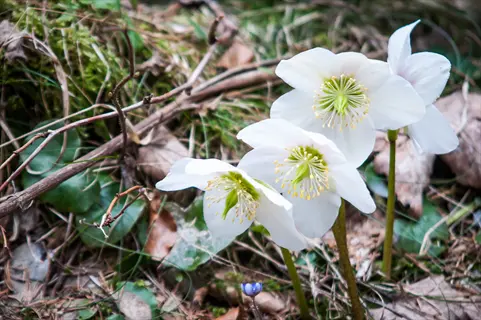
Potter's Wheel
- Flower: Known for large, rounded, pure white blooms with a neat green eye that sit well above the foliage.
- Habit: Forms a compact clump in the usual 9 to 12 inch (23 to 30 cm) height range for the species.
- Best use: A strong choice for the front of a shaded winter border where the clean white shows against dark leaves.
- Conditions: Wants the same partial shade and moist, well-drained, neutral-to-alkaline soil as the species.
- Bloom time: Opens midwinter to early spring like other forms of Helleborus niger.
- Note: A long-loved garden form prized for the size and shape of its flowers.
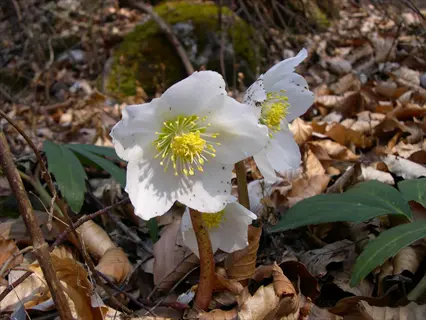
Praecox
- Flower: Valued for blooming especially early, often opening before other christmas rose forms.
- Habit: A typical low, clumping christmas rose suited to the front of shaded beds.
- Best use: Plant it where early winter flowers are most welcome, such as near a path or doorway view.
- Conditions: Needs the standard shade, shelter and moist, well-drained soil of the species.
- Bloom time: Among the earliest, extending the winter display at the front of the season.
- Note: Choose it specifically when you want the earliest possible blooms.
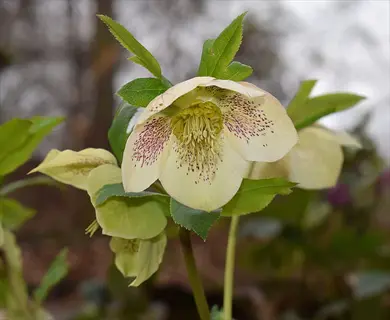
Snowbells Series
- Flower: A modern series offering semi-double, side-facing pure white blooms on tidy plants.
- Habit: Stays compact at roughly 10 to 12 inches (25 to 30 cm), close to the species norm.
- Best use: Good for borders, containers, mass planting and cut flowers thanks to its uniform habit.
- Conditions: Grows in part shade to shade with average water and neutral-to-alkaline soil.
- Bloom time: An early bloomer that brings reliable winter color.
- Note: A widely sold branded selection bred for garden performance.
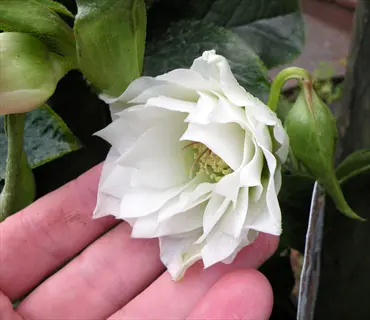
Marion
- Flower: Noted for fuller, often semi-double white flowers that add extra petal interest.
- Habit: A compact christmas rose form in the usual height range for the species.
- Best use: Use it where you want a slightly showier flower than the simple single bowl shape.
- Conditions: Wants the same partial shade and moist, well-drained soil as other forms.
- Bloom time: Flowers midwinter to early spring in line with the species.
- Note: A named selection grown for its fuller flower form.
Think of the christmas rose as the opening act of the shade border. It flowers in the cold and quiet of winter, then steps back as hostas and ferns take the stage in spring and summer. Good companion plants keep that bed worth looking at all year.
Pair it with shade lovers that want the same moist, well-drained, partly shaded soil but peak at other times. Hostas and ferns fill the gap in warm months. Cyclamen, foxglove, and bleeding heart add height and color through spring, so the planting never sits empty.
There is a quiet bonus too. The christmas rose is deer resistant and shrugs off rabbits, so it stays whole while hungry animals strip softer plants nearby. The RHS also lists it as a plant for pollinators, feeding early bees when almost no other flowers are open.
5 Common Myths
The christmas rose is a kind of rose, closely related to the roses grown in summer flower beds and bouquets.
It is Helleborus niger, a hellebore in the buttercup family. The shared rose name comes from its flower shape, not any relation.
Christmas roses are delicate plants that must be kept indoors as a short-lived holiday gift, then thrown away afterward.
They are tough, hardy perennials for zones 3 to 8 that live for years outdoors and improve as the clump matures.
Because it flowers in winter, the christmas rose needs full, bright sun to bloom well during the dark, cold months.
It prefers partial or dappled shade and is intolerant of bright winter sun and heat, which can scorch its leaves and flowers.
The christmas rose is harmless, so it is a safe choice for gardens where dogs, cats and young children play freely.
All parts are toxic to people and pets. Plant it away from animals and children, and wear gloves when handling it.
You should cut a christmas rose back hard every year, like a true rose, to keep it tidy and encourage new growth.
Only remove old or damaged leaves as flowers appear. Hard pruning is unnecessary and can weaken this slow-growing plant.
Conclusion
The christmas rose asks for patience, then pays you back when almost nothing else is in bloom. Get the site and the soil right, and this winter flowering perennial opens its cup-shaped flowers while the rest of the garden sleeps. That payoff is the whole reason to grow Helleborus niger.
Keep the load-bearing facts close as you plant. It is a hardy perennial for USDA zones 3 to 8 that reaches just 9 to 12 inches (23 to 30 cm) tall. It blooms from midwinter to early spring, and it wants partial shade with moist, well-drained, neutral-to-alkaline soil. Match those conditions and most of your christmas rose care is already done.
Treat the plant with respect, because it is toxic to people, dogs, cats and horses. Site it away from where pets dig or children play, and wear gloves whenever you cut or divide it. This is a shade perennial that earns a thoughtful spot, not a casual one.
Expect slow progress at first. Helleborus niger takes 2 to 5 years to reach full size. But it gets better year on year. It feeds early pollinators, and it shrugs off deer and rabbits. So picture the reward that waits for you. One quiet morning in deep winter, a single pure white bloom opens against the frost. The long wait suddenly makes sense.
Glossary
- cardiac glycosides
- Heart-affecting plant compounds historically blamed for the christmas rose's toxicity, now scientifically debated.
- crown rot
- A rotting of the plant's growing point caused by soggy soil or planting the crown too deep.
- hellebore leaf spot
- A fungal disease that marks hellebore leaves, worse on old, wet foliage.
- Helleborus niger
- The botanical name for the christmas rose, a winter-flowering perennial in the buttercup family.
- humus-rich soil
- Soil with plenty of decomposed organic matter, which the christmas rose prefers for moisture and fertility.
- protoanemonin
- An irritant compound in the christmas rose that can cause skin, mouth and digestive irritation.
- Ranunculaceae
- The buttercup plant family, which includes hellebores like the christmas rose rather than true roses.
- rhizome
- The thick underground stem of the christmas rose, which holds its most concentrated toxic compounds.
External Sources
Frequently Asked Questions
Why is it called a Christmas rose?
It blooms around Christmas in mild regions and is named for a legend about a girl's tears in the snow, though it is not a true rose.
Do Christmas roses come back every year?
Yes. The christmas rose is a hardy perennial that returns each year and lives for many years once established.
Is a Christmas rose a true rose?
No. The christmas rose is Helleborus niger, a hellebore in the buttercup family, unrelated to true garden roses.
Can you grow Christmas roses in pots?
Yes. Christmas roses grow well in deep pots with rich, well-drained soil, though they often settle better in the ground long term.
Where is the best place to plant a Christmas rose?
Plant it in partial or dappled shade with moist, well-drained, humus-rich soil, sheltered from harsh winter sun and cold wind.
Are Christmas roses poisonous to dogs and cats?
Yes. All parts are toxic to dogs, cats and horses, and the plant can cause drooling, vomiting and heart effects if eaten.
How do you take care of a Christmas rose?
Give it shade, steady moisture, well-drained soil, an autumn mulch, and remove old leaves as flowers appear in late winter.
Should you cut back a Christmas rose?
Only remove old, damaged or faded leaves as flower buds appear. Do not cut the whole plant back hard.
What are common Christmas rose problems?
Common issues include hellebore leaf spot, aphids, slugs, crown rot from wet soil, and shy flowering on young plants.
When do Christmas roses bloom?
They bloom from midwinter to early spring, often around Christmas in mild regions and into early spring in colder areas.