Houseplant · Bromeliaceae
Air Plant
Tillandsia
No pot, no soil, no fuss to spoil the look. Offer an air plant bright light and a weekly soak, and it carries the rest with ease.
Bright indirect
Every 7–14 days
50–86°F · 10–30°C
USDA 9–11
Overview
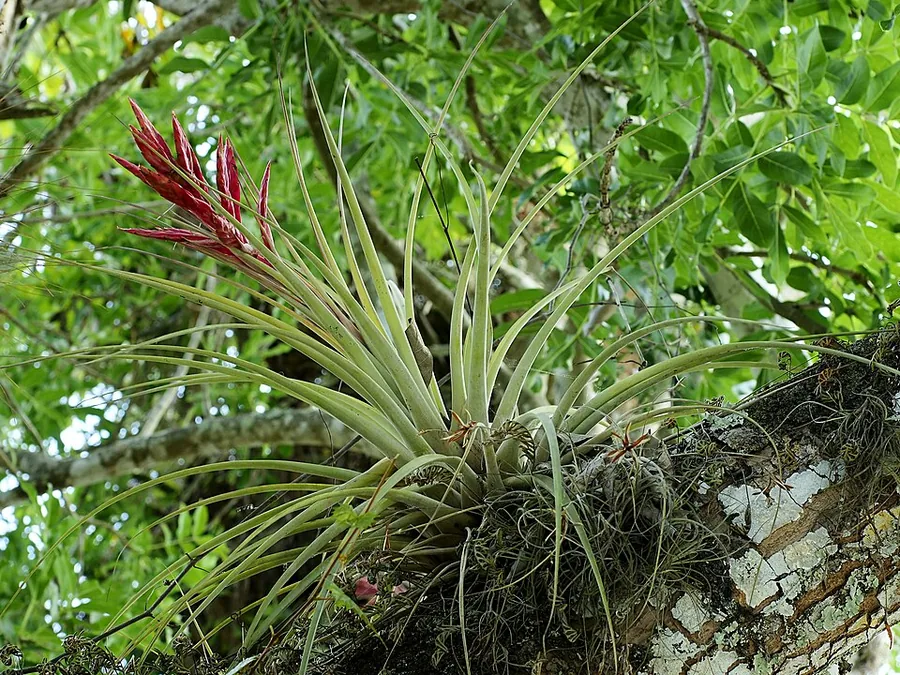
Air plants, the Tillandsias, are a sprawling family of bromeliads that ask for no soil at all. In the wild they settle along tree limbs and bare stone, holding fast with their roots while drawing water and nutrients in through their leaves. That soilless, epiphytic life is what lends them their easy charm at home, where a single specimen can perch on a length of driftwood, rest in a clear glass bowl, or simply punctuate a bare shelf.
Here the leaves take on the work roots usually shoulder. A fine dusting of silver scales called trichomes gathers moisture and feeds it inward, which is why a brief soak counts for so much more than any potting ritual. Forms range from modest clumps a couple of inches across to the broad, curling rosettes of the larger species, and because growth comes slowly, one plant keeps its tidy proportions for years on the shelf.
Every air plant builds toward a single flourish. At maturity it lifts a colorful flower spike, blooms just once, then quietly recedes, leaving a ring of offsets to carry the line forward. With the light and water in balance, that cycle renews itself over a long span, each new pup maturing and coming into flower when its moment arrives.
Care
The short version: bright, indirect light and a weekly soak in room-temperature water, followed by a full dry-out in moving air so moisture never settles in the leaf base.
Light
Air plants are at their best in bright, indirect light, set a few feet back from a window that catches the sun. They will accept a measure of direct sun or medium indirect light, while deep shade leaves them pale and slow. Too much fierce midday sun, by contrast, scorches the leaves, so the gentle middle ground suits them.
Water
Watering is where an air plant's fate is settled. Immerse the whole plant in room-temperature water for 20 to 30 minutes about once a week, or mist it thoroughly several times a week if that fits your rhythm. The decisive part comes after: shed the excess and let it dry through within roughly 4 hours in good air movement, because water lingering in the leaf base is what rots the plant.
Soil
There is no soil in the picture at all. Air plants live as epiphytes, fixed to wood or bark or shown bare, never settled into potting mix. Anything that traps moisture against the base courts rot, so keep them out in the open air where they read best.
Temperature
They keep their ease across a wide band, roughly 50°F to 86°F (10°C to 30°C), which suits most homes the year round. Hold them above freezing, since they have no patience for frost.
Humidity
Everyday household humidity around 40% to 60% suits them nicely. In hot, dry air they shed moisture faster and call for more frequent watering, while a cool, humid room lets you ease the pace.
Feeding
Feed with a light hand from spring through summer, while growth is underway. Stir a dilute bromeliad or low-nitrogen fertilizer at quarter strength into the soak or mist water about once a month, and set it aside through the cooler season.
Pruning
Little upkeep is asked of you. Trim away any dried or browned leaf tips and lift off the dead outer leaves at the base with clean scissors. Once a plant has bloomed and begun to fade, the spent flower stalk can come off while the pups are left to grow on.
Repotting
Not applicable - not potted; remount or rehome only if a display becomes crowded or a mount degrades
Size & spacing
Most air plants stay compact, standing about 2 to 12 inches (5 to 30 cm) tall with a spread of 2 to 10 inches (5 to 25 cm). Since they are displayed rather than planted, all that spacing asks is enough open room for air to move freely around the leaves.
Troubleshooting
Almost every air plant misstep returns to water, whether too little of it or too much pooled where it should not be. The two signs below capture the bulk of what arises, so read what the plant shows you and step in before the trouble reaches its heart.
A darkened, softened heart shedding its leaves at the base
A darkened, softened heart whose innermost leaves lift free at a touch is the mark of crown rot, the consequence of moisture allowed to linger in the leaf base after watering. By the time the center has gone soft and the inner leaves surrender without resistance, the plant has passed the point of rescue and is best retired. Caught at the first hint it can sometimes be dried out and saved, yet the surer safeguard is simply generous air movement around the plant.
Fix:
- Discard plants that have rotted through the center, as they cannot be saved
- If caught very early, dry the plant completely and improve airflow
Parched, rolled leaves finished with browning tips
Foliage gone dry and papery, curling inward on itself, generally signals underwatering or an atmosphere turned too arid, though fierce direct sun can leave the same scorched edges. A 20 to 30 minute soak tends to revive it, and the plant fills out again within a day. Settle it into a more dependable watering rhythm, keep it clear of the intense midday sun, and trim the brittle tips so its silhouette stays clean.
Fix:
- Soak the plant in room-temperature water for 20-30 minutes, then dry fully
- Increase watering frequency and move out of harsh direct sun
- Trim off crispy tips for appearance
Toxicity
For homes with animals, the news is calmly reassuring: air plants carry no known toxin and appear on no list of plants poisonous to cats, dogs, or other pets. The stiff leaves were never meant for eating, yet a passing nibble brings no poisoning. They may take their place safely in any room.
Safe for
People · Cats · Dogs · Horses · Rabbits · Livestock · Birds
Cats Safe
Air plants sit nowhere on the ASPCA's list of plants toxic to cats, so an inquisitive bite poses no poisoning risk. The leaves are stiff and never meant for the menu, and a cat that swallows a piece may simply cough or gag.
Dogs Safe
Dogs are equally untroubled, as nothing in the plant is poisonous to them. A generous mouthful of the fibrous foliage might unsettle a delicate stomach, which is reason enough to set displays beyond a determined chewer's reach.
Horses Safe
Horses face no poisoning hazard from air plants, since the group carries no reported toxic compound.
Rabbits Safe
Rabbits come to no harm beside air plants. The tough, fibrous leaves make poor forage, so the plant should never stand in for a portion of their diet.
Livestock Safe
Cattle, goats, and sheep are in no danger from air plants, which hold no known toxin.
Birds Safe
Pet birds remain safe in their company, with nothing toxic to cause concern should one inspect the leaves.
People Safe
Air plants are non-toxic to people and a pleasure to handle and keep in any room. They are grown for their look rather than the table, so there is no reason to taste them.
Safe to keep around pets; the thin stiff leaves are not a poisoning hazard, though they are not intended for eating.
Varieties
Hundreds of Tillandsia species exist, yet only a few turn up again and again in shops and on shelves. These are the ones worth knowing by name.
Tillandsia ionantha
A small clustering species whose green leaves warm to red while the center deepens to violet as flowering nears.
Tillandsia xerographica
The grand, slow-growing centerpiece of the genus, its broad silvery-gray leaves curling back into a rosette of almost sculptural poise.
Tillandsia usneoides (Spanish moss)
A rootless curiosity that falls in long chains of thread-fine gray foliage, draping from a branch rather than gathering into a rosette.
How to propagate
An air plant collection is less bought than awaited. A contented plant fashions its own copies once it has flowered, and bringing those pups along is the quiet, natural way to expand a shelf.
Offsets & pupsEasy
After the mother plant flowers, when pups reach about one-third to one-half the parent's size · Several weeks to a few months once separated, as growth is slow
A collection tends to grow itself. After a mature plant flowers, the fading bloom gives way to small offsets, called pups, gathering at the base. Let each pup reach roughly one-third to one-half the size of the parent before easing it free to stand alone, or leave the cluster intact and watch it round into a generous clump. The pace is unhurried whichever you choose, so a separated pup takes several weeks to a few months to find its feet.
Myths
An air plant draws all it needs from the air and never wants a drink.
The name flatters the truth. Water and nutrients enter through tiny leaf scales called trichomes, not from the surrounding air. Withhold the regular soaking or misting and the plant dries out and dies, so a watering habit is not optional.
With no roots settled in soil, an air plant asks nothing of the light.
An absence of roots in soil says nothing about a need for light. The plant photosynthesizes as any green thing does and depends on bright, indirect light to keep its color and vigor. Consign one to a shadowy corner and it slowly weakens and dims.