Houseplant · Bromeliaceae
Blushing Bromeliad
Neoregelia carolinae
Keep its central cup full and set it in bright, indirect light, and the blushing bromeliad brings quiet color to a room with almost no fuss.
Bright indirect
Every 7–14 days
50–90°F · 10–32°C
USDA 10–11
Overview
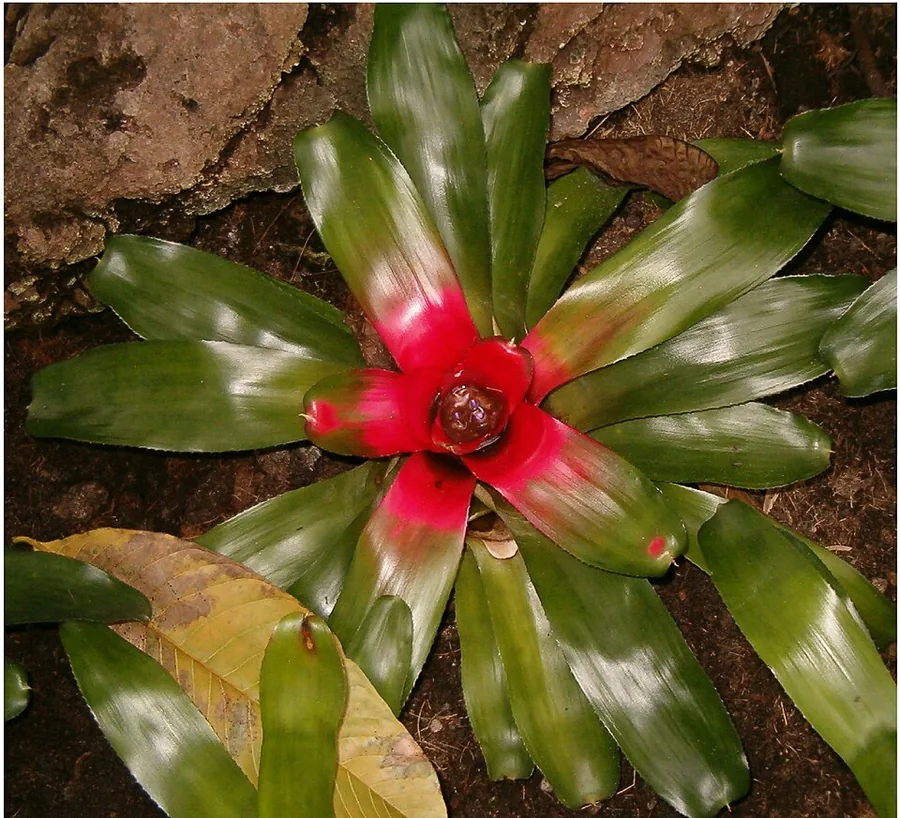
Neoregelia earns its place at home for the low, spreading rosette of broad, glossy leaves it forms, a shape that reads as calm and architectural on a shelf. As the plant matures, the leaves at its heart blush bright red or pink, and small flowers open deep in the central cup, turning a quiet green form into a focal point. That color can hold for months, long enough to anchor a corner through a whole season.
It lives as an epiphyte in the wild, resting on tree branches and taking its water and food through the leaves and the central tank rather than a heavy root system. That light-rooted habit is what makes it such an easy houseguest. A shallow bowl or a spot on a bright side table suits it, and its needs sit comfortably alongside a simple daily rhythm of topping up the cup.
Few plants ask so little for the presence they bring, which is what marks it as an easy houseplant for a considered room. Give it warmth, a humid corner, and light that stays bright but never harsh, and it holds its poise without fuss. Each rosette flowers once and then softens away, yet it leaves pups behind to carry the display on for years, so the look renews itself in place.
Care
The short version: bright indirect light, a central cup kept full of fresh water, and a loose bark mix that dries slightly between waterings, all in a warm, humid corner of the home.
Light
It looks its best in bright, indirect light, which keeps the rosette compact and the central color rich, so an east or filtered window makes a natural home for it. A partly shaded spot or gentle morning sun will do, but harsh midday light scorches the leaves, while a dark corner stretches the form and fades the blush that gives it its charm.
Water
Its daily ritual centers on the central cup. Keep the tank at the heart of the rosette filled with fresh water, ideally rainwater or distilled, and refresh it weekly so it stays clear rather than stagnant. Let the bark mix dry a little between waterings, every 7 to 14 days, since the limited roots resent sitting wet.
Soil
Set it in a loose, fast-draining epiphyte mix, such as equal parts peat, bark, and coarse sand, or a ready-made orchid bark medium, which suits an open, unfussy planter. A slightly acidic pH of 5.0 to 6.5 keeps it content, and the airy texture lets water pass the shallow roots without lingering.
Temperature
Ordinary room warmth, roughly 50°F to 90°F (10°C to 32°C), is exactly where it wants to live. Keep it away from cold drafts and chilly winter glass, since a hard chill is the one thing that unsettles it.
Humidity
It prefers the air a touch humid, around 50% to 70%, which suits a kitchen or a well-lit bathroom. Most living rooms run drier, so gather it with other plants, stand it over a humidity tray, or let a humidifier soften the air nearby.
Feeding
A light hand from spring through summer, about once a month while it grows, is all the feeding it wants. Reach for a dilute balanced liquid fertilizer at quarter to half strength on the mix or misted over the leaves, and keep feed out of the cup, where it can gather and cloud the water.
Pruning
There is next to nothing to do here. Lift away spent flowers and dead outer leaves to keep the rosette looking its best. Once it has bloomed the rosette slowly recedes, since each flowers only once, so clear the tired mother plant after the pups have taken hold.
Repotting
Repotting is a rare event, thanks to the modest root system. Move it on only when the pups crowd the pot or the plant grows top-heavy and unsteady, choosing a slightly larger container with fresh bark mix to keep it settled.
Size & spacing
It stays compact, around 6 to 12 inches (15 to 30 cm) tall with a spread of 12 to 20 inches (30 to 50 cm), a footprint made for a shelf, a side table, or the middle of a grouping. That low, spreading rosette sits gracefully wherever a room wants a little color at eye level.
Troubleshooting
Nearly every setback with this bromeliad comes down to water or light, the same two things that shape where it sits in a room. A soggy mix rots the base, strong sun bleaches the leaves, and a dim corner drains the color. Match the picture below to what you see and adjust the setting before it goes further.
A limp base and a sagging rosette
A rosette that softens at the base and begins to slump is showing crown or root rot, the result of a mix left soggy or cup water allowed to sour. Set watering aside and let the mix dry, then pour out the central cup and refresh it with clean water. As long as the trouble is confined to the roots, a move into a loose, fast-draining bark mix usually brings the plant back to its former poise.
Fix:
- Stop watering the mix and let it dry
- Empty and flush the central cup with fresh water
- Repot into a loose, fast-draining bark mix if rot is limited to roots
Small larvae astir in the water at the center
Small larvae stirring in the tank are a sign that mosquitoes have found still water and made themselves at home. A rinse of fresh water through the cup sends them on their way. Where the problem lingers, a scattering of Bacillus thuringiensis israelensis (Bti) granules settles it, and a habit of regular flushing keeps the water moving so it never turns stagnant.
Fix:
- Flush the cup with fresh water to dislodge larvae
- Apply Bacillus thuringiensis israelensis (Bti) granules to the cup for larval control
A sticky sheen, cottony wisps, or small bumps across the leaves
A sticky film, a wisp of cotton, or small raised bumps across the leaves signal mealybugs, scale, or spider mites, which show as cottony masses, brown bumps, or fine webbing and stippling. Lift them away with a cloth or cotton swab, then follow with insecticidal soap or horticultural oil. Keep the plant apart from its companions until all is clear, so nothing travels.
Fix:
- Wipe pests off with a cloth or cotton swab
- Treat with insecticidal soap or horticultural oil
- Isolate the plant until the infestation clears
Bleached or brown patches on the leaves
Pale, papery patches across the foliage are sun scorch, the mark of light that reaches the plant too direct and too strong for its liking. Draw it back into bright indirect light or a softly shaded corner, and tidy the worst of the burned tips if they disturb the look. It is harsh midday sun the plant would rather be spared.
Fix:
- Move to bright indirect light or partial shade
- Trim badly burned leaf tips if desired
Leggy leaves and a muted heart of color
When the leaves lengthen and loosen and the center loses its glow, the plant is telling you it sits in too little light. Move it to a brighter position with generous indirect light. In good light the rosette holds its tidy shape and the central color returns to its full, saturated best.
Fix:
- Move to a brighter spot with more indirect light
Toxicity
For a home that includes pets, this is a non-toxic plant and an easy one to place. The ASPCA lists the blushing bromeliad as safe for cats and dogs, and NC State Extension adds horses. The leaf tips can be stiff and the cup water is worth keeping fresh, but nothing here calls for a high shelf or a closed door.
Safe for
People · Cats · Dogs · Horses · Rabbits · Livestock · Birds
Cats None
A household cat can share a room with it easily, since the ASPCA lists this bromeliad as safe and a passing nibble means nothing. A pet that overindulges on any houseplant may feel briefly unsettled, and no more than that.
Dogs None
A dog is just as welcome in its company, with nothing harmful in the leaves or the cup. The leaf edges do carry a certain stiffness, so a devoted chewer is worth a quiet glance.
Horses Safe
NC State Extension places it among the plants that are non-toxic to horses, so a barn or paddock setting holds no poisoning risk.
Rabbits Safe
Nothing in this plant carries a toxin that would trouble a rabbit. It is no forage plant, though, so it deserves a place on display rather than in the feed.
Livestock Safe
Grazing animals such as cattle, goats, and sheep meet no poisoning risk from this plant.
Birds Safe
The foliage holds nothing toxic to pet birds. The single point of care is the water in the central cup, which is best kept clean and fresh.
People Safe
It settles comfortably into a home with children and handles easily without gloves. It is not a plant grown for the table, and only the stiff leaf tips ask for a moment's thought.
No special handling precautions for pets; the plant is non-toxic.
Varieties
A few Neoregelia forms come up most often, each with its own way of dressing a room through leaf markings and color. These are the ones worth knowing when you choose one for a space.
Neoregelia carolinae 'Tricolor'
Lengthwise stripes of green, cream, and pink run down its leaves, and the center deepens to bright red as the plant moves toward bloom.
Neoregelia carolinae 'Blushing Bromeliad'
The original and best-loved form, named for the central leaves that flush bright red and pink in the hush just before flowering.
Neoregelia spectabilis (Fingernail Plant)
A bright red tip finishes each leaf like a painted fingernail, with felty silver banding lining the underside.
How to propagate
Neoregelia renews itself through pups, so filling out a collection is mostly a matter of waiting for the offsets and giving each one its own pot.
Offsets & pupsEasy
After the mother rosette flowers and the pups reach about one-third the size of the parent · Several weeks to a few months
Once the mother rosette has flowered, it eases into decline and raises fresh pups around its base, so a single plant renews itself in its own time. Let each pup grow to about a third of the parent's size, then twist it free and settle it into a loose, fast-draining bark mix. Give it several weeks to a few months to root and find its footing.
Myths
Bromeliads live as parasites, sapping the trees they rest upon.
Neoregelia are epiphytes rather than parasites. A tree offers only a place to rest, while water and nourishment arrive through the leaves and the central cup. They take nothing from the host and never do it harm.
The pool of water at the center can be left as is forever.
Left in place, that water grows stale and can invite mosquitoes, more so out of doors. A regular flush of fresh water keeps the cup sweet, and a few Bti granules answer any larvae that appear.