Houseplant · Crassulaceae
Aeonium
Aeonium
Offer it bright light, gritty soil, and a dry summer rest, and this cool-season grower holds its shape, plump and poised.
Full sun
Every 7–21 days
41–77°F · 5–25°C
USDA 9–11
Overview
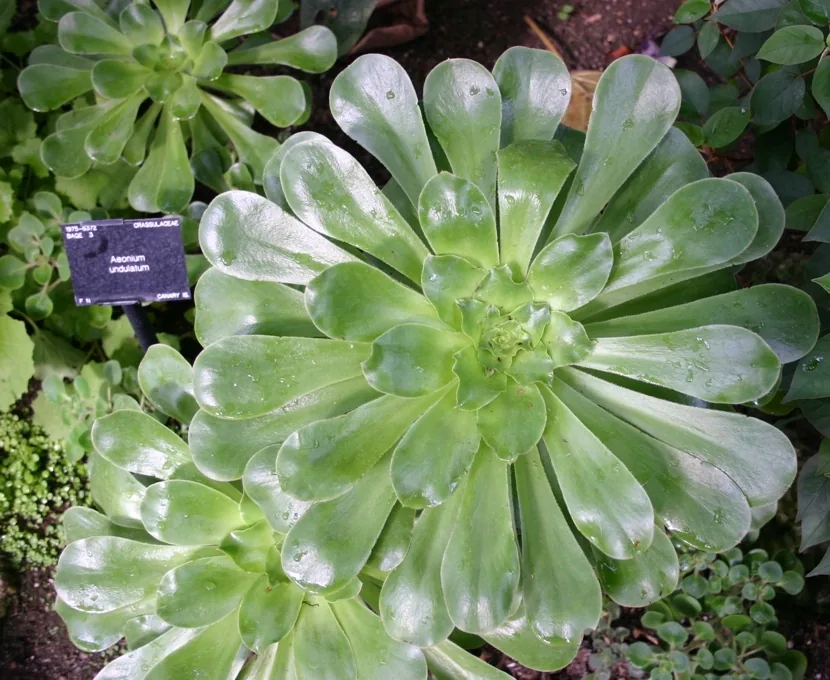
Aeonium gathers its fleshy leaves into neat rosettes at the ends of its stems, a stonecrop-family succulent equally at home on a sunny sill or in a mild garden bed. The silhouette shifts from variety to variety, reading anywhere from a low disc resting on the soil to a small branching tree. Its reputation for being undemanding holds up well: set it in sun with a gritty mix, and there is little left for you to do.
The trait that gives this plant its character is a backwards calendar. Where most greenery surges in warmth and idles through winter, Aeonium flips the script, doing its growing in the cool season and slipping into a semi-dormant state in summer heat. During that pause the rosettes draw shut and the lower leaves wither and fall, a sight that unnerves first-time growers even though it marks rest rather than ruin.
Across the genus the proportions wander from compact sill-side rosettes to broad, spreading clumps, and the palette is just as varied. A few keep to a clean green, while the celebrated black rose wears rosettes so darkly purple they look nearly black. Given the right climate outdoors it builds into a sculptural mound, and in a pot it earns its place as a tidy, low-effort presence on a bright windowsill.
Care
The short version: full sun to bright light, planted in a gritty, fast-draining mix. Water only when the soil has dried during the cool growing season, keep it much drier through the summer rest, and feed at half strength while it grows.
Light
Aeonium leans toward full sun to bright light, though it will accept partial sun or a bright indirect corner indoors. Generous light is what holds the rosettes tight and full. Starve it of light and the stems lengthen and tip toward the glass, opening bare gaps between the leaves.
Water
Hold off until the soil has dried out, and keep the plant's cool-season clock in mind. Across those active months a drink every 7 to 21 days suits it nicely, while summer dormancy calls for far less as the closed rosettes settle into their rest. Wet soil in the heat of summer is the surest path to a rotted stem.
Soil
Give it a gritty, fast-draining mix that lets water move straight through rather than linger at the roots. A pH falling between 6.0 and 7.0 keeps it comfortable. Drainage outweighs richness for this plant, since lingering moisture is the one thing this succulent will not abide.
Temperature
Comfort sits roughly between 41°F to 77°F (5°C to 25°C) for Aeonium. With essentially no tolerance for frost, it needs shelter from any freeze. Push past the upper edge of that band and the plant eases into its summer rest.
Humidity
Low humidity is exactly to this succulent's taste, and dry indoor air troubles it not at all. No target moisture reading is worth chasing. What truly helps is steady airflow around the rosettes, well ahead of any humidity tray.
Feeding
Offer a balanced fertilizer cut to half strength, scheduled to the cool active-growth stretch that runs fall through spring. A single feeding each month covers it. Withhold nothing during summer dormancy, when the resting plant draws up very little anyway.
Pruning
Trim leggy or bare stems back to a leaf rosette to coax new branching. Clip away finished flower stalks and any dead lower leaves so the plant stays trim. The trimmings need not go to waste, since the cuttings take root with ease.
Repotting
Move it up a pot every 2 to 3 years, timed to the opening of the cool growing season so it settles as it rouses. The cues are roots peeking through the drainage holes, a mix that dries far too quickly, or rosettes pressing against the pot's rim. Fresh gritty mix readies it for the growth ahead.
Size & spacing
Depending on type, plants stand 6 to 35 inches (15 to 90 cm) tall and fan out 6 to 24 inches (15 to 60 cm) across. The flat, low forms keep close to the soil while the branching tree types climb toward real height. With growth at a measured, moderate clip, the plant you bring home stays close to the plant you live with.
Troubleshooting
Nearly every Aeonium complaint comes down to a pair of culprits: water and light. Helpfully, the plant flags trouble early, whether through soft tissue, elongated stems, or a summer lull that reads more dire than it is. Find the picture that matches yours below, then make the small correction before it grows into a real one.
A stem turning soft, or a rosette base going glassy and pale
A squishy, see-through base signals rot from overwatering, and it tends to strike a resting summer plant left to sit in damp soil. Trace every soft, off-color section back to firm tissue and cut it away, set the sound cuttings aside to callus, then settle them into dry gritty mix to start over. Going forward, a sharp-draining medium and water reserved for the growing season will keep the trouble from returning.
Fix:
- Cut away all rotted tissue back to firm, healthy stem
- Let cuttings callus, then re-root in dry gritty mix
- Withhold water until new roots form
A summer rosette that folds inward as outer leaves let go
What looks like decline is really normal summer dormancy. As a cool-season grower, the plant clocks off when the heat arrives, drawing its rosette into a tight cup while the outer leaves crisp and fall, all the while keeping its core firm and intact. Pull back on water, screen it from the worst of the afternoon glare, and watch it stir again once autumn brings the temperature down.
Fix:
- Reduce watering and let the plant rest
- Provide light shade from intense summer afternoon sun
- Resume normal care as temperatures cool in fall
Lanky bare stems wearing rosettes only at their tips
When stems run long and naked, the message is too little light. Reaching for brightness, they lean toward the window while the leaves drift apart along the way. Shift the plant to a brighter perch that catches a few hours of direct sun, and feel free to lop off the stretched rosettes and re-root them so growth comes back full and close-knit.
Fix:
- Move to a brighter location with several hours of direct sun
- Behead leggy rosettes and re-root them to restart compact growth
Toxicity
Households with pets or young children can relax here, because Aeonium is non-toxic and pet-safe. It does not appear on the ASPCA list of plants toxic to cats or dogs, and it carries no poisoning risk for the other animals that wander through a home or garden. A passing nibble does nothing, which lets the plant sit on any windowsill free of concern.
Safe for
People · Cats · Dogs · Horses · Rabbits · Livestock · Birds
Cats Safe
A cat may lounge beside it on the sill and taste a leaf without any ill effect.
Dogs Safe
Should a dog chew through a rosette, there is nothing toxic in it to cause harm.
Horses Safe
Grazing horses run no risk of poisoning from it.
Rabbits Safe
It is fine for rabbits, so long as leafy greens remain a modest share of what they eat each day.
Livestock Safe
Goats, sheep, and cattle can graze near it with no danger of poisoning.
Birds Safe
Whether caged companions or backyard hens, birds come to no harm beside it.
People Safe
Even a toddler's poking and prodding leaves the plant safe to have around.
Varieties
The genus stretches across many shapes, from rosettes that lie flat to the ground to stems that branch up like miniature trees. The three below are the ones you will meet most, and together they map the range.
Aeonium 'Zwartkop' (black rose)
Branching stems lift rosettes of such deep purple that they verge on black, the very look behind its black rose name.
Aeonium arboreum
Vivid green rosettes crown woody, tree-like stems, lending the plant genuine stature.
Aeonium tabuliforme
A single flat rosette presses to the soil like a plate, its leaves drawn into close, dense rings.
How to propagate
Among succulents, Aeonium is one of the most willing to multiply, and the cool growing season opens the ideal window. Snip a cutting or ease off a side rosette, and a new plant follows with hardly any work.
Stem cuttingsEasy
During the cool active growing season (fall to spring) · 2 to 4 weeks to root after callusing
Few succulents are easier to start from a stem cutting. Take yours through the cool growing season, give the cut end a few days to callus over, and then nestle it into gritty mix where roots will appear in 2 to 4 weeks. One caveat worth holding in mind: many Aeonium rosettes are monocarpic, which means a rosette finishes its life once it flowers.
Offsets & pupsEasy
During the cool active growing season · 2 to 4 weeks once detached and rooted
On branching forms, the side rosettes arrive as small plants already formed and ready to go. Twist a pup free in the cool growing season, set it into gritty mix, and it will find its feet within 2 to 4 weeks. Bear in mind that many Aeonium rosettes are monocarpic, so a rosette finishes its life once it flowers.
Myths
Aeonium needs frequent watering like a typical houseplant.
Far from thirsty, this is a drought-adapted winter grower that wants very little at the spout. Keep it nearly dry through summer dormancy, and reach for the can only once the soil has dried out across the cool growing months.
A rosette dropping its lower leaves and closing up in summer means the plant is dying.
That summer slump is simply dormancy, the natural pause of a plant built to grow in the cool season. The plant picks up growth again when cool weather returns in fall, so leave it dry and let the calendar do the work.