Houseplant · Bromeliaceae
Earth Star
Cryptanthus bivittatus
Set it in bright indirect light and steady humidity, and the earth star carries its color through every season.
Bright indirect
Every 5–7 days
61–84°F · 16–29°C
USDA 10–12
Overview
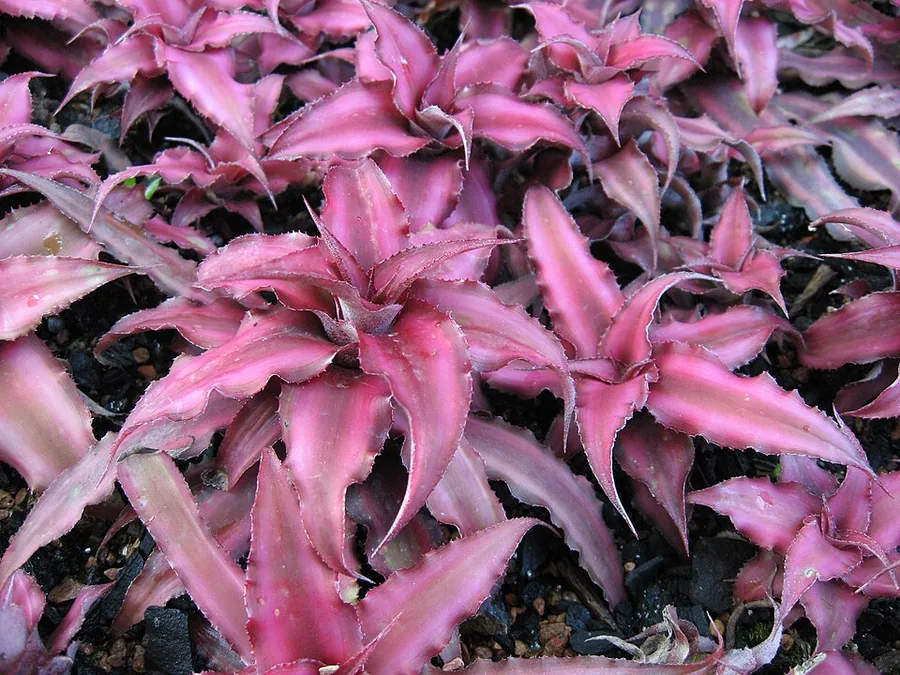
The earth star earns its place on a shelf or a side table the way few small plants can, a flat star-shaped rosette that reads as quiet sculpture in a corner. It is a terrestrial bromeliad, grown in soil rather than the central cup its relatives rely on, and that grounded habit suits the styled, lived-in interior. Its green, pink, and red coloring stays put all year, a steady note in a room that changes around it.
Scale is part of the appeal. At only 3 to 6 inches (8 to 15 cm) tall and a little wider, it slips into a small pot beside a stack of books, anchors a dish garden, or holds the center of a terrarium without competing for attention. It grows slowly and flowers only once, raising small white blooms at its heart before it steps back and lets its pups carry the look forward.
Easy to live with is the phrase that fits. It asks for warmth, humidity, and bright but filtered light, the same gentle conditions that flatter a well-kept room. Park it in direct sun and the leaves wash out, tuck it into a dark corner and the color goes quiet, but place it thoughtfully and the bright striping becomes the detail guests notice.
Care
The short version: bright indirect light, a rich organic mix kept lightly moist but never soggy, gentle warmth, and high humidity. A monthly feed through the growing season keeps it looking sharp, and it raises its own pups as it goes.
Light
Place the earth star where it catches bright, indirect light, the kind that fills a room without glaring. It will live with medium light or partial shade, though the color softens there, and direct sun bleaches the leaves outright. A window dressed with a sheer curtain offers both the light it wants and the soft look a styled space favors.
Water
Keep the rich organic mix lightly moist but well drained, watering roughly every 5 to 7 days once the top has dried a little. Let it run too dry and the plant suffers; water into the center and the crown rots, so neither extreme serves the display. There is no cup to fill on this terrestrial bromeliad, so the watering can goes to the soil.
Soil
Pot it in a rich, organic, well-drained mix, peat- or sphagnum-based rather than a heavy standard soil. The roots prefer acidity, a pH of 5.0 to 6.0, and they languish in dense, water-logging ground, so the right mix is as much about long-term looks as health.
Temperature
Ordinary room warmth keeps it comfortable, anywhere from 61°F to 84°F (16°C to 29°C). Steer it away from cold drafts and chilly winter windowsills, since it has no tolerance for the cold and a chilled spot quickly dulls its appeal.
Humidity
This is a humidity lover, at its best between 50% to 70%. Most rooms run drier, so a pebble tray, a grouping of plants, or a terrarium keeps it looking fresh. Set it too close to a vent and the leaf tips brown first, a small flaw that stands out on so neat a plant.
Feeding
Feed monthly from mid-spring through early fall with a balanced water-soluble fertilizer cut to about half strength. It grows slowly and needs little, so ease off entirely once growth stalls in the cooler months and let it rest.
Pruning
Grooming is light. Remove any dead or damaged outer leaves as they appear to keep the rosette crisp, and once it has flowered and begun to decline, cut away the spent mother plant after its pups have formed.
Repotting
Repot only every 2 to 3 years, or sooner if pups crowd the pot, the mix dries fast, or the rosette starts pushing up out of the soil. The slow growth means it settles into a chosen container and stays put, which suits a considered arrangement.
Size & spacing
It stays small, just 3 to 6 inches (8 to 15 cm) tall and spreading 6 to 12 inches (15 to 30 cm) across. That compact footprint makes it a natural for shallow dishes, terrariums, and the tight corners of a windowsill where a larger plant would overwhelm the space.
Troubleshooting
Most earth star setbacks trace back to light, water, or air that has turned too dry, and the foliage shows it before the look suffers. Match what you see below, then make the small adjustment that brings it back. Pests are uncommon, so an occasional once-over is all the routine asks.
Cottony flecks, hardened bumps, and a sticky sheen on foliage
Cottony tufts, hard bumps, or a sticky film mark mealybugs or scale, while fine webbing in dry air signals spider mites instead. Look over the leaf bases and undersides, then wipe the pests away with a cotton swab dipped in isopropyl alcohol. Follow up with insecticidal soap or horticultural oil, and keep the plant set apart until it is clean again.
Fix:
- Wipe off pests with a cotton swab dipped in isopropyl alcohol
- Treat with insecticidal soap or horticultural oil and repeat as needed
- Isolate the plant until the infestation clears
Faded, scorched patches marring the brightest foliage
Bleached or scorched patches on the most exposed leaves signal too much light, with harsh midday sun the main offender. Direct rays overheat the rosette and fade the leaves until the edges shrivel, and the styled effect goes with them. Move the plant into bright but diffused light and let it take only gentle morning or evening sun.
Fix:
- Move to bright but diffused/indirect light
- Provide only gentle morning or evening sun and shield from intense midday sun
Softened color and pink striping losing its glow
Tucked into deep shade, an earth star lets its bright pink and red striping drift into something muted and flat, and the room loses the accent it was placed for. The remedy is easy: move it to a brighter spot with bright indirect light, and the next flush of growth returns vivid.
Fix:
- Move to a brighter spot with bright indirect light
Brown, brittle tips edging otherwise unblemished leaves
Dry air usually lies behind brown, crispy tips, above all when the plant sits near a heat or air vent. The tips brown while the rest of the rosette still looks well kept. Move it clear of the drafts, lift the humidity with a pebble tray or by grouping plants, and keep the mix evenly moist.
Fix:
- Move away from heating/cooling vents
- Raise humidity with a pebble tray or grouping plants and keep the mix evenly moist
Toxicity
For a home that hosts both plants and pets, the earth star is an easy yes, because it is non-toxic. The ASPCA lists Cryptanthus as safe for cats and dogs, with no toxic compounds anywhere in the plant. The only thing to note is the stiff, wavy leaf edges, which can lightly scratch but carry no chemical hazard.
Safe for
People · Cats · Dogs · Horses · Rabbits · Livestock · Birds
Cats None
Perfectly at ease alongside cats. Because the ASPCA lists no toxic principles, a household cat that swats or samples a leaf faces no real hazard, though an ambitious bite could leave it briefly queasy.
Dogs None
Nothing here to trouble a dog. The plant holds no poison for canines, and even a committed chewer risks only a short, mild bellyache from the tough, fibrous foliage.
Horses None
Entirely safe where horses are concerned. Free of toxins, the plant lets a curious nibble pass without trouble, aside from the slight upset any new greenery can prompt.
Rabbits None
Rabbits may share the space safely. Nothing in it is poisonous, and the foliage presents no chemical danger should a rabbit decide to sample it.
Livestock None
No hazard to livestock at all. Being a non-toxic bromeliad, it contains nothing capable of harming cattle, sheep, or goats.
Birds None
Pet birds are entirely welcome nearby. With no toxic compounds in the plant, a bird pecking at the rosette faces no harm at all.
People None
No danger to people either. The single caution is the firm, undulating leaf margins, which may give small hands a light scratch; in all other ways this plant is non-toxic.
Leaves are stiff with wavy, sometimes finely toothed edges that can lightly scratch; no chemical hazard. As with any plant, nibbling may cause mild stomach upset.
Varieties
Earth stars come in a wardrobe of colors and sizes, and a few forms turn up most often at homes and garden centers. These are the ones worth knowing when you are choosing one for a room.
Cryptanthus bivittatus var. atropurpureus
A darker color form of the species in deep reddish to purple-bronze foliage that lends a richer, more dramatic note, recognized as a variety in Kew's Plants of the World Online.
'Minor' (Dwarf Rose-Stripe Star)
A compact dwarf form carrying rose-pink stripes down its leaves, a neat choice for small spaces, listed by the ASPCA among the non-toxic earth stars.
'Pink Starlite'
A popular cultivar with broad creamy-pink and green banded leaves that blush a deeper pink in bright light, an easy favorite for a styled shelf.
How to propagate
Earth stars renew themselves with little fuss, raising a fresh set of pups each time the mother rosette finishes flowering, so the display refreshes on its own.
Offsets & pupsEasy
After the mother rosette flowers and produces pups, typically anytime in the warm growing season · 4 to 8 weeks
Earth stars multiply through offsets, or pups, that form at the center and base of the parent once it has flowered, usually during the warm growing season. Gently detach a pup, press it into a moist organic potting mix, and keep it watered and humid. It roots and settles in within 4 to 8 weeks, ready to start its own corner.
SeedDemanding
Warm season under controlled humidity · Several months
Growing from seed is possible, but it is slow and rarely done at home. Sown in the warm season under controlled humidity, seedlings take several months to amount to anything, which is why offsets remain the practical way to keep a collection going.
Myths
The earth star drinks from a central cup, in the manner of its bromeliad relatives.
Cryptanthus are terrestrial bromeliads with a flat rosette and no water-holding tank, so the central-cup ritual does not apply. You water them at the roots, growing them in soil and keeping the organic mix lightly moist rather than pouring water into the center.
The earth star, like other bromeliads, poses a poisoning risk to pets.
The ASPCA classifies earth star (Cryptanthus) as non-toxic to cats and dogs, with no toxic principles identified. It is a safe choice for a home that pairs houseplants with curious animals.