Ornamental · Amaranthaceae
Amaranth
Amaranthus caudatus
Give it full sun and warm soil, and amaranth answers with trailing tassels that carry a border from summer into fall.
Full sun
USDA 2–11
3–5 ft · 0.9–1.5 m
Overview
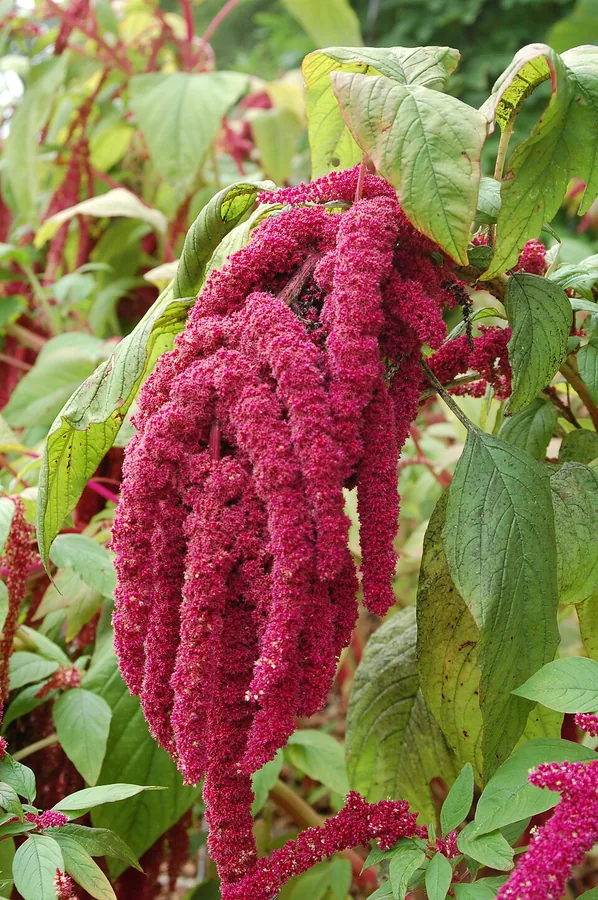
Few annuals bring as much late-season drama to a garden as amaranth. The ornamental favorite, Love-Lies-Bleeding, lets down long ropes of crimson or gold that trail almost to the ground, the kind of plant that turns a quiet bed into a focal point. It belongs at the back of a border or spilling over the lip of a tall urn, where its tassels have room to fall and catch the light at the end of the day.
There is range within the family, and that range is part of its appeal for a planting scheme. Some kinds are grown purely for show, trailing or standing tall in deep reds, greens, and golds, while the grain types carry their edible seeds in upright heads that suit a more architectural, kitchen-garden look. The weedy pigweeds share the genus, a reminder that this is a plant with one foot in the wild.
Around a home, amaranth asks very little of a daily routine. It takes the heat of an exposed terrace, makes do with thin soil in a forgotten corner, and reseeds to return season after season with no replanting on your part. The one thing worth holding in mind is that the leaves can carry high nitrates, which matters only where grazing animals share the grounds.
Care
The short version: place amaranth in full sun and well-drained, moist soil, water it steadily while it establishes, hold back on fertilizer, and stake the tall kinds once the flower spikes form.
Light
Set amaranth in full sun for the richest color and the strongest stems, the difference between a plant that holds the eye and one that fades into the bed. A little afternoon shade is fine, but anything heavier leaves you with weak, leggy growth and thin flower spikes.
Water
Keep the soil evenly moist while the plants are young and finding their footing. Once settled they ride out a dry stretch with ease, though steady water rewards a border with the fullest, most generous growth.
Soil
Amaranth wants nothing more than well-drained, moist soil to look its best. Sharp drainage is the part that counts, since waterlogged ground is what opens the door to root rot.
Humidity
Ordinary outdoor humidity suits amaranth, so there is no figure to chase on a terrace or in a bed. What matters far more is good airflow, which keeps the foliage dry and holds leaf spot at bay.
Feeding
Amaranth seldom needs feeding and looks best in lean ground, so a light hand serves it well. Be especially sparing with nitrogen, since a heavy feed pushes soft growth and nudges the leaves to store up nitrates.
Pruning
There is almost no pruning to do, which keeps amaranth an easy guest in a busy garden. Deadhead or cut the spikes for fresh or dried arrangements, and stake the tall kinds once the heavy heads form so they keep their poise.
Size & spacing
Plants rise 3 to 5 feet (91 to 152 cm) tall and fill out 12 to 24 inches (30 to 61 cm) across. Give the taller kinds room to stand and air to move, and let their height set the scale of the planting around them.
When to plant
Amaranth is a warm-season annual with no tolerance for frost, so its season starts once the cold has truly gone. Sow seed indoors in early spring or set it straight into the bed after the chill lifts, and the planting comes into flower from midsummer into fall, about three months after sowing.
Northern hemisphere
Southern hemisphere
Typical months for a temperate climate: start earlier in warm zones, later where spring frosts linger.
- Sow: 6 to 8 weeks before last frost, or direct sow after last frost
- Plant: After danger of last frost has passed
- Harvest: Blooms summer through fall; flowering begins about 3 months after sowing
Hardiness
USDA hardiness zones: 2–11
Temperature: down to -46°C
Troubleshooting
Amaranth carries a season with little fuss, and the few troubles it meets tend to settle on the leaves, the flower spikes, or the roots. Match what you see below, then act early to keep the display looking its best.
A slumping plant darkening at the soil line
Soil that stays wet underfoot sets the stage for Phytophthora blight and root rot, which leaves the lower stem and roots dark and soft until the whole plant slumps. A plant at that point has nothing left to recover, so lift it and discard it. Correct the drainage in that corner before anything new goes back, and the next display will hold its form.
Fix:
- Remove and destroy affected plants
- Improve soil drainage
Hard-edged dark marks penned in by the veins
Angular, water-soaked marks set off by a pale yellow ring are the look of bacterial leaf spot. Removing the marked leaves as they appear keeps the foliage looking clean. Directing water to the soil rather than over the canopy keeps the leaves dry, and dry leaves give the bacteria far less room to move.
Fix:
- Remove affected foliage
- Avoid overhead watering to reduce leaf wetness
A sticky sheen and new growth that loses its line
When the tassels lose their crisp drape and a tacky film settles over the foliage, aphids are usually the reason. Turn a leaf and study the spikes, where small soft insects gather in their own honeydew. A firm spray of water restores the look on its own, and insecticidal soap is worth keeping in reserve for the rare crowd that lingers.
Fix:
- Spray off with a strong jet of water
- Apply insecticidal soap if populations are heavy
Toxicity
For a home with pets, amaranth is reassuring company: the ASPCA lists it as non-toxic to cats and dogs. The real attention belongs with grazing animals, since the leaves can store up nitrates and oxalates, and a grazing animal eating a large amount of stressed foliage can be poisoned. Keeping cattle, horses, and other grazers away from big stands is all the plant asks.
Toxic to
Horses · Rabbits · Livestock · Birds · People
Safe for
Cats · Dogs
Horses Caution
Amaranth reads as non-toxic to horses on the ASPCA list, yet horses graze in bulk, and leaves carrying high nitrates can upset any animal that browses them. Keep them clear of a large planting, above all after a dry spell.
Rabbits Caution
A leaf or two will rarely trouble a rabbit, though the nitrates and oxalates that affect grazing stock settle into the foliage just the same. Let it stand as a rare taste rather than a daily portion.
Livestock Severe
Nitrate poisoning in cattle and other grazing animals: increased salivation, labored breathing, incoordination, weak pulse, muscle tremors, weakness, chocolate-brown blood, and death; signs appear about two to six hours after eating. Soluble oxalates and nephrotoxin can also cause kidney damage.
Birds Caution
Birds take to a ripe seed head with pleasure, and that part is theirs to share. The single worry is heavy feeding on nitrate-rich leaves, so leave the seeds to them and let the foliage be.
People Caution
Amaranth has long earned a place on the table for grain and greens, both eaten cooked. The point to mind is the nitrates and oxalates that gather in leaves from stressed plants, so cook the greens and skip foliage from drought-hit plants.
Cats None
A houseful of cats poses no problem for amaranth, which the ASPCA marks non-toxic to them, so a passing nibble near the display means nothing.
Dogs None
Dogs sit comfortably alongside it as well. With amaranth on the ASPCA non-toxic list, the odd chewed leaf calls for no concern.
Safe to grow around dogs and cats; the main risk is to grazing animals eating large amounts of foliage, especially under drought stress or high soil nitrogen.
Helpline numbers

United States
ASPCA Animal Poison Control: (888) 426-4435 (fee applies)
Poison Control: (800) 222-1222



Canada
Poison Centres: 1-844-764-7669
Varieties
Amaranth ranges from sprawling ornamentals to upright grain crops, each with its own place in a planting. These are the kinds you are most likely to meet.
Amaranthus caudatus (Love-Lies-Bleeding)
The signature ornamental, draped in long ropes of red or gold tassels that pour toward the floor of the bed.
'Viridis'
A green-flowering turn on Love-Lies-Bleeding, kept for the cool chartreuse of its tassels.
Amaranthus cruentus
An upright grain and garden type that carries its plume-shaped heads aloft and sets an edible seed.
Amaranthus hypochondriacus (Prince's Feather)
A tall, upright grain amaranth, and the species the ASPCA records as non-toxic to cats and dogs.
How to propagate
Amaranth is among the easiest plants to raise from seed, and once it has a season in the ground it sows itself around the garden, filling gaps without any prompting.
SeedEasy
Sow indoors 6 to 8 weeks before last frost, or direct sow outdoors after last frost. · Flowering begins roughly 3 months after sowing
Amaranth comes up from seed with almost no coaxing and returns on its own once it has settled into a corner. Start a tray indoors 6 to 8 weeks before your last frost, or scatter seed where it is meant to grow once the frost has cleared. Thin or set out the seedlings from there, and the first tassels arrive about three months on, ready to anchor the late-season display.
Myths
Amaranth flowers are a hazard to cats and dogs.
This concern can be set down, since the ASPCA keeps amaranth on its non-toxic list for cats, dogs, and horses, which leaves the flowers no threat to pets in the home. The documented harm falls on grazing livestock, where nitrates and oxalates collecting in the foliage are the source of the trouble.
Amaranth is edible, so any animal can graze it without limit.
Pigweeds in this genus pull nitrates and soluble oxalates into their leaves and rank among the leading causes of nitrate poisoning in cattle. Drought stress and high nitrogen drive those levels to their peak, which is exactly when a grazing animal stands in the most danger.