Ornamental · Sarraceniaceae
American Pitcher Plant
Sarracenia
Set it where there is full sun, rain-pure water, and a true winter pause, and the pitcher plant quietly sees to its own meals.
Full sun
Every 1–3 days
1460–1825 days
USDA 6–8
Overview
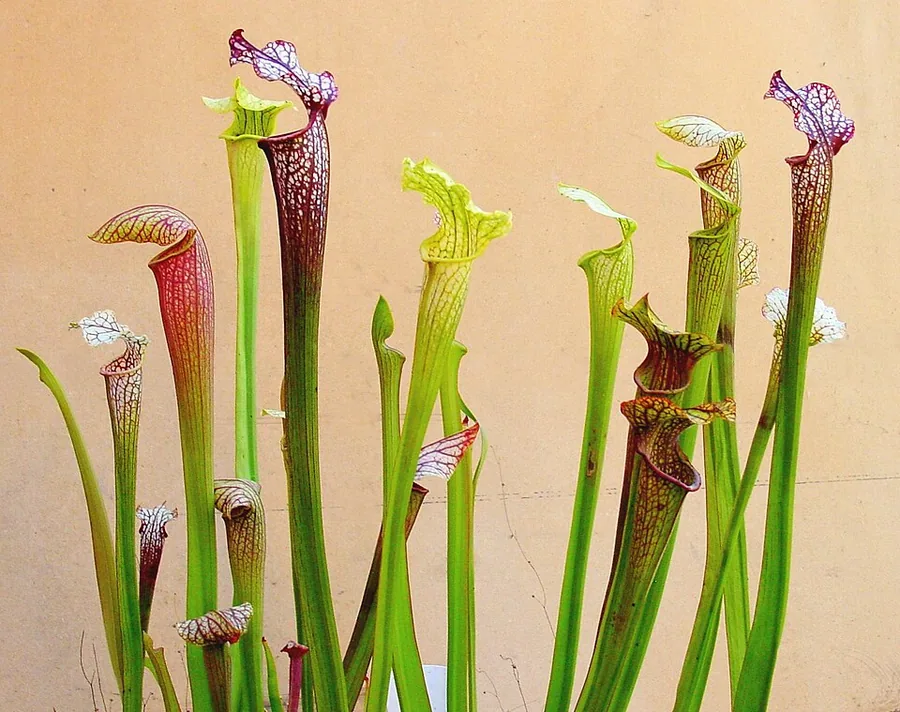
Few plants make as confident a statement on a sunny sill as the American pitcher plant, a living sculpture that earns its keep on looks alone. Instead of drinking from rich soil, it draws meals from the insects it traps, a habit born of the nutrient-poor acidic bogs where Sarracenia belong. Each pitcher reads as a slender, architectural column, a reshaped leaf lined with nectar and built to draw curious visitors down inside.
These are plants of the temperate wetlands of eastern North America, and that heritage sets the rhythm of life with them at home. They ask for a genuinely bright position, wet roots across the warm months, and an honest cold pause once the year turns. Deny them that winter dormancy and the display slowly dims, however attentive the rest of your routine may be.
None of this reads as high-maintenance so much as a clear set of preferences. Offer rainwater in place of tap, a peat-and-sand mix instead of standard compost, and a sun-drenched perch standing in a shallow tray, and you have a long-lived perennial that returns fuller with each spring. Get the watering or the dormancy wrong, though, and a poised silhouette gives way to browned pitchers and a failing crown.
Care
The short version: a bright sunlit spot, a pot kept permanently wet in a tray of rain or distilled water, a lean peat-and-sand mix that never meets fertilizer, and a cold winter rest that lets the plant settle into dormancy.
Light
Give it a full sun position, ideally with 6 or more hours of direct light each day, and the plant rewards the spot with its best self. That light is what deepens the red and purple veining and holds the pitchers tall and poised, the look you want on display. In shade the traps slump, pale, and lose much of their presence.
Water
Through the growing season, keep the medium constantly wet by standing the pot in a shallow tray of water, bog-fashion, with the rhizome and crown held above the waterline. Reach only for mineral-free water, meaning distilled, reverse-osmosis, or rainwater, since the salts in tap water accumulate and burn the plant. As winter settles in, ease back and let the mix turn just damp rather than flooded.
Soil
Plant into a spare carnivorous mix of sphagnum peat moss with sand or perlite, in roughly equal measure. Keep the pH on the acidic side, between 4.0 and 6.0. Ordinary potting soil has no place here, and neither does fertilizer or lime, as any of the three will see the plant off.
Temperature
The plant tolerates a generous temperature range, from about 5°F to 95°F (-15°C to 35°C), which carries it through a hot bog summer and a freezing winter alike. That hardiness is the point: the chill is what cues dormancy and keeps the cycle honest.
Humidity
Everyday humidity in the 40% to 70% range suits it well, and the wet tray beneath keeps the air around the pitchers comfortably moist on its own. There is no call for misting or any chase after a higher figure.
Feeding
Leave this plant unfed. The pitchers catch and digest their own insects, so any fertilizer in the soil, or rich food slipped into a trap, only burns it. Given insects and sun, it already has all it asks for.
Pruning
In early spring, just ahead of the new growth and flowers, clear away the dead brown pitchers. Let the old foliage stand through winter, where it guards the crown against cold. Trim the spent flower stalks once the bloom has passed.
Repotting
Repot every 2 to 3 years in early spring, the same window that suits dividing the rhizome. Move up when the rhizome presses against the pot edge, roots push through the drainage holes, or the medium has broken down and no longer holds water. Refresh with new peat-and-sand each time.
Size & spacing
Mature plants stand 6 to 36 inches (15 to 91 cm) tall, by species, and spread 6 to 24 inches (15 to 60 cm) across. The tall trumpets and the squat purple forms sit at opposite ends of that range, a useful thing to weigh against the spot you have in mind.
When to plant
Life with a pitcher plant moves with the calendar. Flowers arrive in spring just as the new pitchers rise, the traps stay at work through the warm season, and the whole plant fades to brown and rests over a cold winter before the cycle opens again.
Northern hemisphere
Southern hemisphere
Typical months for a temperate climate: start earlier in warm zones, later where spring frosts linger.
- Sow: Late winter; seed needs about 4-8 weeks of cold-moist stratification before sowing
- Plant: Spring, after the last hard frost
- Harvest: Spring (flowers open in spring as or just before new pitchers emerge)
Hardiness
USDA hardiness zones: 6–8
Temperature: down to -23°C
Troubleshooting
Most missteps with a pitcher plant lead back to water, light, or a winter rest that never happened. A glance at the pitchers and the rhizome usually tells you whether you are watching an ordinary seasonal turn or genuine decline. Pair what you see with the right entry below before you reach for a fix.
Browning tips, stalled growth, and a white crust across the soil
A white crust over the medium and scorched tips signal mineral salt damage from tap water, fertilizer, or ordinary potting soil. Change to distilled, reverse-osmosis, or rainwater and flush the medium thoroughly to carry the salts away. Should garden mix or potting soil be in the pot, repot into fresh peat-and-sand, and never feed the soil.
Fix:
- Switch to distilled, reverse-osmosis, or rainwater only
- Flush the medium repeatedly with mineral-free water to leach salts
- Repot into fresh peat-and-sand mix if ordinary potting soil was used
- Never fertilize the soil
A soft, blackened rhizome and a plant that gives way
A soft, foul-smelling rhizome points to crown rot, usually from a waterlogged crown, still air, or a winter kept too warm. Lift the plant, cut away every rotted part, and replant the firm pieces into fresh damp peat-and-sand. Water from below with the tray method and keep the crown above the waterline so it never stands wet.
Fix:
- Lift the plant and cut away all rotted tissue
- Repot firm sections into fresh damp peat-and-sand mix
- Keep the crown above the waterline and wet only from below via the tray method
Floppy, pale pitchers that have lost their color
Pitchers that slump and surrender their red and purple veining are simply short on light. Move the plant into full sun with 6 or more hours of direct light, and the new growth returns upright and well marked. Make the shift gradually if it has been sitting somewhere dim, since a sudden leap into strong sun can scorch the leaves.
Fix:
- Move to full sun with 6 or more hours of direct light
- Acclimate gradually if moving from a low-light spot to avoid scorch
Pitchers browning and dying back through fall and winter
This is winter dormancy at work, not a fault. As the days draw in and the air cools, the plant withdraws and lets its old pitchers brown while the rhizome holds firm below. Let the spent foliage stand over winter to shelter the crown, keep the medium just damp, and clear the brown pitchers in early spring before fresh growth rises.
Fix:
- Treat as normal seasonal behavior, not disease
- Keep the medium just damp (not deeply flooded) through dormancy
- Trim the dead pitchers in early spring before new growth
Toxicity
Households with pets can relax: the American pitcher plant is not toxic. It holds no known poison, and the digestive fluid within the pitchers is far too weak to trouble an animal or a person. The plant is delicate, though, so a high, out-of-reach perch is really about preserving those fine traps, not about the inquisitive nose drawn to them.
Safe for
People · Cats · Dogs · Horses · Rabbits · Livestock · Birds
Cats Safe
No toxic compound is known, so a curious cat that paws or chews a pitcher meets no risk of poisoning. The brittle leaves are the only thing in jeopardy.
Dogs Safe
A dog can nose or nibble the plant without harm, given how weak the digestive fluid inside the pitchers is. At worst, a large mouthful of plant matter might unsettle its stomach briefly.
Horses Safe
Nothing in the plant is poisonous to horses, and the related California pitcher plant holds a place on the ASPCA non-toxic list.
Rabbits Safe
A rabbit can graze a stray pitcher with no risk of poisoning, since the plant holds no harmful toxin.
Livestock Safe
Grazing animals face no danger from these bog plants, and they seldom encounter one anyway, given that pitcher plants grow in wet, acidic ground well clear of pasture.
Birds Safe
Birds meet no toxic threat from the foliage or the trapping fluid. A small bird is far likelier to raid the pitchers for trapped insects than to come to any harm.
People Safe
Handling the plant or brushing against it does no harm, and the weak fluid inside the pitchers is no poison. There is no edible crop here, so it is grown to be looked at rather than eaten.
No toxic principle is known; the digestive fluid in the pitchers is mild. The plants are fragile, so keep them out of reach mainly to protect the plant rather than the pet.
Varieties
Sarracenia spans a small cast of distinct species, from soaring yellow trumpets to low purple cups that settle against the ground. A handful appear often in cultivation, while a couple are rare enough to carry legal protection.
Sarracenia flava (Yellow trumpet)
Its tall yellow-green trumpets rise to roughly 90 cm beneath a flaring lid, and in spring it lifts nodding, bright yellow flowers above the foliage.
Sarracenia leucophylla (White-topped pitcher plant)
Upright pitchers crowned with white, red-veined upper sections give it real drama, and it sends up a strong second flush of growth in autumn.
Sarracenia purpurea (Purple or Northern pitcher plant)
Squat purple pitchers settle low and gather rainwater, and as the most cold-hardy of the group it ranges north into Canada.
Sarracenia oreophila (Green pitcher plant)
Listed as Federally Endangered and on CITES Appendix I, it is legally restricted from wild collection and trade.
Sarracenia rubra subsp. jonesii (Mountain sweet pitcher plant)
Also Federally Endangered, it forms slim red-veined pitchers and fragrant flowers at only a few sites across Carolina.
How to propagate
There are two routes to more pitcher plants, one swift and one slow: dividing a mature rhizome, or raising seedlings that take years to reach flowering size.
DivisionEasy
Early spring before active growth, typically while repotting · 1-2 growing seasons
Division is the quick, dependable path to more plants. In early spring, before active growth and usually as you repot, separate the rhizome into sections so each keeps its own roots and a growth point, then set them into damp peat-and-sand. Allow the divisions a season or two to settle and fill out.
SeedModerate
Sow in late winter or early spring after 4-8 weeks of cold-moist stratification · 4-5 years to flowering size
Raising plants from seed is a patient pursuit. The seed calls for 4 to 8 weeks of cold-moist stratification before it germinates, so sow in late winter or early spring once that chill is complete. The seedlings come along slowly and will not reach flowering size for 4 to 5 years.
Myths
Offering pitcher plants hamburger or fertilizer makes them grow faster.
The plant already feeds itself by trapping insects in its pitchers, so it needs no help at the table. Rich foods and fertilizer burn it, and the soil must never be fed. Let the pitchers find their own meals.
Pitcher plants can take ordinary tap water like any other houseplant.
The minerals and salts dissolved in tap water settle into the medium and poison these bog plants over time. Use only distilled, reverse-osmosis, or rainwater.
Carnivorous pitcher plants are dangerous or poisonous to pets.
The traps look formidable, yet Sarracenia carry no toxin that harms animals. The closely related California pitcher plant appears on the ASPCA non-toxic list for cats, dogs, and horses, and the digestive fluid inside the pitchers is far too weak to hurt a pet.
Pitcher plants are tropical and should be kept warm all year.
These are temperate bog plants, not tropicals, and a warm winter slowly undoes them. They need a cold winter dormancy to return strong each spring.