Shrub · Ericaceae
Japanese Pieris
Pieris japonica
Set it in acidic soil and out of the wind, and andromeda dresses the spring garden in drooping white flowers.
Partial shade
Every 3–7 days
USDA 5–8
9–12 ft · 2.7–3.7 m
Overview
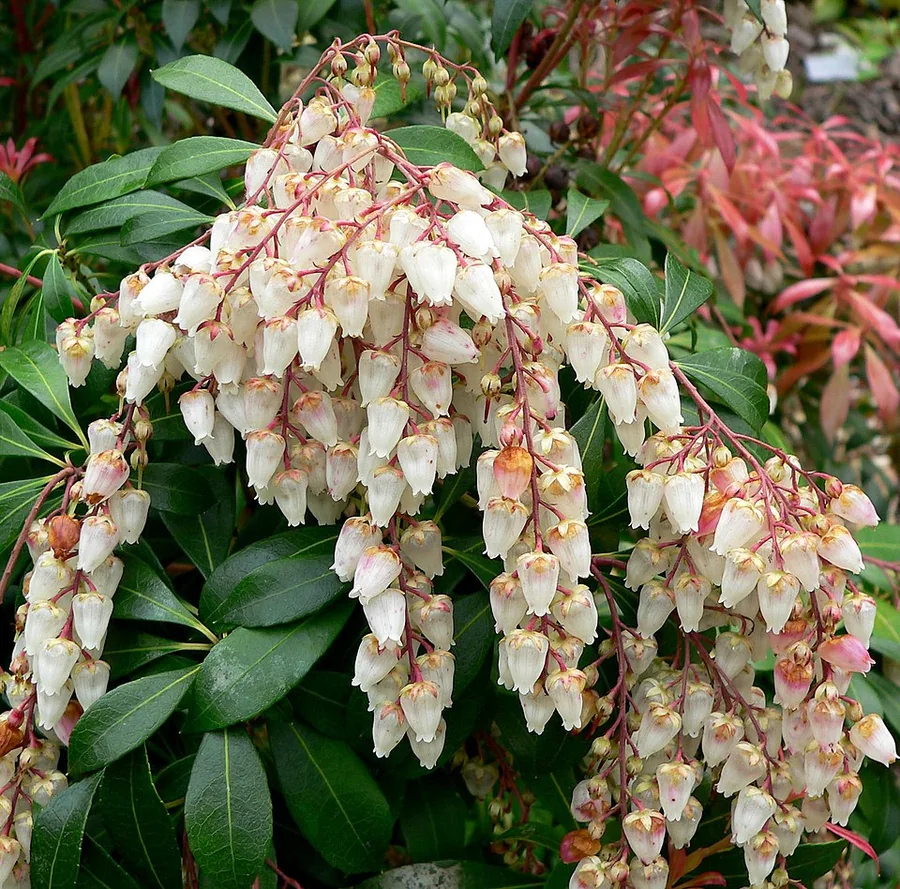
Japanese pieris, more often called andromeda, is a broadleaf evergreen shrub in the Ericaceae family, kin to rhododendrons and azaleas. It comes into its own in early spring, when long, drooping clusters of white urn-shaped flowers hang like tiny lily-of-the-valley bells, an effortless centerpiece for a shaded border or a quiet courtyard. The glossy leaves hold through every season, and the fresh growth opens a bronze-red that mellows to dark green.
Given time, it grows slowly into a generous shrub, 9 to 12 feet (2.7 to 3.7 m) tall and 6 to 8 feet (183 to 244 cm) wide. Hardy across USDA zones 5 to 8, it asks for the same setting its rhododendron cousins favor: rich, acidic, evenly moist soil and a place out of harsh sun and wind. Place it thoughtfully and it carries the garden with very little fuss after that.
One thing to settle before it goes in the ground: every part of this shrub is poisonous. The leaves, flowers, nectar, and pollen all hold grayanotoxins, which makes it a poor fit for any spot where pets, livestock, or small children gather close to it.
Care
The short version: a sheltered place in partial shade out of the wind, rich acidic soil kept evenly moist but never soggy, and one acid-forming feed in early spring once the flowers fade.
Light
Andromeda is at its best in partial shade. It will take full sun in cooler regions and accepts more shade as well, but harsh afternoon sun scorches the leaves and draws lace bugs, so give it some afternoon cover.
Water
Keep the soil evenly moist but well drained, watering more often in heat and while the plant is settling in. Never let it dry out completely, and never let it stand in waterlogged ground, which brings on phytophthora root rot.
Soil
This shrub wants rich, acidic, well-drained soil loaded with organic matter, ideally a pH between 4.5 and 6.0. Like its rhododendron relatives, it simply will not do well in alkaline ground.
Temperature
Hardy from -20°F to 86°F (-29°C to 30°C), it takes cold winters across zones 5 to 8 in stride. Its real vulnerability is drying winter wind and sun, not the cold itself.
Humidity
Everyday outdoor humidity suits it, so there is no figure to chase. What counts more is shelter from drying wind, which scorches the evergreen leaves faster than dry air ever would.
Feeding
Feed once a year in early spring, right after bloom, with an acid-forming fertilizer made for rhododendrons and azaleas. That single seasonal feeding keeps the leaves green and the soil on the acidic side it depends on.
Pruning
This shrub barely asks for the shears. Trim off the spent flower clusters and remove any dead or damaged wood, and save your shaping for just after flowering, since next year's buds set on old wood by late summer.
Repotting
Andromeda lives in the ground and rarely needs moving. Should you grow one in a container, repot only when roots circle the pot or water runs straight through, always into a fresh acidic mix.
Size & spacing
Plan for a substantial shrub in time, 9 to 12 feet (2.7 to 3.7 m) tall and 6 to 8 feet (183 to 244 cm) wide. Hand it that much room from the outset so air moves freely and you are not wrestling with its size down the line.
When to plant
Andromeda is slow and long-lived, so its calendar is really about the planting rather than a seasonal routine. Settle new plants in spring or fall while the weather stays mild, and after that the display arrives on its own each March and April as the flowers open.
Northern hemisphere
Southern hemisphere
Typical months for a temperate climate: start earlier in warm zones, later where spring frosts linger.
- Plant: Spring or fall
- Harvest: Early spring (March to April)
Hardiness
USDA hardiness zones: 5–8
Temperature: down to -29°C
Troubleshooting
Most andromeda problems come down to placement: too much sun, too much wind, or ground that holds water. The leaves are the first to show it. Find the picture below that matches yours, then treat the cause rather than the symptom.
A handsome shrub failing fast in a wet corner
Standing water is the undoing of an otherwise polished planting. Phytophthora root and crown rot takes over once the ground stays soaked, the roots and stem bases darken, and the top half wilts and browns. Cut away the dead wood and bin it, sort out the drainage, and ease off the watering. Where the rot is already settled in, lift the shrub into a raised, free-draining acidic bed.
Fix:
- Prune out and dispose of dead and dying wood
- Improve drainage and stop overwatering
- Replant in raised, well-drained, organically rich acidic beds if rot is established
A washed-out look that quietly spoils the display
When the foliage starts to look tired and pale across an entryway or border, the lace bug is usually behind it, and it does the most damage to a shrub left sitting in hot sun. Turn a leaf over and the small lace-winged insects, their shed skins, and dark sticky droppings give them away. A firm jet of water clears a light case, horticultural oil or insecticidal soap on the undersides handles the rest, and shifting the planting into part shade keeps the look fresh.
Fix:
- Hose off light infestations with a strong jet of water to knock pests off
- Treat with horticultural oil or insecticidal soap on leaf undersides, repeating as directed
- Move or site plants in part shade where lace bug pressure is lower
Crisped edges on a shrub left out in the open
This is leaf scorch, and it lands hardest on the foliage facing into drying wind and winter sun, with dry spells making it worse. A tucked-away spot with afternoon and winter shade keeps the evergreen looking its best, an organic mulch over the roots holds moisture, and a little watering through dry weather rounds it out. In a wide-open setting, a windbreak earns its place.
Fix:
- Provide a sheltered planting site with some afternoon and winter shade
- Mulch and water adequately during dry periods
- Use a windbreak in exposed locations
Toxicity
This is a genuinely hazardous plant to keep near animals and children. Every part holds grayanotoxins, the leaves, flowers, nectar, and pollen together, and even a little can throw the heart out of rhythm. Keep pets, livestock, and children well clear of it, gather up fallen leaves and pruning debris, and wash your hands after handling it.
Toxic to
Cats · Dogs · Horses · Rabbits · Livestock · Birds · People
Cats Severe
A cat that chews even a leaf or two may begin drooling and vomiting, with diarrhea and weakness not far behind. Once the grayanotoxins reach the heart, the rhythm goes abnormal and blood pressure falls, and a serious dose brings tremors, convulsions, collapse, and death.
Dogs Severe
Dogs follow the same pattern, with drooling, vomiting, and diarrhea leading into weakness and an unsteady, uncoordinated walk. The toxin throws off the heartbeat and pressure, and at high doses it can bring on convulsions, coma, and death.
Horses Severe
In horses the foliage causes dullness, weakness, diarrhea, and colicky belly pain. The heartbeat slows or turns erratic, the animal may stop eating and drinking, and cardiac failure is the real danger.
Rabbits Severe
Rabbits are small enough that a little goes a long way, so never let one nibble the leaves or flowers. Look for a gut that shuts down, weakness, and a heartbeat thrown off by the same grayanotoxins that poison larger animals.
Livestock Severe
Grazing animals that strip the foliage drool and vomit, then weaken as the heart rhythm slides toward failure. Goats and sheep browsing a hedge face the highest risk, since a surprisingly small amount can be deadly.
Birds Severe
The grayanotoxins are no gentler on birds, where even small amounts can throw the heart into a dangerous rhythm. Keep poultry and pet birds well away from the leaves, flowers, and dropped debris.
People Caution
No part of this shrub is food, and eating leaves, flowers, or even the nectar can cause nausea, vomiting, and a slowed heartbeat. Keep children from putting any of it in their mouths, and wash your hands after pruning.
Keep all parts, including fallen leaves, flowers, and pruning debris, away from pets, children, and grazing animals; wash hands after handling.
Helpline numbers

United States
ASPCA Animal Poison Control: (888) 426-4435 (fee applies)
Poison Control: (800) 222-1222



Canada
Poison Centres: 1-844-764-7669
Varieties
A handful of named selections stand apart for their foliage color or their scale, and these are the ones most likely to turn up at the nursery.
Mountain Fire
The new growth opens a fiery red to bronze-red before easing into glossy dark green, and that spring flush is exactly why it lands in so many borders.
Compacta
A tighter, denser form that keeps a smaller footprint, ideal for foundation beds and snug corners where the full-size shrub would feel crowded.
Scarlett O'Hara
A pick for those who want showy foliage color set against heavy clusters of white flowers in spring.
How to propagate
Andromeda is slow to multiply, but a home gardener can manage it from cuttings or by layering a low branch.
Stem cuttingsModerate
Summer to late summer · Several weeks to a few months to root
Take semi-hardwood cuttings from the current season's growth in summer or late summer. Dip the cut ends in rooting hormone and hold them humid in a well-drained acidic mix. Roots arrive on their own schedule, anywhere from several weeks to a few months, so settle in for the wait and leave them undisturbed.
LayeringEasy
Spring to summer · Up to a full season or more to root before separating
Layering is the gentler, lower-effort path. In spring or summer, pin a low, supple branch down into acidic soil and let it root while the parent still feeds it. Expect a full season or more before it roots, so wait until it is well anchored before cutting it free.
Myths
Japanese pieris just sits there looking pretty, so the flowers and leaves can't be a problem.
Like its rhododendron and azalea relatives in the Ericaceae, this shrub holds grayanotoxins in every part. Leaves, flowers, nectar, and pollen are all poisonous to pets, livestock, and people, and only a small amount is needed to cause real harm.