Shrub · Ericaceae
Lingonberry
Vaccinium vitis-idaea
Give it acidic soil, full sun, and steady moisture, and this low evergreen carpet lays down two crops of tart red berries a year.
Full sun
Every 3–5 days
USDA 2–7
4–16 in · 10–40 cm
Overview
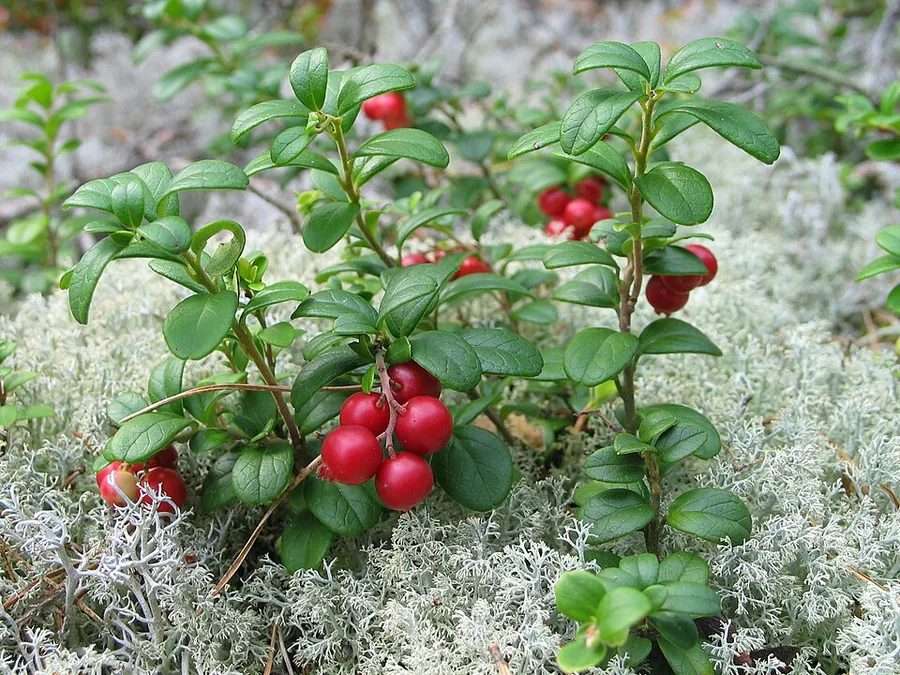
Lingonberry belongs to the heath family, keeping company with blueberries and rhododendrons, and it earns its place in a garden as a low evergreen carpet. Held to just 4 to 16 inches (10 to 40 cm) tall, its underground runners knit a quiet, glossy-leaved cover that reads as calm, tidy ground rather than a fussy specimen. Small bell-shaped flowers give way to bright red berries with a sharp, tart bite that turns kitchen-friendly.
Its charm lies in how easily it settles into a considered setting. Give it the acidic, well-drained ground it favors, and it becomes a groundcover to build a border, a woodland edge, or an evergreen understory around, staying green through winter and unbothered by cold to -40°F (-40°C). It sits happily among other acid lovers and rewards a planting scheme that lets it stretch.
This is a plant for the long view rather than the quick effect. The rhizomes travel season by season until they fill the space you have given them, and European types fold two moments into the gardener's year, with two crops in a single year, one gathered in late summer and another in fall.
Care
The short version: a place in full sun, acidic and well-drained soil in the 4.0 to 5.5 range, and steady moisture that never dries out or turns soggy, with only the lightest feeding now and then.
Light
A lingonberry planting comes into its own in full sun, though it takes partial sun and even light shade in stride, which gives you room to place it. Set it in deep shade and the generous display gives way to a scattered few berries and slow, weak spread.
Water
With roots that run shallow and fine, the planting asks for steady moisture every 3 to 5 days and never a bed that dries out or turns soggy. Where you can, reach for rainwater or another low-mineral source, since hard tap water gradually pulls the ground away from the acidity these plants depend on.
Soil
Soil is where the whole planting is won or lost. Lingonberries want acidic, well-drained soil in the 4.0 to 5.5 range, sandy or peaty and rich in organic matter like peat moss and pine bark. That open, acidic ground is what lets the fine roots feed and the carpet stay lush.
Temperature
Few fruiting plants weather a winter so gracefully. Lingonberries hold through cold to -40°F (-40°C) and grow contentedly up to about 77°F (25°C), at home in the cool northern climates they come from.
Humidity
Average humidity of 40% to 60% is entirely enough, so the air asks nothing of you. What the planting cares about is steady soil moisture, far more than the moisture around it.
Feeding
A light touch suits it best. These plants ask little and are easily overdone, so a single low-rate spring feeding of an acidic, ammonium-based fertilizer made for rhododendrons or azaleas is all a bed needs. A generous hand does more harm here than a sparing one.
Pruning
The planting asks for almost no pruning. Take out dead or weak wood as it shows, and every few years shear or mow an old planting in early spring to clear woody stems and draw up fresh rhizome shoots and new fruiting wood.
Repotting
A container-grown lingonberry wants fresh acidic mix and a larger pot every 2 to 3 years. Roots circling the pot, growth that has stalled, or soil that dries the moment you water are the plant's way of asking for more room.
Size & spacing
The carpet stays low, just 4 to 16 inches (10 to 40 cm) tall, yet each plant spreads by rhizome to 12 to 24 inches (30 to 60 cm) across. Leave a little space between plants and let them run, and in time they close into one dense, even mat.
When to plant
Lingonberries settle into the garden calendar with an unhurried grace. Set young plants out in spring as soon as the soil can be worked, watch for blooms in spring with a second flush in midsummer on European types, and gather the berries in late summer and again in fall.
Northern hemisphere
Southern hemisphere
Typical months for a temperate climate: start earlier in warm zones, later where spring frosts linger.
- Plant: Spring as soon as soil can be worked (about April to May); early fall in mild regions
- Harvest: Blooms in spring, and again in midsummer on European types; harvest late summer and again in fall (two crops per year on European types)
Hardiness
USDA hardiness zones: 2–7
Temperature: down to -46°C
Troubleshooting
Most trouble with a lingonberry planting traces to soil that has turned too sweet or too wet, or to a spot that sits too much in shade. The earliest hints show up on the leaves and roots, and reading them lets you set a bed right before it declines. Match what you see below, then act while the fix still holds.
A young planting wilting and dying back in wet ground
A new bed that never quite takes hold usually has one culprit: soggy, heavy soil that the fine, shallow roots cannot abide. Root rot moves in before the plant settles, betrayed by ground that stays wet and roots that turn dark and soft. The fix is to lift the planting into a raised bed cut with peat and sand, set the drainage right before anything goes in, and keep a lighter hand on the hose.
Fix:
- Plant in raised beds amended with peat and sand
- Improve drainage before planting
- Avoid overwatering
Leaves fading to yellow while the veins stay green
That washed-out, two-toned foliage is chlorosis, a sign the bed has slipped out of the acidic range this plant expects. Once the pH rises past 5.5, the roots lose their grip on iron, and the leaves lighten between veins that still hold their color. Bring the pH back down with elemental sulfur or acidic peat, dress the bed with pine bark, and move to an ammonium-based acidic feed to restore the even green a planting is meant to have.
Fix:
- Lower pH with elemental sulfur or acidic peat
- Mulch with acidic peat moss or pine bark
- Switch to an ammonium-based acidic fertilizer
A sparse show of flowers and berries, slow to fill in
When the display comes in thin, too little light is nearly always the reason. A planting set in deep shade opens few flowers, carries little fruit, and takes its time knitting across the bed. Give it a place in full sun or only light shade, and clear back whatever leans over it, and the carpet fills in as intended.
Fix:
- Site in full sun to only light shade
- Thin overhanging vegetation
Toxicity
This is one to keep without a second thought: the whole plant is safe. The tart red berries have long belonged at the table, and nothing in the leaves or stems is toxic to people, pets, or livestock. A curious pet at the edge of the bed is no cause for concern.
Safe for
People · Cats · Dogs · Horses · Rabbits · Livestock · Birds
Cats None
A household cat can share the garden with it and come to no harm, since nothing in the plant is toxic. A larger helping of leaves might bring a passing bit of stomach upset that settles by itself.
Dogs None
The family dog is welcome around it. A few berries lost to a quick raid mean nothing, and the foliage holds no toxin to think twice about.
Horses Safe
Horses at pasture nearby are in no danger. Neither the low evergreen leaves nor the fruit carry anything that would trouble them.
Rabbits Safe
Rabbits may browse it without any risk. Leaves and berries alike are safe, so a nibbled stem calls for no response.
Livestock Safe
Cattle, goats, and sheep can graze it freely. Lingonberry carries no toxin that affects ruminants.
Birds Safe
Birds take the bright red berries in the wild and carry the seed off, so backyard hens and wild visitors alike are perfectly safe around it.
People Safe
The tart red berries have long earned their place at the table, eaten raw, cooked into sauce, or baked. Every part is safe to handle, and the fruit is a pleasure to eat.
No special handling needed; ripe berries are edible and safe.
Varieties
Most named lingonberries are European selections chosen for bigger berries and steady two-crop yields. These are the ones a gardener is most likely to bring home.
Koralle
The European favorite most gardens begin with, a dependable heavy cropper that offers two flushes of bright red berries a year.
Red Pearl
A vigorous Dutch selection admired for its large fruit and strong, healthy growth.
Sussi
A Swedish cultivar that pairs unusually large berries with neat, compact plants.
Regal
A University of Wisconsin selection with a more upright habit and reliably good yields.
Companions
Lingonberries do best beside other acid-loving plants that share their soil, and worst beside anything that competes for nutrients or wants sweeter ground.
Plant near
Blueberry (Vaccinium): Shares the same acidic, well-drained soil and moisture requirements
Rhododendron and azalea: Acid-loving ericaceous plants with similar culture
Keep apart
Lawn grasses: Compete for nutrients and prefer higher pH that harms lingonberry
How to propagate
Because lingonberries travel on their own by underground rhizomes, extending a planting is refreshingly simple. You might divide an established clump, let a stem layer where it lies, root a few cuttings, or, with rather more patience, begin from seed.
DivisionEasy
Early spring before new growth · One season to establish
The simplest way to extend a planting is to lift a clump in early spring, before new growth begins, and part it into rooted sections of rhizome. Each one is a faithful copy of the parent and settles into its new place within a single season. The single caution is that division can carry disease with the roots, so take only from healthy plants.
LayeringEasy
Spring to summer · One season
Left to itself, the plant layers on its own. From spring into summer the creeping rhizomes and low stems root wherever they rest on moist ground, so pinning a stem down and keeping it damp yields a rooted plant to lift in about a season.
Stem cuttingsModerate
Softwood in spring or semi-hardwood in late summer to fall · About 8-12 weeks to root; 2-3 years to fruit
Softwood cuttings in spring or semi-hardwood ones from late summer into fall will root in roughly 8 to 12 weeks. Patience pays here, since a cutting needs 2 to 3 years to fruit and travels by rhizome more slowly than a division, with lighter yields in its early seasons.
SeedDemanding
After cold stratification · Several years to fruit
Raising from seed is the long way around and seldom repays the effort. The seed needs a cold spell to break dormancy, the seedlings drift along for several years before fruiting, and they never come true to the parent.
Myths
Lingonberry and cranberry are the same plant.
The two are cousins, not one and the same. Lingonberry is Vaccinium vitis-idaea, a low evergreen subshrub, while the American cranberry is Vaccinium macrocarpon, a sprawling bog plant. Placed side by side, they keep entirely different company in the garden.
Lingonberries want acidic soil just because they like acid.
The acid itself is beside the point. The roots and their partner fungi feed well only within the 4.0 to 5.5 range, so as the pH rises the plant grows hungry and yellows even with nourishment at hand. The pH is what keeps a planting healthy and handsome.