Houseplant · Araceae
Anthurium
Anthurium andraeanum
Offer it warmth, steady moisture, and humid air, and the anthurium holds those glossy spathes across the months.
Bright indirect
65–85°F · 18–29°C
USDA 11–12
12–18 in · 30–46 cm
Overview
Native to the warm, rain-soaked forests of Colombia and Ecuador, the anthurium lives there as an epiphyte, perching on tree branches instead of taking root in soil. That backstory shapes how it likes to live in a home: bright but softened light, air that holds its moisture, and a pot that empties quickly. It shares a family with the peace lily and philodendron, and with them it carries the same calcium oxalate that makes a houseful of pets something to consider.
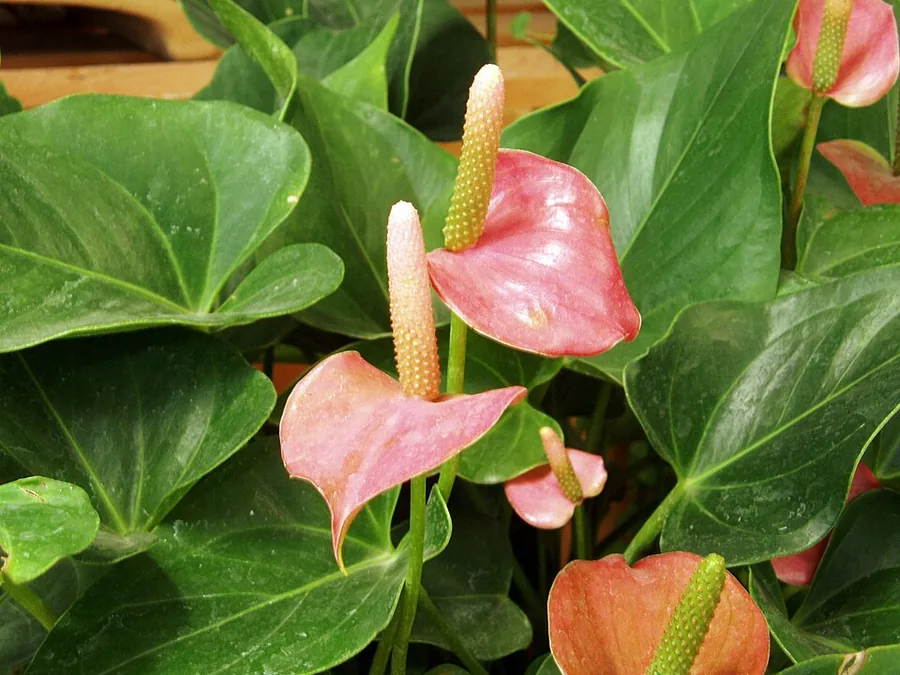
The part people reach for and call the flower is nothing of the sort. That waxy red, pink, orange, or white heart is a spathe, a modified leaf, and the genuine flowers are the small bumps gathered along the pale spadix that lifts from its center. Settled and content, the plant keeps offering fresh spathes through much of the year, which is how it came by names like flamingo flower and painter's palette.
Living with one asks for a little devotion. It answers a careful routine and sulks at neglect, going limp in dry rooms and turning to rot in waterlogged pots. Strike the right balance of light, water, and humidity, though, and it stays sleek and in flower long after most houseplants have given up.
Care
The short version: a bright corner shielded from harsh sun, compost kept gently damp rather than wet, rooms that stay above 65°F (18°C), and generous humidity of 60% to 80%. A weekly feed through the warmer seasons and a roomier pot every second year keep it composed.
Light
Set it in bright, indirect light near a window yet shy of the sun's direct reach. Direct rays scorch the leaves and deep shade leaves you with foliage and nothing to show for it, so a bright, filtered spot is exactly where it wants to be.
Water
Water when the top inch of soil dries out, keeping the mix evenly moist all year without ever letting it parch or stand in water. Overwatering is the fastest end for one, since waterlogged soil rots the roots. Rainwater or filtered water sits better with it than hard tap water.
Soil
Pot it in a light, peaty mix that drains freely, the airy sort its epiphytic roots are built for. A slightly acidic blend at a pH of 6.0 or just below suits it best, and quick drainage is what holds root rot off.
Temperature
Keep it warm, between 65°F and 85°F (18°C to 29°C), and never let it slip under 60°F (16°C) once winter arrives. Cold drafts and a chilly windowsill are more than it can bear.
Humidity
Here is the detail most homes overlook. Anthurium asks for high humidity, around 60% to 80%, well past what a typical heated room provides, and dry air browns the leaf tips quickly. A pebble tray, a humidifier, or a steamy bathroom each lends a hand.
Feeding
Across spring and summer, feed it weekly with a liquid fertilizer. A high-phosphorus formula draws out more blooms. Scale it back through the dimmer months as growth eases.
Pruning
Snip off spent blooms to encourage the plant toward fresh ones, and wipe the broad leaves from time to time so dust does not dull their shine. Wear gloves, as the sap can irritate skin.
Repotting
Move it up every two years into a slightly larger pot. A fresh mix clears out the mineral salts that gather from feeding, and it gives the roots room before they begin to circle the pot.
Size & spacing
Indoors it keeps a tidy frame, rising 12 to 18 inches (30 to 46 cm) tall and reaching 9 to 12 inches (23 to 30 cm) across. That compact scale slots it neatly onto a shelf or a tabletop.
Troubleshooting
Anthurium signals are easy to read once you know the language. Dry air announces itself at the leaf tips, scarce light shows in the missing blooms, and too much water turns up in the roots. Find the picture that matches yours below, then correct the condition driving it.
Sagging yellowed foliage rising from sodden soil
Yellow, drooping leaves sitting above wet soil are a warning that the roots have begun to rot. The trouble traces to overwatering and poor drainage, with the roots going brown and soft below the surface. Ease off the water, move it into a light, fast-draining mix in a pot that drains, and cut away anything that has rotted.
Fix:
- Reduce watering and allow excess water to drain
- Repot into a light, well-drained mix, removing rotted roots
- Use a pot with drainage
Telltale stickiness, webbing, or cottony flecks dulling the leaves
Like most houseplants, the anthurium attracts the familiar indoor sap-suckers: aphids, spider mites, mealybugs, scale, whitefly, and thrips. Look for speckled leaves, a sticky film, faint webbing, or small cottony tufts. Set an affected plant apart, wipe the pests away, and treat it before the problem travels.
Fix:
- Inspect plants regularly and isolate affected plants
- Wipe leaves and remove pests
- Treat with appropriate control measures
Blemished, blighted, or decaying foliage spoiling the display
Spotting and rotted patches across the leaves generally signal fungal or bacterial disease, which settles in where the air is still and the soil stays too wet. Let more air move around the plant, switch to a light, free-draining mix, and remove the leaves that have gone.
Fix:
- Improve air circulation
- Use light, well-drained soil mixes
- Remove affected foliage
Plenty of leaves but few or no flowers
A plant that puts out leaf after leaf and no color has usually been parked too far from the light. Give it a brighter corner that still stays clear of direct sun, tidy away the faded spathes, and offer a high-phosphorus feed to bring the flowers back.
Fix:
- Move to a spot with bright, indirect light, out of direct sun
- Remove spent blooms
- Apply a high-phosphorus fertilizer to encourage flowering
Browned tips marring foliage that is still richly green
Crisp edges against still-green leaves are the classic sign of dry air, the complaint you hear most often in a heated home. Lift the humidity around the plant and move it clear of vents and drafts, both of which parch the foliage and burn the tips.
Fix:
- Raise humidity around the plant
- Move away from drafts and dry-air locations such as heating vents
Pale, sun-scalded areas on foliage left in direct light
Faded, burned patches are a sign the plant is sitting in direct sun, which its leaves simply cannot handle. Move it where the light arrives bright but filtered, and keep it away from drafts and parched corners that only deepen the damage.
Fix:
- Move out of direct sunlight to bright, indirect light
- Relocate away from drafts and very dry spots
Toxicity
Place this one where curious mouths cannot reach it. Every part carries sharp insoluble calcium oxalate crystals, the same irritant running through the arum family, and a single chew sets off burning and swelling inside the mouth. The sap can redden bare skin as well, so pull on gloves before you prune and keep the plant a clear distance from pets and children.
Toxic to
Cats · Dogs · Horses · Rabbits · Livestock · Birds · People
Cats Moderate
Bite into a leaf and a cat knows instantly, mouth burning, saliva running, a paw going to the face. Swollen lips and tongue tend to follow, along with vomiting and a struggle to swallow.
Dogs Moderate
A dog responds in much the same fashion, drooling heavily and turning away from the bowl after a chew. The mouth, tongue, and lips puff up and hurt, and vomiting tends to come next.
Horses Moderate
On contact the crystals sting a horse's mouth, leaving pain, swelling, and a flood of saliva that makes swallowing hard. Since a horse cannot vomit, the discomfort lingers in the mouth and throat.
Rabbits Toxic
Those same oxalate crystals sear a rabbit's delicate mouth and gut, so set the plant well beyond reach and never let any piece of it be eaten.
Livestock Toxic
A grazing animal that takes a bite of the leaves ends up with a mouth full of stinging crystals, followed by drooling, soreness, and an upset stomach. Fence it off anywhere stock can get to it.
Birds Toxic
A curious bird pecking at the leaves or sap runs into the same irritant crystals, which inflame the mouth and crop. Keep it clear of any room where birds fly loose.
People Caution
No part of an anthurium belongs on a plate, and a single bite brings burning and swelling to the mouth. The sap can also leave skin red and itchy, so reach for gloves and keep children at a distance.
Sap and tissue contain insoluble calcium oxalate crystals (raphides) that can cause skin/contact dermatitis; consider wearing gloves when handling or pruning
Helpline numbers

United States
ASPCA Animal Poison Control: (888) 426-4435 (fee applies)
Poison Control: (800) 222-1222



Canada
Poison Centres: 1-844-764-7669
Varieties
Anthurium andraeanum arrives in a spread of named cultivars, sorted for the most part by spathe color. Below are a handful recorded by NC State Extension.
'Acropolis'
A named Anthurium andraeanum cultivar acknowledged by NC State Extension.
'Baron'
Another A. andraeanum selection appearing on the NC State Extension roster of named cultivars.
'Cheers'
An Anthurium andraeanum cultivar on record with NC State Extension.
'Florida'
An A. andraeanum cultivar entered in the NC State Extension records.
'Midori'
A named Anthurium andraeanum cultivar held in the NC State Extension catalogue.
'Rosee Choco'
Yet another A. andraeanum cultivar counted among NC State Extension's named selections.
How to propagate
Anthurium is increased by splitting a plant you already have or by rooting a cutting, each best tried on a settled specimen rather than a young one.
DivisionModerate
Best done at repotting (every 2 years) · Unknown
The easiest route to a second anthurium is to divide a mature plant as you repot, which lands at roughly every two years. Gently pull the clump apart so each section holds onto its own roots, then settle the divisions into their own pots.
Stem cuttingsModerate
During active growth · Unknown
Rooting a stem cutting is another option, taken while the plant is growing actively. NC State Extension names this method along with seed for anthurium, but at home a cutting is the more workable choice.
Myths
The lacquered red heart that gives an anthurium its glamour is the flower.
That shiny red, pink, orange, or white heart is actually a spathe, a modified leaf rather than a flower. The real flowers are the tiny bumps crowded onto the spadix, the pale white or cream column rising at the center of the spathe.