Houseplant · Araceae
Arrowhead Plant
Syngonium podophyllum
Easy and quick to fill a corner, the arrowhead plant climbs a shelf or trails from a hook with equal grace, given bright indirect light.
Bright indirect
64–81°F · 18–27°C
USDA 10–12
3–6 ft · 0.9–1.8 m
Overview
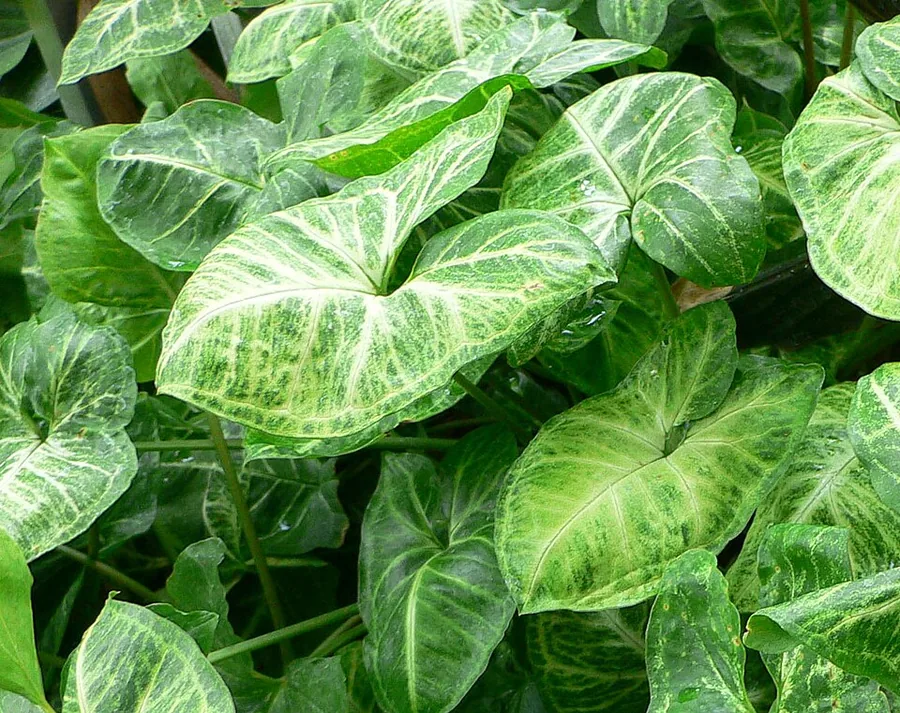
The arrowhead plant arrives as a soft, rounded mound that earns its name from the young leaves shaped like arrowheads, and it settles into a room with almost no fuss. Native from Mexico through tropical America and a member of the arum family, it has become a designer's shorthand for relaxed, lived-in greenery. With green, variegated, and pink-veined forms to choose from, there is a version to suit a calm neutral scheme or a brighter, more playful one.
Its real charm is how it grows into a space over time. The compact young plant matures into a climbing vine, and that change hands you a styling decision. Send it up a moss pole as a quiet vertical accent in a reading nook, hang it where the stems can spill down a bookshelf or a bathroom corner, or pinch it back into a tidy mound for a side table. It bends to the look you are after rather than dictating one.
Living with it is easy, which is half the appeal. Bright indirect light, lightly moist soil, and warm air keep it looking its best, and it tolerates the rhythms of a busy household without sulking. The one note of caution is the sap, which carries calcium oxalate crystals that irritate mouths and skin, so give it a perch on a high shelf or a hanging hook, out of reach of pets and small children.
Care
The short version: set it in bright indirect light, keep the soil lightly moist but never soggy, and surround it with warm, humid air. Water less in winter, and once it begins to vine, style it with a pole or a hanging basket.
Light
Place it in bright, indirect light for the richest color and the fullest, most styleable shape. It holds up in medium light and even low light, which makes it easy to slot into a dim corner, but direct sun scorches the leaves, so keep it back from a hot window.
Water
Keep the soil lightly moist but never soggy through the growing season, watering once the surface starts to dry. Ease off from fall through late winter, when the plant slows and wet soil turns quickly to root rot.
Soil
Pot it in a light, well-draining potting mix with a soil base. Free drainage is what matters most, since standing water at the roots is the surest way to spoil this plant.
Temperature
It is content in ordinary room warmth, roughly 64°F to 81°F (18°C to 27°C), the same comfort range as the people sharing the room. Keep it clear of cold drafts and chilly windowsills in winter, as it has no tolerance for frost.
Humidity
Being tropical, it wants high humidity, ideally 60% or more, which is part of why it looks so at home in a steamy bathroom or kitchen. It manages in average household air, though a humidifier nearby keeps the foliage at its most polished.
Feeding
Offer a balanced foliage-plant fertilizer while it is actively growing through the warmer months. A handful of feedings spread over the growing season is all it asks, and feeding can be set aside entirely once growth eases off in fall.
Pruning
It takes a hard cutting back without complaint, which keeps your styling flexible. Pinch and prune to shape it into a compact tabletop mound, a trailing basket, or a vine trained up a moss pole or trellis as the room calls for.
Repotting
Repot only when the plant outgrows its container and the roots crowd the pot, so the display rarely needs disturbing. There is no fixed schedule; move it up a pot size whenever it starts to look cramped.
Size & spacing
Indoors it reaches about 3 to 6 feet (91 to 183 cm) as a climbing or trailing vine, with a spread near 1 to 2 feet (30 to 61 cm), so plan the shelf or hook accordingly. Give it room to vine or a support to climb, and leave air moving around the leaves.
Troubleshooting
Arrowhead plants are forgiving, and most of what dulls their good looks traces back to light or water. Notice the early changes in the leaves and stems, find the match below, and address the cause before it takes the shine off your display.
Rot softening the stems and roots to mush
Soggy soil invites soft rot, a bacterial decay that turns stems and roots to mush. Cut away the affected tissue, then settle the cause by moving to a light, well-draining mix and letting the pot drain freely. Ease off the water through fall and winter, when the plant drinks far less.
Fix:
- Remove affected tissue
- Improve drainage and avoid waterlogged soil
- Reduce watering, especially from fall through late winter
Bleached, washed-out patches marking the leaves
Too much direct sun scorches arrowhead leaves, leaving washed-out or crisp patches that mar an otherwise lush look. Shift the plant to a spot with bright indirect light or dappled shade, and the new growth comes back clean and even.
Fix:
- Move plant out of direct sun to a bright indirect or part-shade location
Dark spots marring the leaves
Distinct dark lesions usually signal bacterial leaf spot, which spreads on wet foliage. Pick off the marked leaves and keep water off the leaves going forward. Good air movement around the plant does most of the work in stopping it.
Fix:
- Remove affected leaves
- Avoid wetting foliage and improve air circulation
Fine webbing, cottony tufts, or warped sticky shoots
A few common pests find their way to arrowhead plants, each leaving its own signature. Spider mites stipple the leaves and spin fine webbing, mealybugs appear as white cottony tufts, aphids cluster on soft new growth, and scale sits on stems as hard little bumps. Isolate the plant the moment you notice any of them, wash the pests off, and follow up with an insecticidal treatment.
Fix:
- Inspect and isolate the plant
- Wash off pests and treat with an appropriate insecticidal control
Leggy, trailing stems with sparse leaves
This is simply the arrowhead plant coming of age, not a flaw in your display. The young plant is bushy and compact, but with maturity it eases into its natural vining habit and the stems lengthen and trail. Lean into the look by giving it a moss pole or trellis to climb, letting it cascade from a hanging basket, or pinching the stems back to keep a fuller, tidier silhouette.
Fix:
- Provide a moss pole or trellis for the plant to climb
- Grow in a hanging basket to let stems cascade
- Prune or pinch stems to keep the plant compact and bushy
Toxicity
This is a plant to place thoughtfully rather than casually. Every part holds insoluble calcium oxalate crystals, and a single bite stings the mouth at once. The sap can irritate skin as well, so handle cuttings with care and choose a spot, ideally up high or hanging, where pets and children cannot reach it.
Toxic to
Cats · Dogs · Horses · Rabbits · Livestock · Birds · People
Cats Moderate
One bite of a leaf and a cat feels the burn straight away. Expect heavy drool, a paw lifted to the mouth, and a sore, swollen tongue with puffy lips, often joined by vomiting and labored swallowing.
Dogs Moderate
A dog responds just as a cat would. Contact sets the mouth burning, so expect drooling, puffiness around the tongue and lips, vomiting, and hesitation to swallow.
Horses Moderate
In a horse, the crystals inflame the mouth and throat, prompting drooling, swelling, and labored swallowing. Since horses cannot vomit, the distress stays fixed in its mouth and belly.
Rabbits Toxic
Keep the arrowhead plant well out of a rabbit's reach. The same calcium oxalate crystals that harm cats and dogs irritate a rabbit's sensitive mouth and gut, and this is not a safe green to offer.
Livestock Toxic
Livestock that nibble the leaves take in a painful dose of oxalate crystals, and drooling with a swollen mouth typically follows. Keep the plant fenced away from any grazing stock inclined to sample it.
Birds Toxic
Birds fare no better with the sap. A pet bird pecking at the leaves can develop the same sore, swollen mouth, so set cages and perches well away from it.
People Caution
None of this plant belongs on a plate. A bitten leaf brings a sharp sting to the mouth, and the sap may irritate skin, so rinse your hands once the cuttings are done and keep it out of reach of young children.
All parts contain insoluble calcium oxalate crystals; sap can irritate. UF/IFAS notes the toxic sap makes mechanical handling (e.g., string trimming) inadvisable outdoors
Helpline numbers

United States
ASPCA Animal Poison Control: (888) 426-4435 (fee applies)
Poison Control: (800) 222-1222



Canada
Poison Centres: 1-844-764-7669
Varieties
Growers have selected the arrowhead plant for leaf color and pattern, a palette spanning near-white, bright green, and deep pink veins that lets you match it to a room's mood. These are a few of the named cultivars worth looking for.
'White Butterfly'
Its greenish-white leaves are washed with creamy white-yellow veins and edged in dark green, the palest choice for a soft, airy scheme.
'Pink Allusion'
Bred in Florida, it carries deep pink veins down the centers of light olive-green leaves, a flush of color that holds as the leaves age.
'Robusta'
A cultivar raised for the commercial Syngonium market, produced to UF/IFAS standards.
'Neon'
A further commercial pick documented in the UF/IFAS guidelines for interiorscape Syngonium.
'Lemon Lime'
A production cultivar from the same UF/IFAS guidelines, named for its fresh, bright green coloring.
How to propagate
Filling a home with these is delightfully simple. A cutting taken in the warm months roots almost on its own, ready to start a second pot for another shelf, and patient growers can air-layer a longer stem for a fuller, more finished plant.
Stem cuttingsEasy
Spring to summer · Roots in a few weeks
This is the effortless route, and the plant nearly manages it for you. Take a tip or nodal cutting in spring or summer as long as it includes a node, and any aerial roots already on the stem give it a head start. Stand it in water or moist potting mix and it roots within a few weeks, perfect for a second styled pot.
Air layeringModerate
Spring to summer · Several weeks
Air layering asks for more patience but rewards it, and it is the method commercial growers use to bulk up Syngonium. Wound a stem and wrap it in spring or summer, then wait several weeks for roots to form before you cut the new, fuller plant free.
Myths
The arrowhead plant amounts to a philodendron in disguise.
The two share the arum family, which is where the confusion begins, but the arrowhead plant is Syngonium podophyllum, a separate genus from Philodendron. The leaves tell the story: young ones wear the arrowhead shape behind the name, then mature into compound leaves split into 3 to 11 leaflets, something philodendrons never do.
Sources
- Plants of the World Online, Royal Botanic Gardens Kew
- NC State Extension Gardener Plant Toolbox
- Missouri Botanical Garden Plant Finder
- ASPCA Animal Poison Control
- Atlas of Florida Plants, Institute for Systematic Botany, University of South Florida
- UF/IFAS Plant Directory
- UF/IFAS EDIS (EP244, Cultural Guidelines for Commercial Production of Interiorscape Syngonium)