Tree · Fabaceae
Black Locust
Robinia pseudoacacia
A fast, fragrant screen for hard ground, with a few rules about where it belongs.
Full sun
Every 14–30 days
2190–2920 days
USDA 3–8
Overview
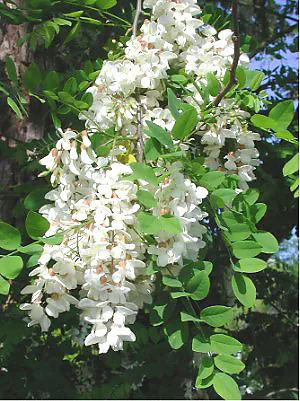
Black Locust is the tree you reach for when a property has a difficult corner to fill and not much time to wait. It rises quickly into a tall, open canopy, and on a poor, dry slope where little else cooperates it sets a green scene almost from scratch. Drooping clusters of fragrant white flowers in late spring (April to June) give it a brief, romantic moment over a garden, and that scent carrying across a yard is the reason many people plant it in the first place.
Read at full size it is a big, working tree, reaching 30 to 50 feet (9 to 15 m) tall with a 20 to 35 feet (6 to 11 m) spread, so it suits the back boundary, the far edge of a paddock view, or a fast living screen between you and a neighbor far more than a polished front entry. The look is loose and airy rather than manicured, casting light dappled shade that pairs well with an informal, naturalistic planting and a property that already leans rural.
The trade-off is real, and it shapes where this tree fits. The wood is brittle and the whole plant runs aggressively from root suckers and seed, so it earns its place at a distance from buildings, walkways, and parking, on ground where its spreading habit is a feature rather than a problem. Treat it as a tough, hardworking screen for the property's outer reaches and it rewards you; ask it to behave like a tidy specimen near the house and it will disappoint.
Care
The short version: Give Black Locust full sun and the worst, driest soil on the property, then mostly leave it alone. It fixes its own nitrogen, so skip the feeding, water only young transplants, and plan to prune in the dormant season and pull suckers to keep it in bounds. Site it well away from the house, paths, and parking, and keep every part except the flowers clear of horses, pets, and children.
Light
Plant it in full sun for the fullest crown and the best flowering; it is an open, sun-loving tree that wants to stand where nothing shades it. It will accept partial shade if the site demands, but it shows its best form and screening density out in the open along a boundary or an exposed slope.
Water
Once it has settled, this is one of the easiest trees on the property to forget about. It is extremely drought-tolerant, takes to dry, sandy, eroded ground, and rarely needs watering past the establishment phase, so a stretch of 14 to 30 days between drinks suits young transplants while older trees fend for themselves.
Soil
Hand it the part of the garden nothing else wants. It thrives on poor, dry, sandy, rocky, and eroded soil, asking only for decent drainage, and it tolerates a wide pH band of 4.6 to 8.2. Because it fixes its own nitrogen, a lean, infertile site is a feature here rather than a fault.
Temperature
This is a genuinely hardy tree, comfortable across a broad swing from -40°F to 104°F (-40°C to 40°C) and suited to zones 3 through 8. That range lets it work as a screen or shade tree across most temperate properties without any winter coddling.
Humidity
It is relaxed about moisture in the air and sits happily at average humidity with no special attention. Damp or dry, it carries on the same, which is part of what makes it such a low-maintenance fixture on an exposed site.
Feeding
Skip the fertilizer almost entirely. As a nitrogen-fixing legume it makes its own, so it needs little to nothing, and a high-nitrogen feed only pushes soft, fast growth on a tree whose wood is already weak. If you feed at all, keep it light and in spring.
Pruning
Work in late winter or early spring while it is dormant, taking out dead, crossing, weak, and storm-damaged limbs and lifting the crown for a cleaner line over a path or lawn. Pull root suckers regularly to hold its spread, and always wear gloves for the sharp paired spines.
Repotting
This is a landscape tree, not a container plant, so repotting does not really apply. Only young container or balled-and-burlapped stock gets moved, and that is best done while dormant; watch for circling or matted roots, roots out the drainage holes, or water running straight through before you transplant.
Size & spacing
Give it room to be the big tree it is, 30 to 50 feet (9 to 15 m) tall with a 20 to 35 feet (6 to 11 m) spread, and set it well back from buildings, walkways, and parking. Place it along a far boundary or open slope where its size and suckering habit read as an asset rather than a crowding problem.
When to plant
The rhythm here is simple and slow to mature. Sow in late winter, set young trees out in spring once frost has passed or in fall while dormant, and look for that fragrant white bloom to arrive in late spring.
Northern hemisphere
Southern hemisphere
Typical months for a temperate climate: start earlier in warm zones, later where spring frosts linger.
- Sow: Late winter; scarify seed (hot water or acid) before sowing to break hard seed coat.
- Plant: Spring after the last frost, or fall, while dormant.
- Harvest: Fragrant white pea-like flowers in drooping clusters in late spring (April to June).
Hardiness
USDA hardiness zones: 3–8
Temperature: down to -40°C
Troubleshooting
Most of what goes wrong with a Black Locust comes down to its wood and a couple of well-known insects, and on a property the questions are usually about safety and looks rather than survival. Here is what to watch for and how seriously to take it.
Borers hollowing out the frame
When a locust starts shedding sawdust and showing swollen knots along the trunk, the structure that holds your screen or shade canopy together is being eaten from the inside, and a tree that anchors a property line cannot do its job while it weakens.
Fix:
- Maintain vigorous tree health to resist attack
- Prune out and destroy heavily infested, dead, or hazardous limbs
- Remove severely declining hazard trees near targets
Brittle limbs that come down in a storm
This is a tree that drops wood when the weather turns rough, so a limb hanging over a patio or a parked car is a liability waiting for the next gust, and placement on the property matters far more than any cure.
Fix:
- Prune out weak, dead, and hazardous limbs while dormant
- Reduce long, heavy limbs over walkways or structures
- Remove hazardous trees near high-use areas
A tired, browned-out canopy in high summer
By the warm middle of the season the crown can read as dull and crisped from a distance, which dents the cool, leafy look you planted for, though the tree itself rarely suffers any lasting harm and dresses back up the following year.
Fix:
- Tolerate damage as it rarely kills established trees
- Rake and remove heavy leaf litter
- Maintain tree vigor with adequate moisture for young trees
Toxicity
This is a beautiful screen with a serious caveat, and the caveat decides where it can go. Every part except the flowers is poisonous, horses most dangerously of all, so plan placement and clean-up around keeping the toxic bark, pods, and prunings out of reach.
Toxic to
Cats · Dogs · Horses · Rabbits · Livestock · Birds · People
Cats Moderate
A curious cat that gnaws bark or fallen pods can be left vomiting, dull, and off its food, so this is not a tree to plant over a favorite napping spot.
Dogs Moderate
Dogs that chew prunings or seed pods left on the lawn may show vomiting, weakness, and a lost appetite; clear the drop zone before they find it.
Horses Severe
Horses are the most at-risk guests on any property, and bark stripped from a paddock fence or stray tree can bring on colic, severe weakness, and death; keep this tree well clear of pasture.
Rabbits Toxic
Rabbits with access to bark, sprouts, or pods can be poisoned badly, so a hutch or run belongs nowhere near where this tree drops its litter.
Livestock Severe
Grazing stock that reach the bark, seeds, or young suckers face severe, potentially fatal poisoning; fence pastures away from any locust on the line.
Birds Toxic
Birds can be seriously harmed by the toxic parts, so site the tree away from coops, aviaries, and feeding areas.
People Caution
Children have been poisoned by the seeds and young sprouts, and the paired thorns are a hazard underfoot; keep little hands away from pods and prunings.
Wear gloves when pruning to avoid the sharp paired thorns, and keep bark, seed pods, prunings, and sprouts away from horses, livestock, pets, and children.
Helpline numbers

United States
ASPCA Animal Poison Control: (888) 426-4435 (fee applies)
Poison Control: (800) 222-1222



Canada
Poison Centres: 1-844-764-7669
Varieties
A handful of named forms trade the wild tree's scale for a particular look, whether that is colored bloom, golden foliage, or a compact contorted shape. Most still carry the brittle wood, so choose for the scene you want and site accordingly.
Purple Robe
The showy choice when you want rose-pink to purple bloom and bronzy new growth carrying a late-spring scene, though it keeps the species' weak wood and the placement caution that comes with it.
Frisia
A bright, golden-leaved form that holds its color all season and lights up a green border, but it breaks as readily in a storm as any wild locust.
Twisty Baby (Lace Lady)
A small, contorted form with twisting branches that suits a courtyard or a quiet corner; it rarely flowers and shares the same brittle wood.
Umbraculifera
A thornless, neat mop-head with a dense rounded crown for a tidy, formal look near walkways, though it seldom blooms.
How to propagate
There are three routes to more locust, and one of them happens whether you want it or not. Seed needs a little preparation, suckers and root cuttings practically do the work themselves, and named cultivars call for grafting.
SeedModerate
Spring · 1-2 seasons
Start in spring after nicking the tough seed coat with a near-boiling soak of about a minute or an acid treatment. Treated seed sprouts and settles in over a season or two, and stored seed still comes up after 10 or more years.
DivisionEasy
Dormant season · 1 growing season
The tree multiplies on its own through root suckers, the simplest path, handled in the dormant season. Suckers and dormant root cuttings from a quarter inch to an inch thick take hold quickly and fill a space within one growing season, which is exactly why it resists being kept in bounds.
GraftingDemanding
Dormant season or summer budding · 1-2 seasons
Named forms such as Purple Robe and Frisia will not breed true from seed, so they are budded or grafted onto seedling rootstock. Do the work in the dormant season or bud in summer, then give the union a season or two to settle.
Myths
Black locust must be harmless because it is a native legume in the bean family and its flowers turn up on the plate.
The flowers do appear in a few dishes and the tree feeds itself by fixing nitrogen, but the rest of it is poisonous. Bark, leaves, seeds, and sprouts carry toxalbumins that can kill, with horses the most vulnerable of all.
It is the kind of polite, low-fuss shade tree you can plant and forget.
It runs root suckers and seeds itself into dense thickets, turning invasive well beyond its native ground. The wood is brittle and prone to dropping limbs, and locust borers only make it worse.