Vegetable · Fabaceae
Chickpea
Cicer arietinum
A cook's garden classic, knee-high and quietly productive in the spring plot.
Full sun
Every 7–10 days
50–86°F · 10–30°C
90–120 days
Overview
Few edibles earn their keep in a kitchen garden as gracefully as chickpea (Cicer arietinum), a member of the family Fabaceae and one of the oldest cultivated crops, traced to the Near East thousands of years ago. It reads as a bushy, knee-high annual, compact enough to tuck between other beds without crowding the view.
In the plot it presents as soft, fern-like foliage carried on a rounded, mounding frame, a quiet green presence that pairs handsomely with the leeks, lettuces, and peas of a cool-season planting. The whole plant wears a coat of fine glandular hairs, so it earns its place in the working part of the garden rather than the ornamental border.
Known just as readily as garbanzo bean, Bengal gram, Egyptian pea, or ceci bean, it carries its seeds two or three to a short, puffy pod. Set in rows among spring vegetables, it gives a cook's plot both structure and a genuine harvest at season's end.
Care
The short version: chickpea is a low-fuss kitchen-garden legume that wants full sun, sharp drainage, and a cool start in spring. Sow it among other cool-season crops, water deeply every 7 to 10 days, and let it largely feed itself. Pods follow in 90 to 120 days, ready for fresh picking or drying on the plant.
Light
Give chickpea full sun and a spot that stays bright through the day. It does not tolerate shade, and a shadier corner of the garden simply yields fewer pods and a weaker, less generous plant. Reserve the sunniest open ground for it when laying out the beds.
Water
Water deeply roughly every 7 to 10 days, leaning toward even moisture during flowering and pod fill when the harvest is being decided. Once established the plant is drought-tolerant, so there is no need to fuss over it daily. Avoid waterlogged soil, which invites root rot, and ease off the watering as the pods dry down for harvest.
Soil
A well-drained sandy loam to loam suits it best, and here drainage matters more than richness, making chickpea an easy fit for an unfussy spring bed. It is comfortable across a pH of 6.0 to 8.0 and tolerates mildly alkaline ground without complaint.
Temperature
This is a cool-season plant that thrives between 50°F to 86°F (10°C to 30°C), the very window when a spring garden is at its most pleasant to work in. Seedlings shrug off light frost, but heat during flowering causes the blossoms to drop before they can set pods, so timing the planting for a cooler bloom pays off.
Humidity
Chickpea favors low humidity, around 30% to 50%, and an airy, open position in the garden. Damp, still air encourages leaf diseases, so give it room to breathe between rows rather than tucking it into a crowded, sheltered pocket.
Feeding
Feed only at planting and then step back. As a nitrogen-fixing legume it makes most of its own nitrogen, and a phosphorus starter plus Rhizobium inoculant at sowing is usually all it asks. Excess nitrogen is actively harmful here, one of the rare cases where the lighter hand is the better one.
Pruning
No pruning required. This is a bushy annual that simply grows to maturity, delivers its pods, and is pulled after harvest, clearing the bed for whatever follows in the rotation.
Repotting
Not applicable (field/garden annual, not container-grown long term)
Size & spacing
Expect a compact plant of 12 to 24 inches (30 to 60 cm) tall with a spread of 8 to 18 inches (20 to 45 cm). Its modest footprint slips easily into rows or among cool-season crops, making it a natural companion in a well-planned kitchen garden.
When to plant
Chickpea keeps a tidy seasonal rhythm that slots neatly into the spring garden calendar, planted as the soil softens and harvested as summer arrives.
Northern hemisphere
Southern hemisphere
Typical months for a temperate climate: start earlier in warm zones, later where spring frosts linger.
- Plant: Direct-sow in early-to-mid spring once soil is workable and has warmed to about 10°C (50°F); chickpea is a cool-season crop that tolerates light frost as a seedling.
- Harvest: Harvest green (immature) seeds earlier for fresh use; for dry seed, harvest when the whole plant and pods have dried and turned brown.
Hardiness
USDA hardiness zones: 4–10
Temperature: down to -34°C
Troubleshooting
Most setbacks in a chickpea bed trace back to weather and water, and a well-sited, well-spaced planting heads off the worst of them before they start.
ASCOCHYTA BLIGHT
Watch for brown to tan lesions with dark margins on leaves, stems, and pods, often in concentric rings, with a rapid collapse in cool, wet weather. This is the most damaging chickpea disease, spread by rain and by infected seed or residue, and confirmed by tiny dark fruiting bodies set in concentric rings within the lesions. Sow certified disease-free treated seed, apply registered foliar fungicides preventively in high-risk wet seasons, and destroy infected residue; in future plantings choose resistant varieties, rotate out of chickpea and pulses for several years, avoid overhead watering, and keep seed clean.
Fix:
- Use certified disease-free, treated seed
- Apply registered foliar fungicides preventively in high-risk wet seasons
- Remove and destroy infected crop residue
FUSARIUM WILT
Look for yellowing, wilting, and stunting, with plants dying in scattered patches across the bed. Split a lower stem and the telltale vascular browning confirms it: a soil fungus that clogs the plant internally, worse in warm soils and infested ground, with no cure once established. Remove and destroy affected plants and improve drainage to avoid overwatering; going forward, plant resistant cultivars, rotate crops, and steer clear of fields with a history of the disease.
Fix:
- Remove and destroy affected plants
- Improve drainage and avoid overwatering
FLOWER DROP IN HEAT
When flowers drop and few or no pods set during hot spells, the cause is heat stress above the cool-season optimum at flowering, made worse by dry soil. Keep even soil moisture during flowering and time the planting so bloom misses the peak of summer. The reliable fix is to sow early in spring so the reproductive stage falls in cooler conditions, and to choose well-adapted varieties.
Fix:
- Maintain even soil moisture during flowering
- Time planting so flowering avoids peak summer heat
Toxicity
This is a food plant first and foremost, the same legume that fills the pantry, so it sits comfortably in a garden shared with pets and curious visitors.
Safe for
People · Cats · Dogs · Horses · Rabbits · Livestock · Birds
Cats None
Cooked chickpeas are harmless to cats and even appear in some pet foods, so a nibble of the plant is no cause for worry.
Dogs None
Dogs can eat plain cooked chickpeas without trouble, and the growing plant poses no poisoning risk if a curious dog takes a bite.
Horses Safe
There is nothing toxic here for a grazing horse.
Rabbits Safe
A rabbit can sample the leaves safely, though the sticky acidic hairs may make them less appealing than fresh greens.
Livestock Safe
Cattle, sheep, and goats can graze chickpea without harm, and the residue is sometimes fed as fodder.
Birds Safe
Backyard hens and other birds can eat cooked chickpeas, and the seed is common in feed mixes.
People Safe
Cooked chickpeas are a staple food worldwide; cook the raw seed first, and wear gloves at harvest since the acidic hairs can irritate skin.
The foliage and pods are covered in glandular hairs that secrete an acidic exudate (chiefly malic and oxalic acid). Prolonged skin contact during harvest can cause irritation, so wear gloves and long sleeves when handling plants by hand. Raw seeds are cooked before eating.
Varieties
Two familiar types carry the chickpea name, each suited to a slightly different place at the table and in the plot.
Kabuli
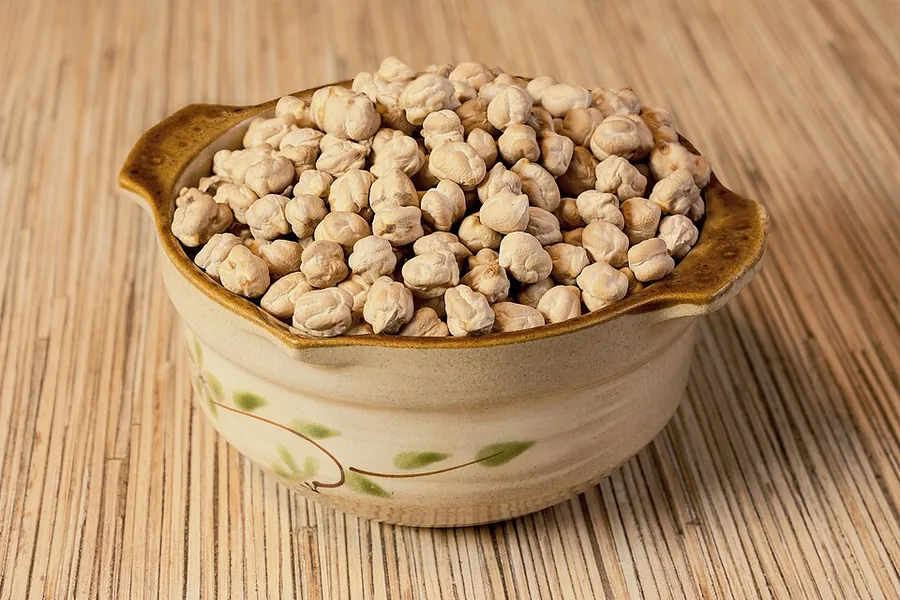
Kabuli is the large, pale cream garbanzo with smooth round seeds and a thin coat, the type sold dried or canned and the one most cooks reach for in the kitchen.
Desi
Desi is the smaller, darker chickpea with angular seeds and a thicker, often colored coat, common across South Asia and frequently split into chana dal, also called dal.
How to propagate
Starting chickpea is refreshingly direct: a packet of seed, a workable spring bed, and a little patience while the rows fill in.
SeedEasy
Direct-sow in early-to-mid spring once soil is workable and around 10°C (50°F). · Seedlings typically emerge in about 1-2 weeks under suitable conditions.
Grown from seed only and easy to start, chickpea is direct-sown in early-to-mid spring once the soil is workable and around 50°F (10°C), with seedlings emerging in about 1 to 2 weeks. If chickpeas have not grown in that ground before, coat the seed with the right Rhizobium inoculant at planting so the roots can fix their own nitrogen.
Myths
Chickpeas need heavy nitrogen fertilizer to grow well.
As a legume it partners with Rhizobium bacteria and fixes much of its own nitrogen from the air. Extra nitrogen fertilizer is simply wasted, and too much can actually reduce the nodulation the plant depends on, so a light starter feed serves it far better than a generous one.