Ornamental · Boraginaceae
Brunnera
Brunnera macrophylla
Set in shade with steady moisture, Brunnera turns a garden's dimmest corner into a cool, composed retreat of silvered leaves and small blue spring flowers.
Partial shade
USDA 3–8
12–18 in · 30–46 cm
Overview
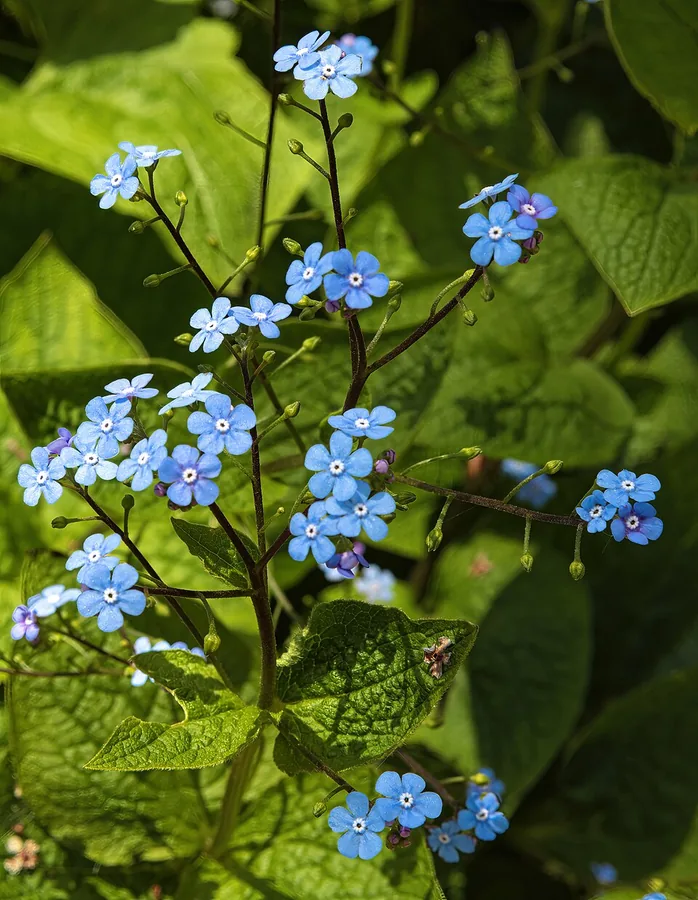
Brunnera is the plant for the corner of the garden where nothing else seems to settle, the shaded spot a home tends to overlook. Its broad heart-shaped leaves hold the scene long after the flowers have passed, giving a quiet, restful structure that anchors a shade border through the season. A member of the borage family also known as Siberian bugloss, it forms a slow, clump-forming perennial, and in early spring it lifts a soft haze of small blue flowers so like forget-me-nots that it took the name false forget-me-not.
The leaves set the mood of a planting. Plain green on the species, the favored kinds carry silver, bright veining, or creamy edges that pick up what little light reaches a shaded bed and lend it a cool, polished air. Staying low at around 12 to 18 inches (30 to 46 cm) tall, it rounds into a tidy mound that sits easily beside hostas and ferns and gives a shade scheme a settled, considered look.
It folds into a garden routine with little fuss once it has found its place. Brunnera asks for shade, rich soil, and dependable moisture, and it holds its own against both deer and rabbits. The one setting it cannot carry is heat and drought, which scorch the leaf edges and leave a planting looking weary by midsummer, so a cool, sheltered corner keeps it at its most refined.
Care
The short version: a shaded corner out of the hot afternoon sun, soil kept evenly moist and never left dry, and rich ground dressed with mulch to hold the moisture and keep the bed cool.
Light
Brunnera belongs to the shaded side of a garden, at home in part to full shade with shelter from the hot afternoon sun. Direct light scorches the leaves and drains the cool color a planting is grown for. A dappled spot beneath trees gives it the gentle setting it suits.
Water
Keep the soil consistently and evenly moist, since dry ground is the one thing this planting will not carry. A dressing of mulch holds the moisture and keeps the bed cool, which matters most as summer heat settles over the garden.
Soil
Set it in fertile, organically rich loam that drains freely while holding steady moisture. It accepts a wide pH range, from 6.0 to 8.0, so most beds enriched with compost give it the grounding it needs.
Humidity
Everyday garden air suits it, so there is no figure to meet. What unsettles a planting is hot, humid summers, the kind common in the deep South, where heat and moisture together wear it down.
Feeding
Feed lightly through the growing season with a balanced fertilizer, or simply work compost and organic matter into the soil each spring. A rich bed keeps the foliage full, and that is most of what a planting asks for.
Pruning
Lift away scorched or tattered leaves as they appear, and cut back the spent flower stems once the blue blooms have gone over. In late fall or early spring, take the old foliage down to the ground so the bed reads clean before fresh growth arrives.
Size & spacing
Plants reach about 12 to 18 inches (30 to 46 cm) tall and widen slowly to 18 to 30 inches (46 to 76 cm) across. Give each clump that room and a planting closes into a neat, ground-covering mound that holds a shade scheme together.
When to plant
Brunnera lives on as a perennial, so a planting set once carries year to year with no annual replanting. Place new plants or divisions in spring or fall while the weather stays mild, then look for the blue flowers from early to mid-spring before the foliage settles in to carry the rest of the season.
Northern hemisphere
Southern hemisphere
Typical months for a temperate climate: start earlier in warm zones, later where spring frosts linger.
- Sow: Usually propagated by division rather than seed; sow indoors is not typical.
- Plant: Plant in spring or fall during mild weather to avoid heat or cold stress.
- Harvest: Blooms early to mid-spring (about April to May), sometimes into early summer.
Hardiness
USDA hardiness zones: 3–8
Temperature: down to -40°C
Troubleshooting
Brunnera keeps a planting calm and rarely asks for intervention, and what does go awry usually traces to too much sun or too little water. Watch the leaf edges and the foliage through high summer, where the first hints surface. Match what you notice to the entries below and tend to it before the look of the bed suffers.
A drooping, fading planting as the sultry season peaks
Brunnera was made for the cool, quiet corners of a garden, so hot, humid weather, the kind that settles over the deep South, asks more of it than it can give, and any warm-summer setting can wear it thin. Deep shade and steady moisture carry the planting through the heaviest weeks, with a generous mulch to keep the bed calm and cool. It looks its most at ease in zones 3 to 8, where a sheltered, shaded spot lets it hold its place in the garden.
Fix:
- Provide deep shade and consistent soil moisture in summer
- Mulch heavily to cool soil
- Grow in cooler microclimates or northern zones where possible
Browning edges and a foliage display losing its color
When the edges crisp and the color fades, the planting is telling you it sits in too much sun for the setting, the mark of leaf scorch brought on by hot light and soil that dried in the heat. Relocate it to a shaded corner of the garden, out of the afternoon glare, keep the ground evenly moist, and mulch to settle the bed. Clip away the tired leaves and the planting renews itself before long.
Fix:
- Move or transplant to part to full shade with afternoon shade
- Keep soil consistently moist
- Mulch to cool and conserve soil moisture
- Remove badly scorched leaves to encourage fresh growth
Torn openings across the leaves and a sheen of slime
The shaded, restful bed that makes Brunnera such a pleasure is the same setting that invites slugs and snails, and they leave their holes and trails behind. An evening turn through the garden, picking them off by hand, keeps the planting looking composed. Clear away the damp mulch and litter where they gather, and reach for iron phosphate bait only when they refuse to give up the spot.
Fix:
- Handpick slugs and snails in the evening
- Reduce excess moisture and remove debris hiding spots
- Use iron phosphate slug bait if needed
Toxicity
Reassuring news for a home with pets or children: Brunnera is not toxic. It does not appear on the ASPCA's list of plants dangerous to cats or dogs, and there is no known hazard to other animals or to people. It can take its place freely in a garden the whole household shares.
Safe for
People · Cats · Dogs · Horses · Rabbits · Livestock · Birds
Cats None
A cat that wanders the shaded border is in no danger, since Brunnera sits off the ASPCA's toxic list and a curious sniff does no harm.
Dogs None
A dog at ease in the garden can taste a leaf without worry, as the planting holds no toxin known to trouble them.
Horses Safe
Horses grazing near the bed face no poisoning risk.
Rabbits Safe
Rabbits tend to pass it by, and a stray bite leaves them perfectly well.
Livestock Safe
Cattle, goats, and sheep can browse it safely, though it rarely draws their interest.
Birds Safe
The planting sits safely among birds, with no toxic seeds or foliage to give pause.
People Safe
Nothing toxic makes it a hazard to tend or to keep in a garden shared with children. It is an ornamental rather than a food plant, so there is no occasion to eat it.
Varieties
A planting almost always turns on the named foliage selections rather than the plain green species, and these are the ones that shape most shade schemes.
Jack Frost
Its frosted silver foliage, traced with green veins and a slim green rim, brings a luminous note to a shaded planting of about 12 to 15 inches tall.
Looking Glass
Its heart-shaped leaves read as almost pure metallic silver, lending a polished, reflective presence to the bed with scarcely any green to interrupt it.
Variegata
Edged in broad creamy white at about 12 to 15 inches tall, it lifts the mood of a dim corner with a soft, brightening contrast.
Alexander's Great
The largest of the group, with generous silvered leaves rimmed and veined in green, it anchors a shaded scheme at roughly 12 to 18 inches.
How to propagate
Brunnera extends itself with quiet ease, by dividing an established clump rather than starting from seed, and a single planting soon becomes the source of the next.
DivisionEasy
Divide clumps in early spring or fall. · Usually establishes within one growing season.
Because Brunnera grows from a creeping rhizome, an established planting becomes the source of the next, and dividing a clump is the graceful way to extend it through the garden. Lift it in early spring or fall, ease the rhizomes apart, and replant the pieces, and each settles into its new corner within a single growing season. One note before you begin: patented cultivars cannot be legally propagated, so check the name first.
Myths
Brunnera is just another forget-me-not.
The flowers play the part, and one common name is even false forget-me-not, yet Brunnera macrophylla stands on its own as a rhizomatous perennial in the borage family. It earns its place in a planting for the bold heart-shaped leaves, not for any resemblance to a true Myosotis.
A sunny position is what draws the best growth and bloom from Brunnera.
This is a plant for the shaded side of a garden, content in part to full shade with shelter from the hot afternoon sun. A sunnier spot does it no favors, since too much sun scorches the leaves and undoes the very look it is grown for.