Ornamental · Boraginaceae
Forget-me-not
Myosotis sylvatica
Plant it once for a spring carpet of tiny blue flowers, and it quietly furnishes next year's display for you.
Full sun
Every 3–7 days
56–70 days
USDA 3–8
Overview
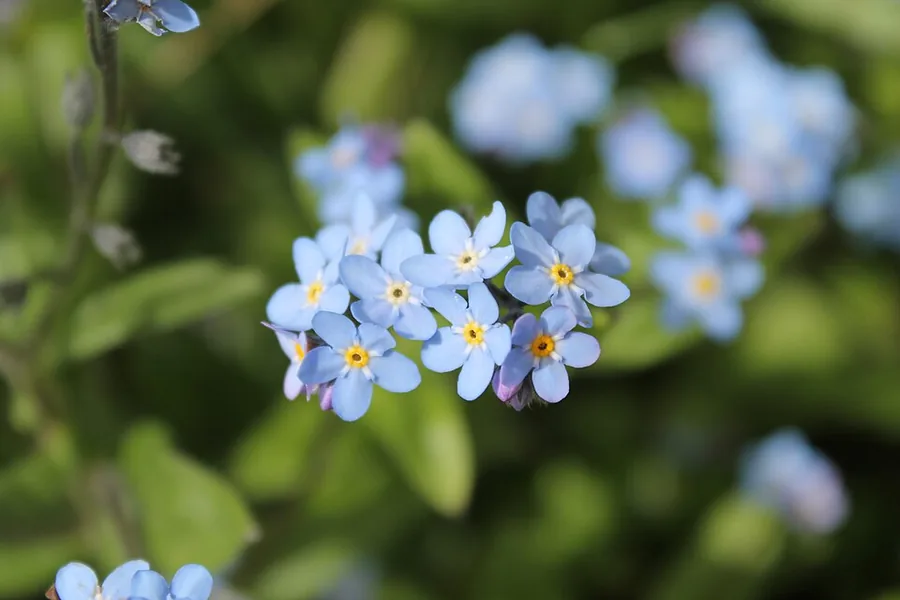
Forget-me-not is the plant behind that soft blue haze drifting around spring bulbs, the kind of detail that makes a border feel composed rather than planted. It belongs to the borage family and comes from Europe and Asia, at home in damp woodland and along streambanks. In the garden it keeps a low, easy profile, a biennial that flowers in its second spring and then leaves a new generation to take its place.
Its generosity is exactly what gives a planting that lived-in, settled look. It seeds itself freely and roots from creeping stems, so one drift becomes a patch and then a whole sweep of blue. Under tulips and daffodils that filling-in is the whole appeal, though it pays to keep it in view where it might stray past the garden's edge.
Offer it rich, steadily moist soil and a little afternoon shade where summers are hot, and it carries the season with almost no input. The blue comes in April and May, with a few flowers lingering into summer, and it weathers cold with ease, holding on through the harshest winter lows.
Care
The short version: rich, consistently moist soil, full sun to part shade with afternoon cover where summers are hot, and a light feed at planting. A pass with the shears after bloom keeps the self-seeding part of the plan, not a surprise.
Light
Forget-me-not settles happily into full sun through partial shade, and it looks its best given morning sun with shelter from the hard afternoon where summers turn hot. Push it through heat with too little cover and it loses its poise, stressed and prone to mildew.
Water
Keep the soil consistently moist and never let it bake dry, especially in the heat of the season. It even takes the occasional damp spell or shallow standing water in stride, so for a planting that always reads fresh, err toward moist rather than dry.
Soil
Give it rich, well-drained loam or clay worked with plenty of organic matter and it sits comfortably in almost any bed. A pH of 6.1 to 7.5 suits it, spanning slightly acidic to mildly alkaline, which covers most established gardens without fuss.
Temperature
This is a quietly resilient plant, at ease up to about 86°F (30°C) and able to come through winter lows near -40°F (-40°C). Heat troubles it more than cold ever will, since hot, humid stretches are what dull its look and invite disease.
Humidity
Ordinary outdoor humidity suits it and there's no figure to chase. Air movement matters far more than the reading, because damp, crowded foliage is where powdery mildew and rust take the shine off a planting.
Feeding
Forget-me-not lives lightly and asks little at the table. Fold a little balanced fertilizer or compost into rich soil at planting and leave it there, since ongoing feeding adds nothing to the display.
Pruning
A clean pass to deadhead or shear the spent flower cymes right after bloom keeps the flowers coming and the seeding within the design. Cut back any tired or mildewed foliage in the same moment to keep the planting looking its best.
Repotting
It rarely needs repotting and is most at home set straight in the ground. If a container is part of the scheme, pot it on only when roots circle or push through the drainage holes or the soil dries out far too quickly.
Size & spacing
Plants keep a modest scale, 6 to 12 inches (15 to 30 cm) tall with a spread of 6 to 10 inches (15 to 25 cm), ideal for the front edge or the gaps between bulbs. Leave each a little room so air moves and the foliage stays dry.
When to plant
Forget-me-not keeps a graceful two-year rhythm. Start seed indoors 8 to 10 weeks before the last frost for flowers the same year, or scatter it outdoors in mid-summer for bloom the following spring. The blue arrives in April and May, with a few flowers lingering on into summer to soften the change of season.
Northern hemisphere
Southern hemisphere
Typical months for a temperate climate: start earlier in warm zones, later where spring frosts linger.
- Sow: 8-10 weeks before the last spring frost for bloom the same year
- Plant: Direct sow in mid-summer for bloom the following spring, or transplant seedlings after frost
- Harvest: April to May, with sporadic intermittent bloom into mid-summer
Hardiness
USDA hardiness zones: 3–8
Temperature: down to -40°C
Troubleshooting
Forget-me-not is a forgiving guest in the border, and the occasional issue tends to surface on the foliage or in its enthusiasm to wander. Catch the early cues and the planting keeps its composure. Match what you see below, then act before the look starts to slip.
A drift of seedlings spilling past where it was wanted
Forget-me-not is a willing self-seeder, its creeping stems rooting as they travel to widen a patch. Left to itself the soft drift can overrun a bed and even slip beyond the garden. Deadhead the spent cymes before seed drops, edit out the volunteers that don't fit, and lift any rooted runners to keep the composition intact.
Fix:
- Deadhead and remove flower cymes immediately after bloom to limit seeding
- Pull unwanted volunteer seedlings
- Remove rooted creeping stems to control spread
A dusty white film dulling the leaves and stems
That powdery bloom is powdery mildew, and it settles in where plants sit crowded in still, humid air. It wipes away, but it returns until the air around them moves again. Thin or space the planting, water at the soil line, and shear back the worst of it after bloom to restore the look.
Fix:
- Improve air circulation by thinning or spacing plants
- Remove and discard severely affected foliage
- Avoid overhead watering and water at the soil line
- Shear back heavily infected plants after bloom
Orange or brown speckles marking the foliage
Raised rusty flecks across the leaves signal rust, a fungus that takes hold when foliage stays wet. Remove and discard the marked leaves as soon as they appear. Keep water off the foliage and open the planting so the leaves dry quickly after rain.
Fix:
- Remove and destroy infected leaves
- Avoid overhead watering to keep foliage dry
- Improve spacing and air movement
- Clean up plant debris at season end
Toxicity
For a home shared with pets or small children, the news is easy: true forget-me-not is not considered toxic. The NC State Extension Plant Toolbox records no poison data for it, and the ASPCA leaves it off its list. The one thing to keep clear is the name, since Chinese forget-me-not is a separate plant that does carry harmful alkaloids.
Safe for
People · Cats · Dogs · Horses · Rabbits · Livestock · Birds
Cats None
Safe for cats. A curious taste of a leaf or bloom poses no poisoning risk, though eating a large amount of any plant might bring brief drooling or a mild stomach upset.
Dogs None
Safe for dogs. Nothing in the plant is toxic enough to endanger a dog, so an occasional mouthful pulled from the border need not concern you.
Horses Safe
Safe for horses. This is the true forget-me-not, not its poisonous namesake the Chinese forget-me-not, so a horse grazing beside a drift faces no genuine hazard.
Rabbits Safe
Safe for rabbits, which can nibble the leaves with no ill effect. As with any fresh green, introduce it to their diet gradually instead of all in one go.
Livestock Safe
Safe for cattle, goats, and sheep. The species holds only trace alkaloids and isn't flagged as a poisonous pasture plant.
Birds Safe
Safe for birds. Both backyard hens and passing wild birds may peck at its seeds and leaves without any harm.
People Safe
Safe for people, with the little blue blooms occasionally scattered over a dish as an edible garnish. Keeping it away from children is unnecessary.
Generally considered safe; as with any plant, discourage pets and small children from eating large amounts of foliage or flowers.
Varieties
Almost every forget-me-not offered for the garden is a selection of this single species, sorted chiefly by the color it brings to a planting and the shape it holds. These are the ones you'll meet most often when you're choosing a palette.
Victoria Blue
A compact selection that brings rich blue and a neat, mounded shape to the front of a planting.
Victoria Rose
A pink-flowered choice that trades the familiar sky blue for a softer, rosier note.
Snowball
A white-flowered form that reads cool and clean set against darker companions.
Blue Basket
A taller blue-flowered selection that lifts its color a touch above the rest of the drift.
Ultramarine
A selection prized for the deep, dark-blue it lends a planting.
Companions
Forget-me-not earns its keep woven among spring bulbs, where its low blue haze fills the gaps and sets off taller flowers above it.
Plant near
Spring-flowering bulbs such as tulips and daffodils: Forget-me-not is recommended for interplanting with spring bulbs, where its blue flowers complement bulb displays and fill in around them.
How to propagate
Forget-me-not all but multiplies on its own, which suits a garden meant to feel unforced. When you want to direct where it goes, you can raise it from seed or lift and split a clump that has settled.
SeedEasy
Start indoors 8-10 weeks before last frost for same-year bloom, or sow outdoors in mid-summer for bloom the following spring · Several weeks to germinate and establish; biennial sowings bloom the next season
Seed is the usual route, and forget-me-not makes it an easy one. Start it indoors 8 to 10 weeks before the last frost for flowers the same year, or scatter it outdoors in mid-summer for bloom the following spring. The seedlings take a few weeks to find their feet, and once a planting settles it self-seeds freely, sometimes more generously than the scheme intended.
DivisionEasy
Spring or after flowering · A few weeks once rooted
An established clump also divides well in spring or once the flowers fade. The creeping, stolon-like stems root as they spread and form clonal offsets, so lift a rooted piece, separate it, and replant it where the drift needs filling. It settles within a few weeks and matches the parent exactly.
Myths
Any forget-me-not in the garden is a serious poison risk to household pets.
True forget-me-not, Myosotis sylvatica, isn't reported as toxic and stays off the ASPCA toxic plant list. The hazard sits with a different plant altogether, Chinese forget-me-not (Cynoglossum amabile), a separate genus whose pyrrolizidine alkaloids can harm a horse's liver with large or prolonged feeding.
Forget-me-not counts as one of North America's own native wildflowers.
Its true origin lies in Europe and Asia. North America is not its homeland at all. Myosotis sylvatica slipped out of cultivation and settled across parts of the continent, and a handful of Midwestern areas now list it as a noxious weed.