Ornamental · Boraginaceae
Lacy Phacelia
Phacelia tanacetifolia
Sow it once and a soft haze of lavender-blue settles over the garden, humming with bees all summer.
Full sun
Every 5–10 days
42–56 days
USDA 3–10
Overview
Lacy phacelia is a fast, unfussy annual from California and the western states, prized for the way its fine foliage and coiled sprays of lavender-blue bells soften the lines of a bed. It sits in the borage family rather than among the daisies, a quiet distinction that does nothing to dull its charm. Few plants this easy to grow bring so much atmosphere to a garden.
Its great appeal is the life it draws in. Honey bees, native bees, hoverflies, and parasitic wasps drift through the flowers, turning a plot into something that hums, which is why it belongs as readily in a pollinator planting as in the working rows of a cover crop. Gardeners also lean on it as a green manure, letting it scavenge loose soil nitrogen and cover bare ground while it flowers.
It suits a garden that changes with the season, blooming a few weeks after sowing and lasting only that one turn of the year. Sow it in spring or fall, give it sun and soil that drains, and stagger a few sowings to keep the color present. Left to set seed, it returns of its own accord the following year, reshaping the picture as it goes.
Care
The short version: set phacelia in full sun and well-drained soil, water only until it settles and then leave it be, sow in succession for a long, atmospheric bloom, and cut it back before it seeds.
Light
Give phacelia full sun, where it flowers most fully and draws the liveliest traffic of bees. It accepts partial sun or light shade, but the flowering thins in shadow and the plants tend to stretch and lean, a looser look than most beds want.
Water
Water young seedlings until they settle, then step back, because phacelia turns drought tolerant once established and lives on 7 to 18 inches of rain or watering a year. Let the top half of the soil dry between waterings, and never leave the planting sitting in wet ground.
Soil
It thrives in well-drained sandy, gravelly, or loamy soil and takes to the poor, dry corners that defeat more demanding plants. The pH range is generous, from 6.4 to 8.5, so most garden soil will suit it as long as the water moves through.
Temperature
Phacelia lives across a wide span, roughly 18°F to 95°F (-8°C to 35°C), and young plants weather a light frost. A hard freeze near the low end ends the foliage, which is why it earns its place as a spring or fall planting rather than a winter one.
Humidity
Ordinary outdoor air is all it asks, so there is no figure to meet. Airflow matters more than moisture, since crowded, still plantings are where aphids and rot find their way in.
Feeding
Set the fertilizer aside in all but the poorest soil. As a cover crop phacelia scavenges the nitrogen already in the ground rather than calling for more, and a heavy feed only yields soft, aphid-prone growth.
Pruning
There is no true pruning to keep up with. Deadhead the spent clusters to hold the bloom and rein in self-seeding, and where it grows as a cover crop, mow or till the whole stand at flowering before it sets seed.
Repotting
none
Size & spacing
Plants rise to 1 to 3 feet (30 to 91 cm) with a spread near 8 to 18 inches (20 to 45 cm). Sown thickly as a cover crop they close into a solid sweep and smother weeds, while a thinner sowing gives each plant space and keeps the planting airy.
When to plant
Phacelia keeps a brisk seasonal rhythm. Direct sow it in early spring once the soil can be worked, or in fall where winters stay mild, and the drift comes into flower about 6 to 8 weeks later. Stagger sowings every couple of weeks for color that carries a garden along, and expect a hard frost to draw the display to a close.
Northern hemisphere
Southern hemisphere
Typical months for a temperate climate: start earlier in warm zones, later where spring frosts linger.
- Sow: Generally direct-sown; if starting indoors, sow 4 to 6 weeks before last frost in darkness (light inhibits germination)
- Plant: Direct sow in early spring when soil is workable, or in fall in mild-winter climates; sow seed about 0.25 inch deep when soil temperatures are below 68 degrees F
- Harvest: Late spring through summer; blooms roughly 6 to 8 weeks after sowing over a long period
Hardiness
USDA hardiness zones: 3–10
Temperature: down to -40°C
Troubleshooting
Phacelia is an obliging plant, and the little that troubles it nearly always traces to wet ground or its own habit of reseeding. Set what you notice against the entries below and act early. A small matter tended now rarely grows into something that unsettles the whole planting.
Uninvited seedlings scattered through the beds
A planting left to its own devices will sow itself widely, because once the coiled seed heads dry and split they scatter a seed bank that wakes with the next rain. Keeping the look you designed comes down to timing. Mow, till, or lift the stand at peak bloom before the seed sets, and clip the spent clusters so tomorrow's borders stay yours to arrange.
Fix:
- Mow, till, or pull plants at flowering before seed matures
- Deadhead spent flower clusters before they dry and shatter
- Hand-pull or hoe volunteer seedlings while young
A wilting, yellowing stand set in wet ground
Phacelia has no patience for wet ground, and standing moisture invites root rot that softens and darkens the roots and undoes the crown at soil level. A plant that has collapsed will not rally, so lift it and turn your attention to drainage. Set the planting in sandy, gravelly, or loamy soil, and keep it clear of the low, damp corners of a garden.
Fix:
- Improve drainage and stop overwatering
- Remove and discard collapsed plants
A display that fades before the season does
The fleeting show is part of the plant's charm, not a failing. Phacelia is a short-lived annual that carries a few weeks of flower from each sowing, and its tender foliage darkens the moment a hard frost nears 18°F (-8°C). For color that stays with a garden through the season, sow a fresh drift every 2 to 4 weeks, and simply begin again once the cold has moved on.
Fix:
- Make successive (succession) sowings every 2 to 4 weeks to extend continuous bloom
- Replace winterkilled plantings with a new sowing once frost danger passes
Soft insects clustered along the stems
Those small clusters are aphids, which favor soft or stressed new growth and leave a sticky film where they gather. A firm jet of water sends them off, and a modest few are easily overlooked. It helps that phacelia keeps its own company of hoverflies, lacewings, and parasitic wasps, guests that see to the aphids and let the planting look after itself.
Fix:
- Spray off colonies with a strong jet of water
- Tolerate light infestations, as phacelia attracts predatory and parasitic beneficial insects that help control aphids
Toxicity
Phacelia is gracious company in the garden, non-toxic to pets, livestock, and people alike, with no poison in any part of the plant. The single thing to note is that its hairy foliage can leave an itchy rash on those who handle it and react, so slip on gloves before pulling or mowing a stand.
Safe for
People · Cats · Dogs · Horses · Rabbits · Livestock · Birds
Cats None
A cat is welcome in a phacelia bed. Should one nibble a leaf, there is nothing here to trouble it.
Dogs None
A dog can wander the border or taste a leaf with no cause for worry, and the plant is nowhere on poison-control lists.
Horses Safe
Horses that graze phacelia are none the worse for it, as the plant holds nothing harmful to them.
Rabbits Safe
Rabbits may browse the leaves at leisure, with no troubling compounds in the mix.
Livestock Safe
Cattle, goats, and sheep sit comfortably with phacelia, which finds its way straight into pasture cover-crop blends.
Birds Safe
Birds come to no harm here. Many drop in for the seed heads, and the plant offers no poisoning risk.
People Safe
There is nothing here to poison a person. The single caveat is the foliage, whose glandular hairs can leave an itchy rash on sensitive skin, so reach for gloves before handling or mowing a stand.
Phacelia foliage bears glandular hairs and contains skin-sensitizing compounds (geranylhydroquinone and related substances). Some people develop allergic contact dermatitis (an itchy skin rash) from handling the leaves. Wear gloves when handling or terminating the plants if you are sensitive, and supervise children who handle the foliage.
Varieties
Most seed offered as phacelia is the everyday lacy type, though a close relation appears in wildflower plantings. The two below are simply the ones worth telling apart.
Lacy phacelia (Phacelia tanacetifolia)
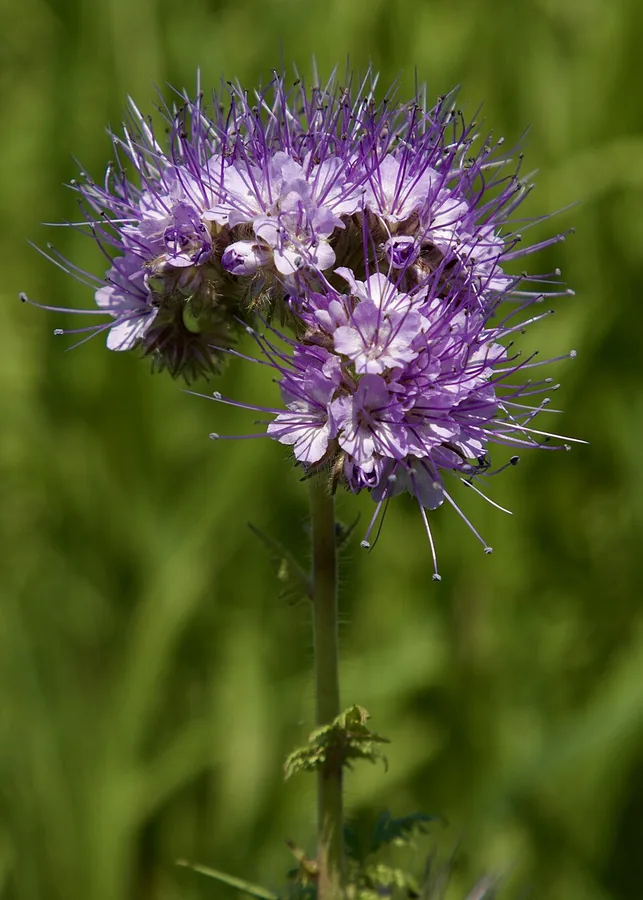
This is the familiar cover-crop and bee-garden selection, recognizable by its finely cut fern-like gray-green leaves and coiled, one-sided sprays of lavender-blue bells whose long stamens carry well beyond the petals.
California bluebell (Phacelia campanularia)
A related ornamental annual grown for its deep gentian-blue bells, it settles lower and bushier than lacy phacelia and is treasured as a desert wildflower rather than a cover crop.
How to propagate
Phacelia comes from seed and nothing else, and it obliges without fuss, whether from a packet you sow or from the seed an established drift lets fall on its own.
SeedEasy
Direct sow in early spring, or in fall in mild-winter climates; make successive sowings to extend bloom · Germinates in about 15 to 30 days; flowers roughly 6 to 8 weeks after sowing
Phacelia asks little beyond a packet of seed sown straight into the spot it will occupy. Settle the seed about a quarter inch deep once the soil cools below 68°F (20°C), since light and warmth above that point stall germination. Green appears in 15 to 30 days and flowers around 6 to 8 weeks after sowing, and an established drift will carry itself forward, reseeding freely from year to year.
Myths
Names like scorpionweed and fiddleneck mean phacelia is a dangerous garden plant.
The names sound severe, yet they only sketch the coiled, scorpion-tail turn of the flower clusters, with no warning behind them. Phacelia is one of the finest bee and beneficial-insect plants a garden can hold, and it is non-toxic to pets and people. The lone caveat is a possible skin irritation from handling the hairy foliage if you happen to be sensitive.
Phacelia fixes nitrogen like clover or vetch.
It is a natural assumption, but phacelia belongs to the borage and waterleaf family rather than the legumes, so it adds no new nitrogen to a bed. As a cover crop it instead draws up the nitrogen already present, holds it, and returns it to the soil as it breaks down.