Houseplant · Marantaceae
Peacock Plant
Goeppertia makoyana
Give it warmth, humidity, and soft water, and the peacock plant becomes one of the most striking pieces of greenery a room can hold.
Bright indirect
65–75°F · 18–24°C
USDA 11–12
12–24 in · 30–60 cm
Overview
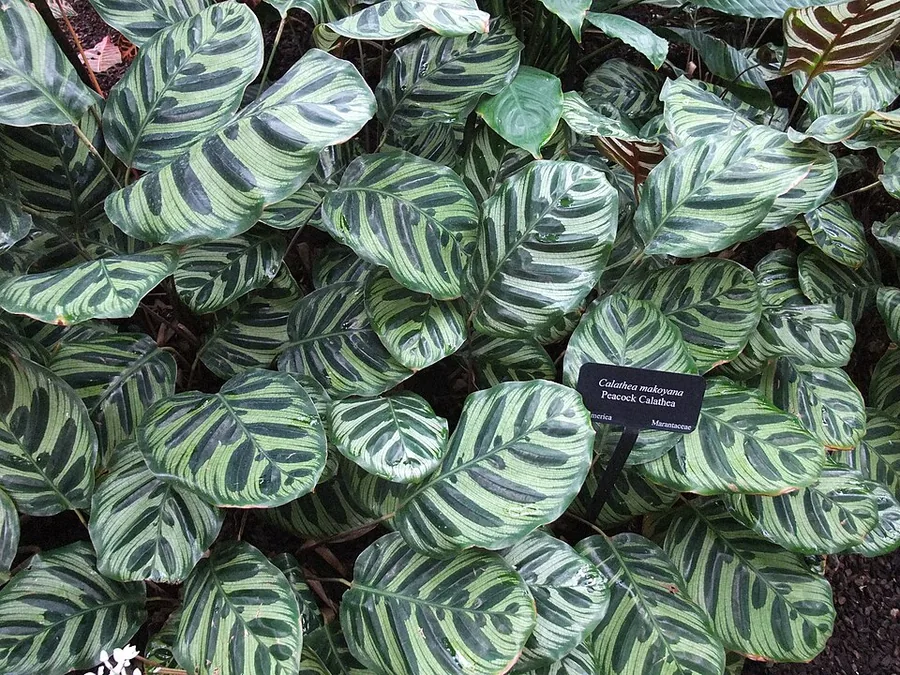
The peacock plant is the kind of greenery that gives a room a quiet focal point. Its leaves read like the eye of a peacock feather, and a single specimen turns a bare corner or an empty shelf into something worth a second look. It comes from the prayer plant family, the Marantaceae, native to the rainforest floor of eastern Brazil.
What sets the mood is the movement. The leaves rise and close in the evening and ease open again at first light, a habit called nyctinasty that gives the plant its own rhythm alongside the rhythm of your day. That tropical origin also lays down the conditions a room has to meet: warm air, steady moisture, and humidity close to what you'd feel beneath a forest canopy.
It rewards a thoughtful spot rather than a casual one. The plant is particular about water and dry air, and it will register either shortfall in brown edges within days. Suit it to the right corner, though, and few houseplants bring as much presence to a living space.
Picture it a few steps back from a softly lit window, on a bedroom dresser or a reading-room console, where it sets a calm, refined tone. Group it with other moisture-loving plants and the whole arrangement reads as deliberate, the centrepiece of a styled corner rather than an afterthought.
Care
The short version: bright indirect light, never direct sun, with soft water that keeps the soil moist but never soggy, warmth in the 65°F to 75°F (18°C to 24°C) range, and humidity at 60% or higher.
Light
Settle the plant in bright, indirect light, the kind found a few steps back from a window rather than against the glass. Part shade and even full shade suit it too, but direct sun scorches the leaves and fades the very markings that earn it a place on the shelf.
Water
Keep the soil moist but never waterlogged across spring and summer, then taper off from autumn into late winter. Reach for distilled or rain water, since the fluoride in tap water leaves the edges brown. Overdo it and root rot follows quickly.
Soil
Pot it in a well-drained, humusy mix full of organic matter, with perlite folded through to keep things airy. Stay on the acidic side of pH 8.0, and choose a pot that drains cleanly so the roots are never left sitting in water.
Temperature
Keep the room between 65°F and 75°F (18°C to 24°C). As a tropical plant it has no patience for cold drafts, so place it away from chilly windowsills and the path of an air vent.
Humidity
Humidity is the detail most people miss. The plant looks for 60% or higher, and a dry room reports back fast in crisp brown edges, so a humidifier or a pebble tray tends to pay for itself.
Feeding
Offer a balanced fertilizer monthly through the growing season, from spring into summer. Hold off completely in winter, when growth slows and the plant has no call for the extra feed.
Pruning
Little needs doing here. Clip away any damaged or browned leaves as they show, and pass a damp cloth over the broad surfaces from time to time so dust doesn't dull them or shade the light.
Repotting
Set a plan to divide and repot roughly every two years, in late spring. The job refreshes the mix and parts the rhizome in one go, which happens to be how new plants come about.
Size & spacing
It keeps a compact frame, standing about 12 to 24 inches (30 to 60 cm) tall with a spread of 8 to 12 inches (20 to 30 cm). That modest footprint slots it onto a shelf, a desk, or in among a cluster of other humidity-lovers with ease.
Troubleshooting
Nearly every issue a peacock plant runs into surfaces on the leaves, and the root cause is usually water or air rather than anything dramatic. Look to the edges and the markings, and the answer tends to reveal itself before things worsen. Find the description that fits your plant below, then correct the condition driving it.
A drooping plant in a pot that never seems to dry out
When a plant sags while the soil stays heavy and wet, thirst isn't the issue: it's root rot brought on by overwatering. Slide it from the pot, cut back the brown, soft roots, and settle it into fresh, free-draining mix. After that, water just enough to keep the soil moist and never soggy.
Fix:
- Remove from wet soil and trim rotted roots
- Repot into fresh well-drained mix
- Water only to keep soil moist, never waterlogged
Faint webbing and a dusty speckling when the air turns dry
A parched room is an open door for spider mites, which thread fine webs beneath the leaves and leave the surface peppered with pale flecks. Rinse the foliage, wipe each leaf clean, and follow with insecticidal soap or horticultural oil. A more humid corner makes the plant a far less welcoming home for them.
Fix:
- Rinse foliage and wipe leaves
- Treat with insecticidal soap or horticultural oil
- Increase humidity to discourage mites
When the leaf edges go brown and brittle in the corner you've placed it
Crisp brown rims are tip burn, the slow result of fluoride, chlorine, and salts in tap water collecting in the tissue, and a dry room only hurries it along. Move to distilled or rain water and lift the humidity to 60% or higher. Trimming the worst margins keeps the plant looking presentable, though the browning itself won't fade.
Fix:
- Switch to distilled water or rain water
- Raise ambient humidity to 60% or above
- Trim off badly browned margins for appearance
A washed-out, scorched look from sitting in too strong a light
A spot with direct sun burns the foliage and flattens the markings to a dull, even green. Set the plant back into bright indirect light or a part-shade corner, and clear away any leaves that have truly burned. Fresh growth comes in with the pattern restored.
Fix:
- Move the plant to bright indirect light or part shade
- Remove severely scorched leaves
Toxicity
Reassuring news for households with pets and children: the peacock plant is safe. The ASPCA records Calathea as non-toxic to cats, dogs, and horses, and the leaves hold no harmful compounds for other animals or for people. That leaves you free to place it on any shelf or table without second-guessing a curious nibble.
Safe for
People · Cats · Dogs · Horses · Rabbits · Livestock · Birds
Cats None
The ASPCA rates this plant non-toxic to cats, so a passing nibble poses no danger. A cat that overindulges on any houseplant may still bring up the roughage, but the leaves themselves carry nothing harmful.
Dogs None
Dogs have nothing to fear from it. The ASPCA marks the peacock plant safe for them, and the foliage holds no toxic compounds should one decide to take a bite.
Horses None
Horses can browse nearby without concern, as the ASPCA and NC State Extension both list the plant as non-toxic to them.
Rabbits None
A rabbit comes to no harm from the leaves. They aren't part of its usual menu, so an occasional nibble is fine while hay and greens stay the staple.
Livestock None
Goats, sheep, and cattle run no risk of poisoning from this Marantaceae plant. Being a tropical houseplant, it seldom comes within their reach anyway.
Birds None
The peacock plant carries no toxins to bother a pet bird, so a curious tug at the leaves does no harm.
People None
Fine to keep in a home with young children. It's grown for its leaves rather than the table, but a stray mouthful poisons no one.
How to propagate
There's a single path to more peacock plants, and it falls in step with the upkeep you're already doing. You divide the rhizome at repotting time instead of trying to root a cutting.
DivisionModerate
Late spring · Several weeks to a few months to establish new growth
To gain a second plant, you take the divide the rhizome route, which slots neatly into the repotting the plant asks for about every two years. Work in late spring, teasing the root ball into clumps that each hold a few sound shoots, then pot them and keep them warm and humid. Fresh growth needs anywhere from a few weeks to a few months to settle. Stem and leaf cuttings, for their part, refuse to root.
Myths
The flowers are the reason to keep a peacock plant on display.
Those small purple-to-white blooms are slight, and indoors they barely appear at all. The foliage is the whole performance, with markings that radiate across each leaf like the eye on a peacock feather. The leaves are what draw people to it, not any flower.
A peacock plant is a hazard around pets.
Calathea sits on the ASPCA's non-toxic list for cats, dogs, and horses, and NC State Extension records the same for Goeppertia makoyana. A home full of animals is no obstacle to keeping one in plain view.
Calathea makoyana is still the proper botanical name.
The name lingers on plant tags in every shop, yet it now stands as a synonym. Kew lists the accepted name as Goeppertia makoyana, in line with the 2012 reclassification that shifted many Calathea over to the genus Goeppertia.