Houseplant · Marantaceae
Rattlesnake Plant
Goeppertia insignis
Bold, wavy leaves that fold up at night bring quiet drama to a room once the water and humidity are right.
Partial shade
64–75°F · 18–24°C
USDA 11–12
9–30 in · 23–76 cm
Overview
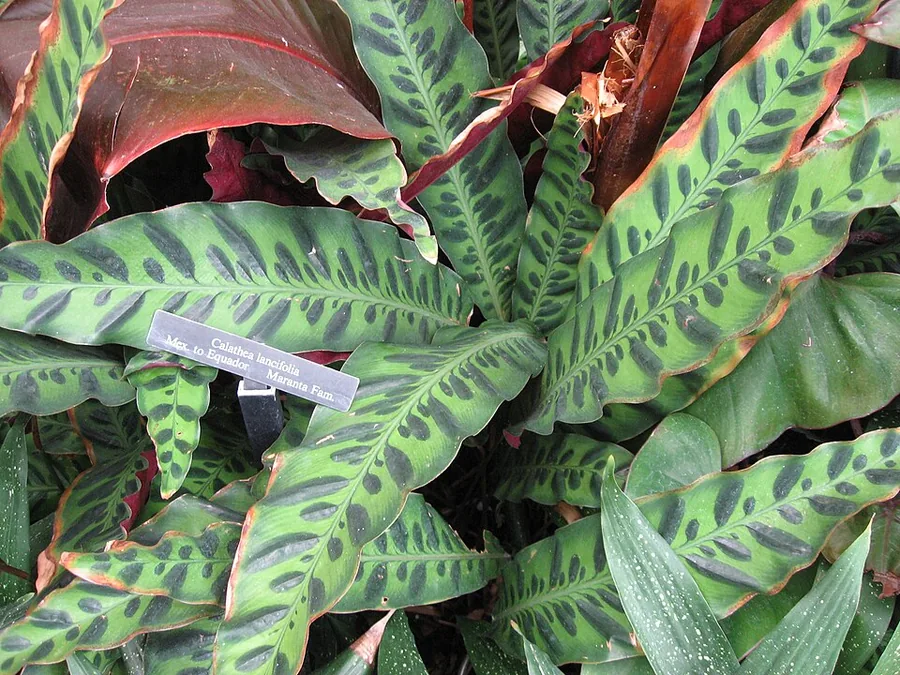
The rattlesnake plant makes its case on looks: long, wavy leaves patterned with dark green spots along a bright green blade, a graphic echo of a snake's back that reads beautifully against a plain wall. Their undersides carry a deep purple-red that catches the eye whenever a leaf lifts. Part of the prayer plant family and native to the rainforests of Brazil, it grew low beneath the canopy in warm, damp, shaded air, and that heritage shapes where it belongs at home.
Give it a spot you pass through daily and it rewards the attention. The leaves lie open and flat through the day, then fold upward at dusk and lower again by morning, a living rhythm that turns a shelf into something worth watching. Staying a composed 9 to 30 inches (23 to 76 cm) tall, it settles onto a side table, a low bookshelf, or a bathroom counter without ever crowding the room.
This is a plant that asks to be part of a routine rather than left in a corner. It favors soft water, steady moisture, and humid air, and it signals any neglect with browning along the leaf edges, so it suits an attentive household and a warm, shaded, humid spot. Meet those conditions and it fills its place quickly and fully, an easy centerpiece for a considered room.
Care
The short version: a bright, shaded position out of direct sun, evenly moist soil watered with rainwater or distilled water, a warm room, and humidity kept as high as the space allows.
Light
Set it where the light is bright but indirect, or in gentle partial shade, the kind of filtered light it knew under a rainforest canopy. It will hold up in a fairly deep-shaded corner as well, which opens up rooms a sun-lover could never fill. Keep it clear of direct sun, though, since that bleaches the markings and scorches the leaves.
Water
Keep the soil evenly moist but never soggy from April to August, then ease back through winter. The water itself matters as much as the schedule: choose rainwater or distilled water, because the fluoride in ordinary tap water accumulates and browns the leaf edges that give the plant its poise.
Soil
Plant it in a well-drained, peaty mix rich in organic matter, so the roots stay moist without standing in water. It takes a relaxed view of pH, thriving anywhere from 6.0 to 8.0, acidic through slightly alkaline, which keeps potting simple.
Temperature
It prefers the warmth of a lived-in room, between 64°F to 75°F (18°C to 24°C). Cold is not its friend, so keep it away from drafty windows and the chill of an unheated hallway.
Humidity
Humidity is where most rooms fall short for this plant. It wants high humidity, more than a typical living room offers, so a wet pebble tray, regular misting, or a naturally steamy bathroom suits it well. Let the air run dry and the edges crisp and brown, spoiling the very look you keep it for.
Feeding
Feed it monthly with a balanced fertilizer through spring and summer while it is in active growth. Pull back sharply in winter, when the plant rests and needs little.
Pruning
There is no shaping to fuss over, which keeps it low-maintenance on a busy shelf. Simply remove any dead, damaged, or browned leaves at the base to keep the display crisp.
Repotting
Move it up every 1 to 2 years in spring, or sooner if roots begin circling the pot or reaching through the drainage holes. The same moment is your chance to divide the clump and spread the plant to another corner of the home.
Size & spacing
It keeps a tidy footprint indoors, 9 to 30 inches (23 to 76 cm) tall with a 9 to 18 inches (23 to 46 cm) spread. One plant fills its container on its own, so choose a pot with a little room and let it anchor the surface it sits on.
Troubleshooting
Nearly every issue with this plant surfaces on the leaves, which is fitting, since the leaves are the whole reason to grow it, and most trouble traces to water quality, light, or dry air. Read what the foliage is telling you and the cause is usually clear. Find the symptom below, then adjust the condition behind it.
Yellowing, drooping leaves with rot at the base
Yellowing and collapse usually mean soggy soil and root rot from overwatering, though bone-dry soil can yellow the leaves as well. Check the mix and the roots: dark and mushy signals rot, while dust-dry signals the opposite. Water so the soil stays evenly moist but never wet, confirm the pot drains, and repot into fresh mix while trimming away any rotted roots.
Fix:
- Adjust watering so soil stays evenly moist but never soggy
- Ensure the pot and mix drain freely
- Repot into fresh well-drained mix and trim rotted roots if rot is present
Fine webbing and a dull, speckled surface
A dull, speckled surface and fine webbing point to spider mites, which arrive once the air turns dry. Turn the leaves over to find tiny mites and faint threads. Rinse the foliage, raise the humidity, treat with insecticidal soap or horticultural oil, and set the plant apart from the rest until it is clear.
Fix:
- Rinse foliage and raise humidity
- Treat with insecticidal soap or horticultural oil
- Isolate the plant to limit spread
Crisp brown edges dulling the leaves
Behind those spoiled margins is fluoride and salt buildup from tap water, collecting in the foliage and burning the edges while the center of each leaf holds its color. Dry indoor air deepens the effect. Move to rainwater, distilled, or filtered water, lift the humidity, and trim the worst edges to restore the look.
Fix:
- Switch to rainwater, distilled, or filtered water
- Raise humidity using a wet-pebble tray, regular misting, or a humidified room
- Trim badly browned edges for appearance only
Washed-out markings and bleached patches
Too much light is dimming the display. Direct sun drains the bold variegation and dries the leaf into brown scorch patches, a poor trade for a plant meant for the shaded forest floor. Return it to partial or full shade with bright indirect light, and offer nothing stronger than soft early-morning sun.
Fix:
- Move the plant out of direct sun to a partial- or full-shade location with bright indirect light only
- Provide diffused or early-morning sun at most
Toxicity
For a household with pets, this is a safe, non-toxic houseplant, which makes it easy to place anywhere. The ASPCA and NC State Extension both clear it for cats, dogs, and horses, and nothing in the leaves will trouble rabbits, birds, livestock, or children. It can sit at floor level in a busy home without a second thought.
Safe for
People · Cats · Dogs · Horses · Rabbits · Livestock · Birds
Cats None
Both the ASPCA and NC State Extension list it as non-toxic to cats, so a curious nibble is no cause for concern. A cat that eats a lot of any leaf may still see a mild, passing stomach upset.
Dogs None
Dogs are covered on the same two listings, with no poisonous compounds to worry about. The most a large mouthful brings is a little drool or a soft stool that clears on its own.
Horses None
The ASPCA clears it for horses as well. As an indoor tropical it rarely comes near one, and a stray taste does no harm.
Rabbits None
Nothing in the foliage is toxic to rabbits. It is best kept as a houseplant rather than forage, since a steady diet of any ornamental leaf can unsettle a rabbit's digestion.
Livestock None
With no toxins present, grazing animals face no real risk. As a tropical houseplant it almost never reaches a pasture in any case.
Birds None
Pet birds can share a room with it safely, with no poisonous parts to concern one that takes a curious peck.
People None
It is harmless to keep around children, and handling the leaves causes no irritation. It is not grown as food, so no part is meant for the plate.
How to propagate
There is a single practical way to make more of this plant, and it folds neatly into the repotting you would already schedule.
DivisionModerate
Spring, at repotting · Several weeks to a few months
This plant grows in number through division rather than cuttings, so spring repotting is the natural moment to do it. Ease the plant from its pot, part the rhizome clump into sections that each keep sound roots and a few leaves, and pot them separately to place around the home. Kept warm and humid, the new divisions settle in over several weeks to a few months.
Myths
The rattlesnake plant's real botanical name is Calathea lancifolia.
The naming has shifted. Kew's Plants of the World Online now lists Goeppertia insignis as the accepted name, with Calathea lancifolia, Calathea insignis, Goeppertia lancifolia, and Maranta insignis kept on as synonyms. Goeppertia was split away from Calathea, which is why so many plants sold as Calathea now go by Goeppertia. A pot marked Calathea holds exactly the same plant.
Like most tropical houseplants, the rattlesnake plant is toxic to pets.
It is not. Both the ASPCA and NC State Extension list Calathea and Goeppertia insignis as non-toxic to cats, dogs, and horses. That freedom lets you style it at floor level beside a curious pet without hesitation.