Shrub · Theaceae
Camellia
Camellia japonica
Give it acidic soil, dappled shade, and steady water, and the camellia brings the garden to life when little else is in flower.
Partial shade
Every 5–10 days
USDA 7–9
6–13 ft · 1.8–4 m
Overview
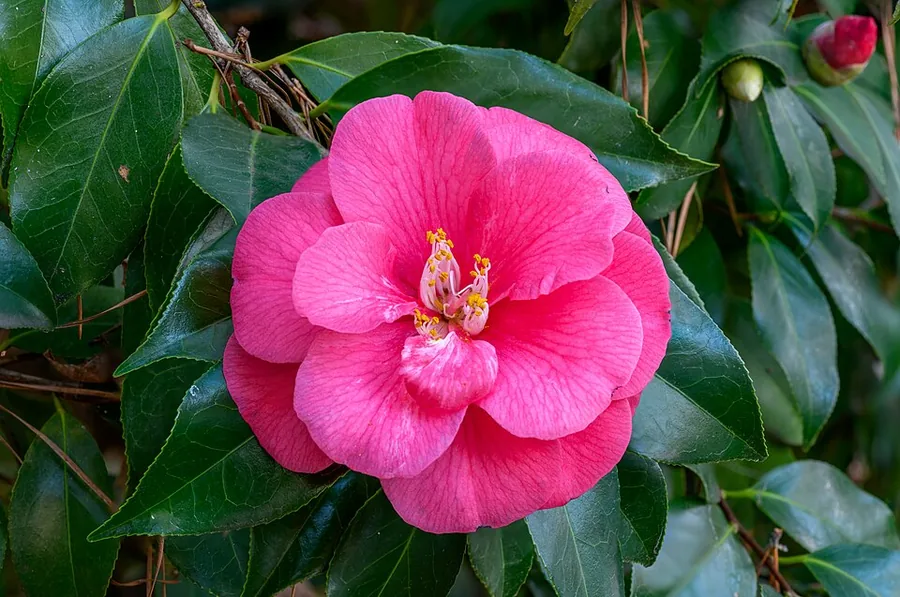
A camellia is the shrub that keeps a garden in flower at the year's quietest moment, when the borders around it have gone still. The common or Japanese camellia opens from late winter into spring, while its sasanqua cousin carries the show through fall and early winter, so a pairing of the two keeps color in view across the cold season. Even between flushes, the thick, glossy evergreen leaves hold the shape of a planting and anchor the scene.
Treat it as a slow, long-lived woody shrub that settles into the garden as a fixture rather than a passing accent. It rises to roughly 6 to 13 feet (1.8 to 4 m) over many years at an easy pace, which makes it the centerpiece you place once and build a corner around. Suited to zones 7 to 9, it wants acidic, well-drained soil and a sheltered position out of harsh sun and drying winter wind.
The pleasure of a camellia lies in how little it asks once the setting is right. Give it acidic soil, dappled light, and steady moisture, and it carries a shady corner or an entry border with quiet ease through the year. Misplace it in alkaline ground or full afternoon sun, though, and the yellowing leaves and dropped buds that follow undercut the very effect it was chosen for.
Care
The short version: set it in partial shade away from hot afternoon sun, in acidic well-drained soil rich in organic matter, keep the moisture steady through summer, feed lightly with an acid-forming fertilizer in spring, and prune as soon as the flowers fade.
Light
A camellia looks and flowers its best in partial shade, sheltered from hot afternoon sun, which makes it the natural choice for a softly lit corner. It will accept partial sun or even full shade, but a spot with morning light and afternoon cover gives the finest display and keeps the foliage unmarked.
Water
Keep the soil evenly moist but well drained, watering roughly every 5 to 10 days and a little more through summer heat. A dry spell while the buds are setting costs you the very flowers you planted it for. Skip overhead watering as well, since wet blooms invite petal blight onto the display.
Soil
Plant it in acidic, well-drained ground rich in organic matter, ideally a pH of 5.5 to 6.5. Alkaline soil locks away iron and yellows the leaves with green veins, so a camellia in the wrong bed never quite holds the presence a garden corner needs.
Temperature
The shrub takes a wide range in stride, from about 5°F to 95°F (-15°C to 35°C), across zones 7 to 9. Sharp swings or a hard freeze while buds are forming can still thin the display, so a sheltered position protects the look as much as the plant.
Humidity
Ordinary outdoor humidity suits a camellia, so there's no figure to chase. Good air movement matters more, since the still, damp pockets of a crowded planting are where petal blight and leaf gall settle in.
Feeding
Feed lightly in spring with an acid-forming azalea or camellia fertilizer, and a restrained hand keeps the planting looking its best. Overdo it and you scorch the leaf edges and trigger leaf drop, undoing the lush effect you were after.
Pruning
Prune right after flowering, saving any harder cutting for the window from mid-February through May 1, when reshaping won't cost next season's bloom. Take out dead or weak stems whenever you notice them, and clear infected and fallen blossoms to keep both the planting and petal blight in check.
Repotting
A camellia grows slowly and lives long, so a container specimen on a terrace needs repotting only every 2 to 3 years or once it's clearly rootbound. Move it into an acidic, well-drained mix, watching for roots circling the pot or water running straight through as your signal.
Size & spacing
Plan for a mature shrub to reach 6 to 13 feet (1.8 to 4 m) tall and 5 to 10 feet (1.5 to 3 m) wide over time, and give it that room from the start. The space keeps air moving through the branches and lets the plant hold its shape as the anchor of a border.
When to plant
A camellia is a slow-growing evergreen you place once and live with for decades, so it rewards a thoughtful spot. Plant in spring or fall into a sheltered, partly shaded position, and look for japonicas to flower from late winter into spring and sasanquas from fall into early winter.
Northern hemisphere
Southern hemisphere
Typical months for a temperate climate: start earlier in warm zones, later where spring frosts linger.
- Plant: Spring or fall in a sheltered, partially shaded site protected from hot afternoon sun and cold drying winter wind.
- Harvest: Camellia japonica blooms late winter to spring (about February-April); Camellia sasanqua blooms fall to early winter.
Hardiness
USDA hardiness zones: 7–9
Temperature: down to -18°C
Troubleshooting
Most of what troubles a camellia lands on the flowers and leaves, and the fungal kinds travel through the debris that gathers beneath it. Match what you see below, then keep the ground tidy before anything takes hold. A little sanitation does as much for the planting as any spray.
Blossoms discoloring inward, veins turning dark
When the season's flowers brown from the middle outward and the veins darken into a netted pattern, petal blight has arrived, a fungus that spoils the very display the shrub was planted for. Cold can mimic it, but cold begins at the petal edges, so the starting point tells the story. Keep the planting looking its best by removing and destroying every infected and fallen bloom, since the spores linger in the soil for years and carry far.
Fix:
- Hand-remove and destroy infected blooms and fallen blossoms promptly
- Rake up and remove fallen petals and debris under the plant
- Replace surface mulch with fresh pathogen-free organic mulch
- Apply a labeled fungicide during bloom as supplementary control
Yellow-mottled leaves hiding scale beneath
A yellow-mottled hedge that should be reading as lush green often hides tea scale, a sap-feeding insect crusting the leaf undersides in brown and white while the upper surface fades. Left to its own devices it dims the flowers and thins the foliage that gives a border its presence. Restore the look by coating the undersides with horticultural oil, turning to a systemic insecticide when an infestation takes hold.
Fix:
- Apply horticultural oil to thoroughly coat leaf undersides, repeating as needed
- Use insecticidal soap during crawler emergence
- Apply a systemic soil insecticide such as dinotefuran in early spring or fall for heavy infestations
- Prune out and destroy heavily infested branches
Buds falling before the blooms ever open
Few disappointments rival a shrub set with buds that fall before the show begins, and the usual reason is uneven moisture, most often a plant left dry through summer while the buds were forming. Temperature swings, freezes, poor drainage, and a nutrient shortfall can join in. Protect the display by watering steadily through the heat, placing the shrub where afternoon shade tempers the day, and choosing cultivars timed to your local frost.
Fix:
- Provide consistent soil moisture, especially during summer bud development
- Improve drainage and relocate plants from extreme exposures
- Correct nutrient imbalances based on a soil test
- Choose cultivars suited to the local frost timing
A dulling black film over the foliage
A dulling black film over a once-glossy hedge is sooty mold, and it settles on the sticky honeydew that scale and aphids leave behind rather than on the plant itself. It lifts away with a cloth and never feeds on the foliage. Address the insects producing the honeydew and the film has nothing left to settle on, and the shine returns.
Fix:
- Control the underlying scale or aphid population producing honeydew
- Wash foliage to remove mold once the insect source is controlled
Bloated pale spring growth that later browns
Spring flushes that arrive thick, fleshy, and oddly pale among the season's fresh growth signal leaf gall, a fungus partial to the sasanqua types. Underneath the swollen growth, a whitish bloom of spores appears before the galls harden and brown into eyesores. Keeping the planting tidy is as simple as snapping them off and destroying them before that spore layer forms.
Fix:
- Remove and destroy young galls before they produce spores
- Apply a labeled fungicide from budbreak through June at 7-14 day intervals for partial protection
Toxicity
For a home with pets, the ornamental camellia is safe. The ASPCA lists the common camellia as non-toxic to cats, dogs, and horses, and it holds nothing that would poison other animals or people. Like any garden plant it isn't meant to be eaten in quantity, but a stray nibble is no cause for concern.
Safe for
People · Cats · Dogs · Horses · Rabbits · Livestock · Birds
Cats None
A camellia earns its place in a household with cats, since the ASPCA lists the common camellia as non-toxic and a curious nibble won't poison one. The most a cat that overindulges on any leaf might face is a passing stomach upset.
Dogs None
The shrub sits comfortably in a home with dogs, which can wander past and even mouth the foliage without risk of poisoning. A large helping at most brings mild, short-lived tummy trouble.
Horses None
Set along a paddock fence, the plant is non-toxic to horses, so a grazed leaf is no cause for concern. No special handling is called for around the stable.
Rabbits None
A camellia poses no toxic hazard to rabbits sharing the garden. Rich foliage in quantity can unsettle any small animal's digestion, so it is best left as the occasional nibble rather than a meal.
Livestock None
Cattle, goats, and sheep face no known poisoning risk from a camellia growing nearby. As an ornamental it isn't grown for grazing, so it is kept out of their feed all the same.
Birds None
A flowering camellia and the birds that visit it coexist without concern. Nothing in the plant would harm them through a peck at a leaf or a petal.
People None
Grown for its flowers rather than the table, the shrub presents no poisoning danger to the household. There is no need to keep children at a distance beyond the everyday rule against chewing on garden plants.
No special toxicity handling is needed; as with any plant, discourage pets and children from chewing ornamental foliage to avoid mild stomach upset.
Varieties
Camellias divide first into two species with distinct bloom seasons, then into named cultivars chosen for the form and color of their flowers. These are the ones worth knowing as you plan a planting.
Camellia japonica
The common or Japanese camellia is the slow, stately choice, carrying large glossy leaves and showy late-winter to spring blooms that ask for shelter from hot afternoon sun.
Camellia sasanqua
A quicker, more relaxed grower with smaller leaves and flowers, the sasanqua blooms from fall into early winter and takes more sun than the japonica.
Kramer's Supreme
A japonica cultivar that brings large, fragrant, red peony-form blooms to a sheltered border.
White by the Gate
A japonica cultivar prized for the quiet elegance of its formal double white flowers.
How to propagate
A camellia can be increased in several ways, each of them unhurried. The method that suits you depends on whether you want an exact copy of a cultivar for the garden or you're working with rootstock or breeding.
Stem cuttingsModerate
Take semi-hardwood cuttings of current-season growth in summer. · Several weeks to a few months to root; slow to establish overall.
To raise more plants for the garden, take semi-hardwood cuttings of this season's growth in summer and settle them into a well-drained acidic medium, with rooting hormone to improve the odds. Expect several weeks to a few months before they root, and a slow, unhurried settling-in even after that.
LayeringEasy
Spring through summer. · Several months to over a year for a layered branch to root.
The most forgiving approach is to wound a low branch, pin it into acidic soil, and let it root while it stays joined to the parent. Carried out anytime from spring through summer, it takes several months to over a year for that branch to root.
Air layeringModerate
Spring to summer on healthy stems. · Several months for roots to form before severing.
Air-layering suits the taller stems that won't bend to the ground, rooting them in place while they remain joined to the parent. Work on healthy stems in spring or summer, allowing several months for roots to form before the new plant is parted from it.
GraftingDemanding
Late winter to early spring. · Several months to establish a successful graft union.
Grafting is the specialist's route, joining a prized cultivar to vigorous rootstock. Undertaken in late winter to early spring, it asks for several months before the graft union takes.
SeedModerate
Sow fresh seed in fall after harvest. · Slow; seedlings do not come true to the parent cultivar.
Sow fresh seed in fall as it ripens, bearing in mind that seedlings won't match the parent cultivar. The path is slow and suits breeding or rootstock work more than reproducing a named variety for the border.
Myths
The camellia gracing a border is the same one that fills the teapot.
The garden camellia and the tea plant are two different species, the latter being Camellia sinensis. The shrubs grown for their place in a border are Camellia japonica and Camellia sasanqua, valued for their flowers rather than for any cup.
A camellia is dangerous to household cats and dogs.
Reassuring for any pet-friendly home, the ASPCA lists the common camellia (Camellia japonica) as non-toxic to cats, dogs, and horses. A pet that chews a leaf is in no danger of poisoning, though a large mouthful of any foliage may bring a brief stomach upset.