Tree · Anacardiaceae
Cashew
Anacardium occidentale
A tropical tree that gives two harvests in one, the cashew apple and the nut, as long as its roots stay warm, sunny, and well drained.
Full sun
Every 7–14 days
USDA 10–13
20–39 ft · 6–12 m
Overview
The cashew is a fast-growing tropical tree, a relative of both poison ivy and the mango, native to the warm lowlands of Brazil and now a fixture across the frost-free tropics. It wants real heat and refuses the cold, holding only in the warmest zones that frost never touches. Given a generous corner of the grounds, it opens into a broad, sheltering tree that can rise past 40 feet (12 m), with a canopy spreading just as wide. On a property it reads as a true shade tree, an anchor for any warm-climate garden.
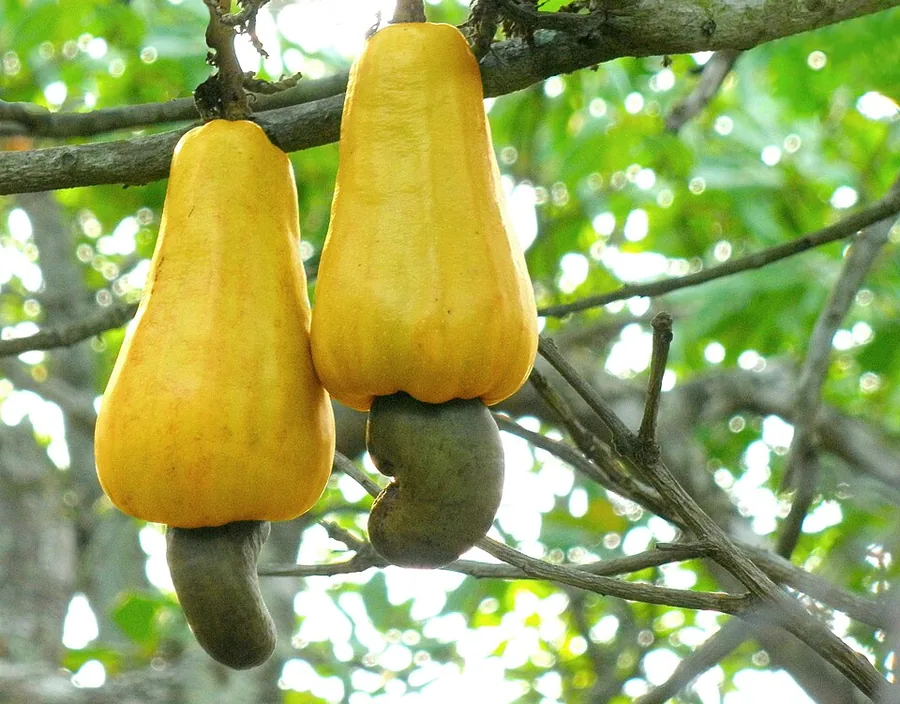
There is a quiet drama to what the branches carry. The fleshy red or yellow piece that catches the eye is the cashew apple, a swollen stalk rather than the true fruit, while the kidney-shaped nut hangs below it on the outside. The nut is the reward, though its shell holds a caustic oil that must be cooked away before the kernel can come to the table.
For all its scale, the cashew settles into a property with ease. It thrives in poor, sandy ground where more demanding trees would falter, and once the early years are behind it, dry spells pass without complaint. Wet feet are its one refusal, so a fast-draining site matters far more than rich soil from the day it goes in. Picture it presiding over an orchard corner, a courtyard edge, or a sunny stretch of lawn.
Care
The short version: give it full sun and deep, sandy, fast-draining ground. Water steadily only while it is young, keep it warm and frost-free, and ease off the watering once it matures. Above all, never let the roots sit in soggy soil.
Light
A cashew belongs in full sun and gives little in shade, so reserve an open, bright position with clear sky overhead. That generous light is what keeps the flowers, and in turn the nuts, in steady supply. An unshaded spot also lets the tree become the centerpiece a planting wants.
Water
Water a young tree often as it establishes, then ease back, since a mature cashew is highly drought tolerant and resents soggy ground. Let the top half of the soil dry between waterings, roughly every 7 to 14 days, and favor restraint over excess. The grown tree rewards a hands-off routine.
Soil
Give it deep, well-drained sandy or sandy-loam soil, even the poor, low-fertility ground that frustrates other trees. A pH of 5.0 to 6.5 suits it, and quick drainage counts for far more than richness. This is a tree that makes the most of a difficult corner.
Temperature
A tree of true tropical temperament, it is content from 50°F to 104°F (10°C to 40°C) and lost to frost. Reserve it for tropical or frost-free subtropical settings where cold never takes hold, and let it set the warm-climate mood of a garden.
Humidity
Cashews favor air on the humid side, around 50% to 80%, in keeping with the tropics that shaped them. Even so, an open canopy that lets the leaves dry keeps disease at bay and the tree looking its best in the landscape.
Feeding
Through the warm growing season, offer a balanced NPK of nitrogen, phosphorus, and potassium, with zinc added where the soil falls short. A single seasonal feeding is ample for so undemanding a tree, which keeps the upkeep light.
Pruning
Train a young tree to a single strong leader, then take out the dead, diseased, crossing, and low limbs. An open canopy moves air through the crown, the surest guard against the fungal troubles cashews face, and it gives the tree a clean, sculptural line in the garden.
Repotting
A field-grown cashew is a permanent fixture of the grounds, while a container specimen wants a larger pot every 2 to 3 years. Roots circling the pot, water slipping straight through, or stalled growth all signal it has outgrown its place.
Size & spacing
A common cashew matures into a broad tree of 20 to 40 feet (6 to 12 m) tall and nearly as wide, so plan its place with room to spare. Set it well clear of buildings, paths, and power lines, as the canopy can reach 33 feet (10 m) across and define the whole corner it occupies.
When to plant
The cashew keeps to the rhythm of the tropics rather than a temperate calendar. Start the nuts in nursery bags a couple of months ahead, settle the young trees outdoors once the soil is warm and the frost has passed, and look for flowers in the dry season with nuts and apples following a few months later.
Northern hemisphere
Southern hemisphere
Typical months for a temperate climate: start earlier in warm zones, later where spring frosts linger.
- Sow: Seeds sown in nursery bags 2 to 3 months before transplanting in warm climates
- Plant: After all frost danger when soil is warm; tropical and frost-free subtropical regions only
- Harvest: Flowers in dry season; nuts and cashew apples harvested several months later, typically late dry season
Hardiness
USDA hardiness zones: 10–13
Temperature: down to -1°C
Troubleshooting
Most cashew trouble settles on the new growth, the flowers, or the roots, and damp conditions are usually behind it. Caught early, a fungicide or better drainage turns the corner. Match the symptom below, then act before it travels through the canopy.
Black, sunken spots on leaves and shoots with dying twigs
Those dark, sunken marks signal anthracnose, a fungus that arrives when warm weather stays wet and the fresh growth and flower clusters linger damp for hours. Prune away and destroy the infected shoots, open the canopy so air moves freely, and turn to a labeled fungicide as the tree flushes and flowers. Generous spacing and keeping water off the foliage head off most of it before it begins.
Fix:
- Prune and destroy infected shoots
- Improve canopy air circulation
- Apply a labeled fungicide during susceptible flushing and flowering
Wilting and scorched leaves in wet, soggy soil
A cashew that wilts and barely sets fruit in heavy, waterlogged ground is troubled by root rot, not drought. The roots discolor and the decline follows hard on heavy watering or standing water. Improve the drainage, ease the watering, and on heavy soils raise the tree on a mound. A mature cashew weathers dry stretches with grace, so the genuine hazard is keeping the roots too wet.
Fix:
- Improve drainage
- Reduce irrigation
- Plant on mounds in heavy soils
Grayish-white powder on flowers and tender new nuts
A pale, dusty film across the flower clusters and young nuts marks powdery mildew, which favors soft new growth through cool, dry flowering spells. Left unchecked it sheds flowers and small nuts and thins the harvest. Dust with sulfur or a labeled fungicide at bloom, remove the worst clusters, and keep the canopy open so it finds little purchase.
Fix:
- Apply sulfur or a labeled fungicide at flowering
- Remove badly affected panicles
Toxicity
The roasted, shelled cashew is a familiar pleasure at the table, yet the raw nut is anything but. Its shell and the thin layer wrapping the kernel hold a caustic oil called CNSL, rich in the same urushiol behind poison ivy, and it burns skin and mouth on contact. Keep raw shells, husks, sap, and prunings well clear of children and pets, and handle them only with gloves.
Toxic to
Cats · Dogs · Horses · Rabbits · Livestock · Birds
Safe for
People
Cats Caution
The rich, fatty kernel can prompt drooling, vomiting, and loose stools, and a cat that licks or bites a raw shell may burn its mouth on the caustic oil. Keep both safely out of reach.
Dogs Caution
A few pilfered nuts usually bring vomiting and diarrhea, and a larger share of the fatty kernel can set off painful pancreatitis. A chewed raw shell adds urushiol burns to the mouth and skin.
Horses Caution
Horses have no place near raw shells, sap, or prunings, where the urushiol that scars human skin can blister the lips and mouth. Keep fallen shells and trimmings cleared from any paddock.
Rabbits Caution
The caustic shell oil and the dense, fatty nut are both unkind to a rabbit's gut. Offer neither, and watch for soft stools or a flagging appetite should one reach dropped shells.
Livestock Caution
Cattle, goats, and sheep can burn their mouths on the raw shell liquid and upset their stomachs on the oily kernels. Fence stock away from the tree and clear shell waste once harvest is done.
Birds Caution
Backyard birds should never receive raw shells or husks, as the irritant oil burns soft tissue. A crumb of plain roasted kernel now and then does no harm, though the fat brings them little good.
People Roasted nuts safe
Properly roasted and shelled cashews are a wholesome treat and safe to enjoy. The raw nut and its shell are another story, for the urushiol they carry is the same irritant as poison ivy and burns skin and mouth, which is why no one should handle or eat them unprocessed.
Wear gloves when handling raw shells, husks or sap; never let people or pets contact or chew unprocessed nuts. Roasting in the open can release irritant fumes.
Helpline numbers

United States
ASPCA Animal Poison Control: (888) 426-4435 (fee applies)

United Kingdom
Animal PoisonLine: 01202 509000 (fee applies)

Australia
Animal Poisons Helpline: 1300 869 738
Varieties
Cashews are grouped mainly by size and by how soon they begin to bear, and these two broad types cover most of what a grower is likely to plant.
Common (medium/tall) cashew
The common medium to tall cashew is the traditional plantation tree, a broad, spreading presence that rises to 12 m or more and is in no hurry to begin bearing.
Dwarf precocious cashew (e.g. anao precoce types)
Dwarf precocious cashews, among them the anao precoce types, are compact selections that flower and fruit within a few years and stay small enough to set close together and gather with ease.
How to propagate
A cashew can be raised from a fresh nut or cloned from a tree worth keeping, and the route you choose sets how soon it fruits and how closely it follows its parent.
SeedEasy
Sow fresh viable nuts in the warm season · Germinates in 2 to 3 weeks; bears in about 3 years
Seed. Sow fresh, viable nuts in the warm season, keeping those that sink in water, and the seedlings break ground in 2 to 3 weeks. Set them directly in the ground or in bags, for the long taproot resists transplanting once it forms. Seedlings differ from one to the next, and a tree raised this way takes about 3 years to come into bearing.
GraftingModerate
Onto vigorous seedling rootstock in warm conditions · Bears in roughly 2 to 3 years
Grafting. Grafting a chosen clone onto vigorous seedling rootstock in warm weather yields uniform trees that crop sooner. A softwood, cleft, or veneer graft is the customary approach, and the resulting tree bears in roughly 2 to 3 years.
Air layeringModerate
Warm humid growing season · Several weeks to root before severing
Air-layering. Air-layering through the warm, humid growing season produces a clone of the parent tree. The wrapped stem needs several weeks to root before it is cut free, and the method sees far less use than grafting at commercial scale.
Myths
The cashews sold as raw are truly raw, and any nut taken from the tree is fine to eat.
The cashews sold as raw have in fact been steamed or heat-treated and shelled long before they reach the shelf. A nut taken straight from the tree still carries caustic shell oil, the urushiol and anacardic acid that burn skin and mouth. No cashew is safe to eat or handle until it has been roasted and processed.
The fleshy red or yellow cashew apple is the fruit, with the nut sitting inside it.
The plump, juicy cashew apple is not the true fruit but a swollen stalk, an accessory fruit the tree forms below the flower. The real fruit is the kidney-shaped nut that hangs outside and below the apple, never tucked within it.