Shrub · Hydrangeaceae
Climbing Hydrangea
Hydrangea anomala subsp. petiolaris
A patient choice that turns a plain shaded wall into a curtain of fragrant white lacecaps.
Partial shade
Every 5–10 days
USDA 4–8
30–60 ft · 9.1–18.3 m
Overview
Few plants transform a difficult corner the way climbing hydrangea does. This deciduous woody vine scales brick, stone, and tree bark on its own, so a bare north wall or a tired fence becomes a living backdrop without trellising or fuss. Its home is the woodland of Japan and Korea, and it brings that quiet, shaded sensibility into the garden, settling happily into part shade or full shade. Given the years, it stretches 30 to 60 feet (9 to 18 m), softening an entire facade in green.
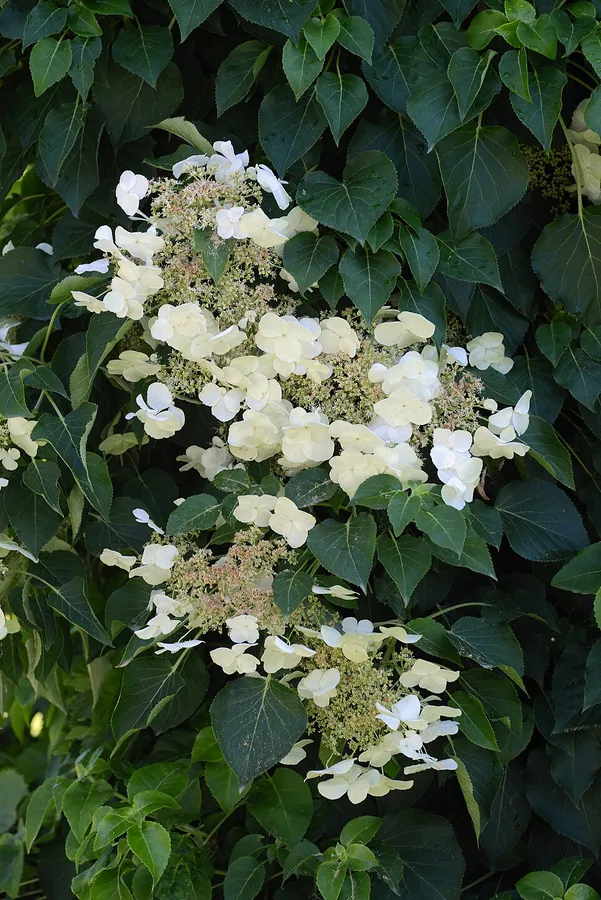
Then comes the moment it earns its place. Through late spring to early summer the vine carries flat, fragrant white lacecap clusters that lend a cottage-garden ease to even a formal setting, perfect for a shaded seating nook or an entry you pass each morning. When autumn strips the leaves, the peeling cinnamon bark keeps the wall worth looking at all winter.
This is a vine for the long view, the kind you plant with the house rather than for the season. Early on it asks for restraint while it settles in, repaying you later with presence that grows year over year. Choose it where permanence suits the space, give it good soil and steady moisture, and let it become part of the architecture.
Care
The short version: set it against a shaded masonry wall or a freestanding support in rich, evenly moist soil, and plan it as a long-term feature that grows into the space over several patient years.
Light
Part shade is where it looks its best. It accepts full shade and will grow in full sun, though sun only suits it where the soil stays reliably moist, and deep shade trades flowers for foliage. A north- or east-facing wall with a little light reads as ideal, which makes it a rare answer for the shaded sides of a house.
Water
Keep the soil consistently moist but never waterlogged, since standing water is the one thing it will not forgive. Water deeply through dry spells, around every 5 to 10 days as the weather dictates, and stay attentive while it settles in. A wall in sun simply asks for more.
Soil
Give it rich, humus-heavy loam with good drainage, the woodland soil it came from. It is easy about acidity across a pH from 5.5 to 7.5, so the feel and moisture of the soil matter far more than any reading when you are siting it for the long term.
Temperature
This is a hardy companion for cold gardens, at ease through USDA zones 4 to 8 and unbothered by winters near -29°F (-34°C). At the warm end, around 86°F (30°C), it simply appreciates moist soil and a shaded aspect to stay composed.
Humidity
Ordinary outdoor humidity suits it, so there is nothing to manage. Airflow is the quiet essential, because still, humid air around crowded leaves is what invites powdery mildew and leaf spot to mar the display.
Feeding
It is not a hungry plant, which keeps maintenance light. Work a balanced or slow-release granular fertilizer into the soil around the base in spring and leave it there, since heavy nitrogen feeds soft growth and aphids rather than the flowers you planted it for.
Pruning
Keep pruning restrained, both for looks and for bloom. It flowers on old wood, so cut only in late winter or just after flowering, and only to shape, to control size, or to remove dead, damaged, or stray stems. A heavy hand costs you next year's flowers.
Repotting
It rarely lives in a container and almost never needs repotting, which suits its role as a permanent feature. Should a potted plant show roots circling the base, water draining straight through, or stalled growth, move it up a size or into the ground, where it belongs in the design.
Size & spacing
Scale your expectations to a major feature. It climbs 30 to 60 feet (9 to 18 m) tall and spreads 5 to 6 feet (152 to 183 cm) wide, so give it a strong support and the room to dress a wall fully over time.
When to plant
Plan the planting as you would any lasting feature. Settle it into its spot in spring or early fall, while the soil stays cool and moist, and look ahead to its signature display from late spring into early summer, once the vine has truly made itself at home.
Northern hemisphere
Southern hemisphere
Typical months for a temperate climate: start earlier in warm zones, later where spring frosts linger.
- Plant: Spring or early fall
- Harvest: Late spring to early summer (May to July)
Hardiness
USDA hardiness zones: 4–8
Temperature: down to -34°C
Troubleshooting
Most of what goes sideways with climbing hydrangea comes down to placement and patience, not pests. Slow early years are simply part of its character, while the genuine missteps are about where and on what you let it climb. Read the cues below before reaching for any treatment.
Clinging rootlets marking siding, paint, or mortar
The vine holds on with self-clinging aerial rootlets that work into cracks, loose joints, and the gaps behind trim. On wood or stucco those holdfasts pull material away and spoil paint, and a mature vine grows heavy against its support. Reserve it for brick, stone, or a freestanding arbor, and set any trellis 4 to 6 inches off the wall so air moves and the vine stays manageable.
Fix:
- Keep the vine off wood-sided houses; grow it on brick, stone, or sturdy masonry, or on a freestanding arbor, trellis, fence, or large tree
- Mount a trellis 4-6 inches off the wall to allow air circulation and easier removal
- Prune regularly to limit weight and keep growth away from gutters, windows, and trim
Quiet, flowerless first years
Read the slow start as normal establishment, not a fault in the planting. Climbing hydrangea sleeps, then creeps, then leaps, laying down a deep root system before it offers length or bloom. Allow it 2 to 5 years, keep the soil moist and mulched, and resist heavy pruning that strips the old-wood flower buds you are waiting on.
Fix:
- Be patient; allow 2-5 years to establish before expecting vigorous growth and bloom
- Keep soil consistently moist and mulched while establishing
- Site in part shade with at least some light to encourage flowering
- Avoid heavy pruning that removes old-wood flower buds
Marked leaves or a soft white film
Two fungi can dull the foliage. Cercospora leaf spot leaves tan centers ringed in purple, while powdery mildew veils the surface in white when the air turns humid and still. Clear away affected and fallen leaves, water at the base early in the day, and open the plant up so the foliage dries quickly and stays presentable.
Fix:
- Remove and dispose of affected and fallen leaves
- Improve air circulation and avoid wetting foliage; use drip irrigation or water early in the day
- Apply a labeled fungicide (such as horticultural oil for powdery mildew) per directions if needed
Sticky leaves, gathered insects, or fixed stem bumps
Soft new growth draws aphids, which cluster at the tips and leave a sticky honeydew behind. The fixed, immovable bumps on stems and leaf undersides are scale insects such as cottony camellia scale. Rinse aphids off with a strong jet of water or use insecticidal soap, treat scale with horticultural oil, and ease off the nitrogen feed that pushes the tender growth they favor.
Fix:
- Knock aphids off with a strong water spray or treat with insecticidal soap or horticultural oil
- Treat scale with horticultural oil, following label directions
- Encourage natural predators and avoid over-fertilizing with nitrogen
Toxicity
For all its grace, treat the whole plant as off-limits to mouths. The leaves, buds, and flowers hold cyanogenic glycosides, which can release cyanide when chewed and unsettle the stomach in pets and people. Serious poisoning is rare because it takes a large amount, but no part of this plant belongs on a plate, so keep pets, grazing animals, and small children from sampling it.
Toxic to
Cats · Dogs · Horses · Rabbits · Livestock · Birds · People
Cats Mild
A cat that chews the leaves or flowers usually ends up with vomiting, diarrhea, and a dull, lethargic mood. Serious cyanide poisoning is rare, since it takes a lot of plant to cause it, but the upset stomach alone is reason enough to keep them off it.
Dogs Mild
Dogs react much the same way, with vomiting, loose stools, and low energy after a mouthful of foliage or blooms. The risk climbs with the amount eaten, so a single nibble is far less worrying than a chewed-up branch.
Horses Mild
The ASPCA lists vomiting, depression, and diarrhea in horses that browse the plant. Most cases stay mild, though a horse stripping a large vine is another matter.
Rabbits Caution
The same cyanogenic glycosides sit in every leaf, bud, and flower, so this is not safe browse for a rabbit. Keep it out of reach and out of the hutch.
Livestock Caution
Grazing animals can take in the cyanide-releasing compounds if they eat the foliage, which is most likely when better forage runs short. Fence it off from cattle, goats, and sheep to be safe.
Birds Caution
There is no record of birds eating it, but the toxin is present throughout the plant, so treat it as unsafe and keep pet birds away from the leaves and flowers.
People Caution
No part of this plant is food. The leaves, buds, and flowers all carry cyanogenic glycosides, so keep small children from chewing on them, even though a serious dose would take a large amount.
Keep pets and small children from chewing leaves and flowers; no special skin-handling precautions are typically needed.
Helpline numbers

United States
ASPCA Animal Poison Control: (888) 426-4435 (fee applies)
Poison Control: (800) 222-1222



Canada
Poison Centres: 1-844-764-7669
Varieties
The species carries most gardens beautifully, yet a handful of named selections deserve attention when you want variegated foliage or a more generous show of bloom.
Firefly
Firefly is the variegated choice, its leaves edged in bright yellow that gives a shaded wall color long before the flowers appear.
Miranda
Miranda is a second variegated form, with leaves rimmed in soft lime-green that lightens a dim corner.
Skylands Giant
Skylands Giant is grown for the noticeably larger flower clusters it brings once the vine has settled into its spot.
Japanese hydrangea vine (Schizophragma hydrangeoides)
Japanese hydrangea vine (Schizophragma hydrangeoides) is not a true hydrangea but a close clinging relative, just as slow to establish, sometimes taking up to 7 years to bloom, and crowned with showy lacecap-style flowers.
How to propagate
There are a few ways to bring on more climbing hydrangea, and each asks the same patience the plant always does. Layering is the most dependable, while seed is by far the longest game.
Stem cuttingsModerate
Early to mid summer (softwood or semi-hardwood) · Several weeks to root; multiple years to establish and bloom
Take softwood or semi-hardwood cuttings from this season's growth in early to mid summer, then keep them moist and humid until they root over several weeks. The same patience the plant always asks applies here too, since a rooted cutting still needs years to settle in and flower.
LayeringEasy
Spring or summer · One or more seasons to root before separating
Layering in spring or summer is the surest path. Pin a low, flexible stem onto moist soil and it roots readily where it meets the ground, though a season or more passes before the rooted section is ready to separate.
SeedModerate
Fall or spring · Slow; seedlings take years to reach flowering size
Seed sown in fall or spring is possible but the slow road. Seedlings develop at a crawl and take years to reach flowering size, which is why most gardeners turn to cuttings or layering.
Myths
Climbing hydrangea quickly clothes a wall or fence.
In truth it is among the slowest vines to begin, adding little over the first 2 to 3 years while it roots in. The old phrase, sleep, creep, then leap, sums up its arc, and real cover arrives only after that final stage. Choose it for a place where you can wait a few seasons, not where you need an instant screen.