Tree · Lythraceae
Crepe Myrtle
Lagerstroemia indica
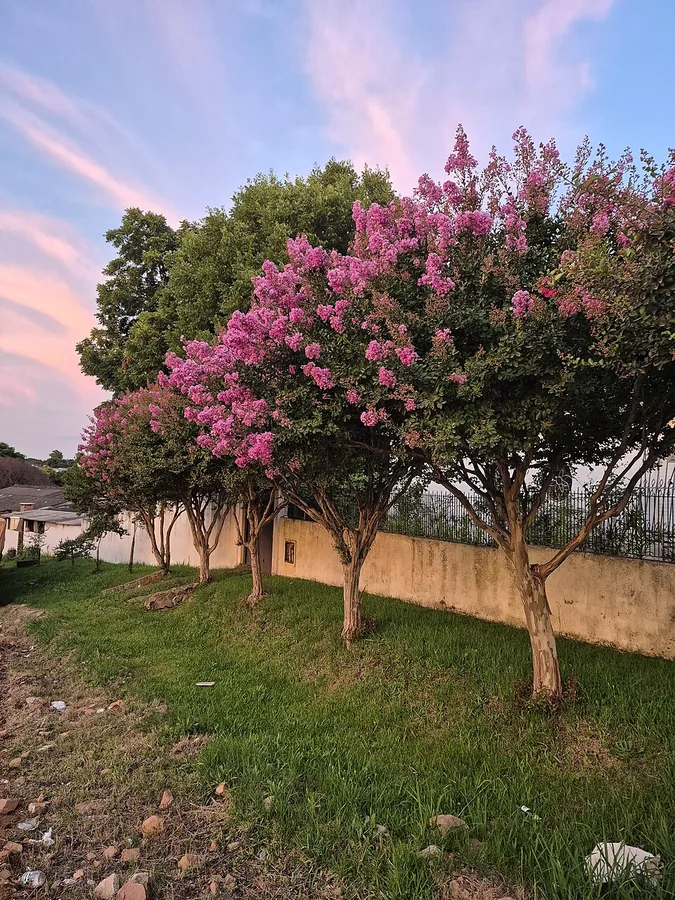
Set in full sun with room to spread, the crepe myrtle anchors a summer garden in color and turns to sculptural bark when the season cools.
Full sun
Every 7–14 days
USDA 6–9
15–25 ft · 4.6–7.6 m
Overview
A garden gains a whole season the moment a crepe myrtle comes into bloom. From July into September it carries crinkled, crepe-paper flowers in white, pink, lavender, and deep red, then trades them for handsome winter bark once the borders quiet down. It settles in fast and asks little, taking heat, drought, and ordinary soils in stride, which makes it the kind of tree that earns its keep in a yard meant to look good with minimal fuss.
Place it where it can act as a centerpiece, not a filler. A mature crepe myrtle stands 15 to 25 feet tall and spreads nearly as wide, so it reads beautifully at the corner of a patio, along a drive, or as the tree that frames a view from the kitchen window. It is the lilac of the south for a reason, bringing that warm, flowering presence to climates where true lilacs never settle.
The most elegant approach to a crepe myrtle is restraint. It blooms generously on its own and wants only sun, drainage, and the lightest seasonal shaping, which keeps it tied to an easy garden routine rather than a chore list. Leave the heavy cutting behind and the tree keeps the graceful, open silhouette that makes a space feel considered.
Care
The short version: full sun and well-drained soil, with deep watering reserved for its first young years. A light late-winter shaping keeps its form, a modest hand with nitrogen keeps it flowering, and an open canopy keeps it looking clean all season.
Light
Give a crepe myrtle the brightest spot in the garden, full sun for 6 or more hours a day. It will live with a little shade, but it answers with fewer flowers and more powdery mildew, so the open, sunny corners are where it truly performs.
Water
Water a young tree regularly through its first year while it puts down roots. After that it turns heat- and drought-tolerant and slips easily into a low-water garden, wanting a deep soak only through a long dry spell. Letting the top half of the soil dry between waterings keeps the rhythm simple.
Soil
This is a forgiving tree for almost any plot, settling into clay, loam, sand, or shallow rocky ground as long as it drains. It takes a wide pH range from 5.0 to 8.0, so most gardens welcome it without any reworking of the bed.
Temperature
Built for warm-climate gardens, the crepe myrtle holds its composure through summer heat up to 100°F (38°C). It is hardy to about -9°F (-23°C), dependable through zone 6, though a severe winter may take the top and let the tree rebuild from the base.
Humidity
Everyday outdoor humidity asks nothing of the gardener, so there is no figure to manage. What shapes the look is airflow, since still, damp air pooled among crowded branches is what invites the powdery mildew and leaf spot that mar an otherwise clean tree.
Feeding
Feed in spring with a balanced fertilizer, guided by a soil test so the garden gets only what it needs. Keep a light hand with nitrogen, because an excess trades the flowers you planted for at the expense of plain leafy growth.
Pruning
Prune lightly in late winter or early spring, taking out crossing limbs, suckers, and old seed heads, then limbing up the lower branches over time to reveal a clean, sculptural trunk. Never top it hard, which collapses the elegant form into weak, twiggy regrowth.
Repotting
Crepe myrtle belongs in the open garden and rarely stays potted for long. A container specimen needs repotting only occasionally, and the cues are roots circling the drainage holes and soil that dries almost as fast as you can water it.
Size & spacing
Plan around a mature tree of roughly 15 to 25 feet (4.5 to 7.5 m) tall and as wide. Giving it the full footprint lets the canopy breathe, which keeps the tree both healthier and more graceful as a feature in the landscape.
When to plant
Crepe myrtle suits gardens from zone 6 through 9 and works to the rhythm of the warm season. Plant a new tree in spring or fall so it can settle before the weather turns, and let it carry the garden's summer story from July through September.
Northern hemisphere
Southern hemisphere
Typical months for a temperate climate: start earlier in warm zones, later where spring frosts linger.
- Plant: spring or fall
- Harvest: July to September
Hardiness
USDA hardiness zones: 6–9
Temperature: down to -23°C
Troubleshooting
When a crepe myrtle looks off, the cause is usually a fungus or an insect, and it tends to surface first on the leaves or the bark. Spotting it early keeps the tree looking its best and blooming on schedule. Match what you notice below, then step in before it dulls the whole canopy.
A pale powdery film over leaves and stalled buds
That dusty white film is powdery mildew, a fungus that thrives in the mild, damp turns of spring and fall and can keep buds from ever opening, which spoils the show. Open the tree to sun and moving air, clear the crowded sprouts at the base, and turn to a labeled fungicide only if it gets ahead of you.
Fix:
- Site in full sun with good air circulation
- Remove basal sprouts and crowded growth to improve airflow
- Apply a labeled fungicide such as myclobutanil, propiconazole, or thiophanate-methyl if severe
Yellow-spotted leaves dropping in late summer
Small yellow spots arriving in warm, muggy weather signal Cercospora leaf spot, which can leave a tree bare just as the garden peaks. Keep water off the foliage, give the canopy room to dry, and rake up the fallen leaves so the fungus has nowhere to settle for winter.
Fix:
- Improve air circulation and avoid wetting foliage
- Rake and remove fallen infected leaves
- Apply thiophanate-methyl or myclobutanil if needed
White felted crusts marring the bark
White, felt-like bumps along the trunk and limbs are crapemyrtle bark scale, and a crushed one leaves a telltale pink smear. The insects shed honeydew that blackens the whole tree with sooty mold and dulls that prized bark. Wash the bark with mild soapy water and a soft brush to lift the scale and grime, then pair a spring systemic soil drench with a late-winter dormant oil spray to break the cycle.
Fix:
- Wash trunk and branches with mild soapy water and a soft brush to remove scale and mold
- Apply a systemic soil drench (e.g., imidacloprid) in spring per label
- Use dormant horticultural oil sprays in late winter
Sticky, blackened leaves losing their shine
The sticky sheen is honeydew from crape myrtle aphids feeding beneath the leaves, and the black sooty mold is a harmless fungus living on that sugar rather than the tree. Rinse the aphids away with a hard jet of water, follow with insecticidal soap or neem oil, and let lady beetles and lacewings finish the work. Once the aphids retreat, the black film fades on its own and the leaves regain their gloss.
Fix:
- Spray plants with a strong stream of water to dislodge aphids
- Use insecticidal soap or horticultural/neem oil
- Encourage predators such as lady beetles and lacewings
Toxicity
For a household with pets or children, this is a tree that simply fits: crepe myrtle is safe all around. The ASPCA lists it as non-toxic to cats, dogs, and horses, with no known danger to other animals or people. The only thing to plan for is fallen petals, which can stain a walkway or a parked car.
Safe for
People · Cats · Dogs · Horses · Rabbits · Livestock · Birds
Cats None
The ASPCA lists crepe myrtle as non-toxic to cats, so a curious nibble on a leaf or a fallen bloom is nothing to worry about.
Dogs None
Dogs can mouth the leaves, flowers, or bark without harm. It is safe should a dog chew a low branch, though a large helping of any plant may pass an upset stomach.
Horses None
Horses grazing nearby are perfectly fine. The plant is not poisonous to horses, and no special fencing is needed.
Rabbits Safe
Rabbits face no risk from the leaves or stems. The plant holds no known toxin, so a stray bite will not hurt them.
Livestock Safe
Cattle, goats, and sheep can browse around a crepe myrtle without trouble, since the foliage carries nothing toxic to them.
Birds Safe
Backyard and wild birds are in no danger. They often pick at the seed capsules, and the plant is safe for them.
People Safe
Crepe myrtle is harmless to people, children included. None of its parts are a known food, so there is no reason to eat it, but a tasted petal or leaf does no harm.
No special toxicity precautions are needed; fallen flowers may stain walkways or vehicles.
Varieties
Hundreds of crepe myrtles fill the market, but a well-composed garden leans on the disease-resistant hybrids. These four come up again and again among growers with an eye for form.
Natchez
A vigorous indica and fauriei hybrid reaching about 30 feet, prized for white flowers, cinnamon-brown bark that peels through winter, and strong resistance to powdery mildew.
Muskogee
An indica and fauriei hybrid topping 20 feet, loved for its soft lavender flowers, a long bloom season, and good mildew resistance.
Tuscarora
An indica and fauriei hybrid in coral-pink to dark pink, carrying solid resistance to both powdery mildew and Cercospora leaf spot.
Sioux
A mildew-resistant indica and fauriei hybrid that follows bright pink summer flowers with standout red-purple color in fall.
How to propagate
Crepe myrtle can be increased in several ways, and the right one depends on the look you are after: an exact echo of a tree you love, or the chance of something new.
Stem cuttingsEasy
Softwood cuttings in late spring to summer; hardwood cuttings in winter · 4 to 8 weeks to root
Cuttings are the dependable way to reproduce a tree you admire, since the new plant matches its parent exactly. Take softwood cuttings in late spring or summer, or hardwood cuttings over winter, and look for roots in 4 to 8 weeks.
SeedModerate
Collect ripe seed in fall and sow · One or more seasons
Sowing seed is the route for the patient and the curious. Collect the ripe capsules in fall and sow them, knowing the seedlings come up variable and will not match a named tree, and that a season or more passes before one amounts to much.
LayeringModerate
Growing season · Several months
A low branch offers the simplest method of all. Pin it to the ground through the growing season and let it root in place, then after several months of layering, cut the new plant free from its parent.
Myths
Crepe myrtles need a hard yearly chop, the so-called crepe murder, to bloom well.
Cutting a crepe myrtle back hard does nothing for its flowers and a great deal of harm to the very shape that makes it worth planting. The tree blooms heavily on its own, while severe cuts ruin that graceful form and force out weak, whippy regrowth. A light shaping in late winter is all the tree ever asks.