Bulb · Iridaceae
Montbretia
Crocosmia × crocosmiiflora
One spring planting buys a whole season of arching, fiery summer color that turns a quiet border into a stage.
Full sun
Every 3–7 days
USDA 5–9
2–4 ft · 0.6–1.2 m
Overview
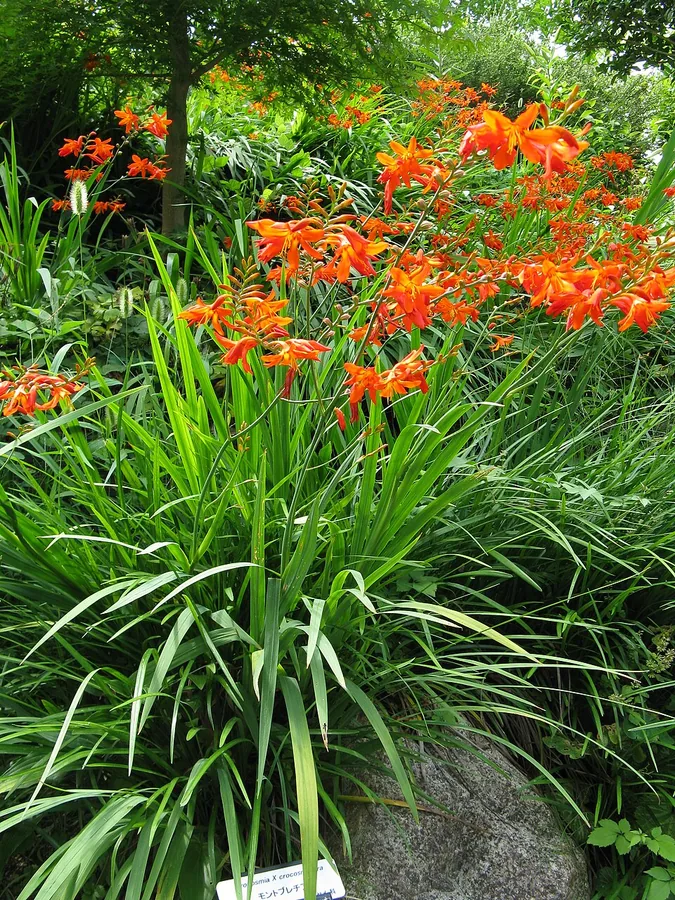
Crocosmia, the plant catalogues still list as montbretia, is the kind of summer perennial that gives a garden its high notes. A member of the iris family that grows from a corm rather than a true bulb, it traces back to southern Africa and brings arching stems of tubular flowers in hot reds, oranges, and yellows from June into August. Set against cooler greens or grey stone, it reads as the spark that lifts a planting out of the ordinary.
It earns its keep with almost no demands. Place it in full sun to light shade on free-draining soil and a clump will widen season by season, multiplying its corms in chains below the surface until it anchors a corner of the border. That generosity comes with a note for the design-minded: in mild regions crocosmia spreads with real ambition and has slipped into the wild along the US Pacific coast, so a clump occasionally wants editing back to keep a scheme composed.
Beyond the look, it pulls hummingbirds into the garden, the sort of living detail that makes an outdoor room feel inhabited. It sits easily in a household with pets, children, and grazing animals, which keeps it on the table for family gardens. Where winters fall within zones 5 to 9 the corms stay put through the cold and return each year, so the effect deepens rather than starting over.
Care
The short version: give it full sun to light shade and soil that drains freely without baking dry, settle the corms a few inches down in spring, and lift and divide the clump every few years to keep the display generous and the scheme tidy.
Light
Crocosmia gives its best display in full sun, though it takes partial sun or light shade gracefully when a border runs part-shaded. The more sun it draws, the more upright the stems and the fuller the show, so reserve it an open position where it can hold the eye.
Water
Keep the soil evenly moist through the season, since the plant loses its poise when it dries out. The balance to strike is drainage, because it will not stand in wet ground without the corms rotting, so water every 3 to 7 days in dry spells and ease back where the soil holds its own moisture.
Soil
It settles into humus-rich, well-drained soil and is unbothered by the makeup of a bed, taking clay, loam, or sand as long as water moves through. Easy about pH from 6.0 to 8.0, it fits most established borders without any reworking of the ground.
Temperature
Crocosmia carries a wide comfort range, from about 28°F to 86°F (-2°C to 30°C), so high summer leaves the display untroubled. The corms feel cold past their hardiness range, which is the single reason colder gardens lift them before winter sets in.
Humidity
Ordinary garden air suits it, so there is no atmosphere to manage for this one. The condition to watch is dry, baking heat, which stresses the foliage and can invite spider mites onto an otherwise handsome stand.
Feeding
A balanced general-purpose fertilizer at planting and again in spring is all the feeding the display needs. Crocosmia is no heavy feeder, and over-rich ground simply trades flowers for foliage, which is the opposite of the effect a border wants.
Pruning
When the blooms have spent themselves, cut the flower stems back to where they meet the leaves to keep the planting trim. Leave the foliage in place until it dies down on its own, since it is still feeding the corm, then clear it to the ground to close the season cleanly.
Repotting
Crocosmia belongs in the ground rather than a pot, and over time it crowds its own patch in the border. Divide the corm clumps every 2 to 3 years to keep the stand vigorous, taking congested clumps, thinner flowering, and smaller blooms as the cue to refresh the planting.
Size & spacing
Expect a clump to rise 2 to 4 feet (61 to 122 cm) and spread 12 to 24 inches (30 to 61 cm), a scale that suits the middle of a border. Set the corms about 6 inches apart and they will weave into a full, settled stand within a season or two.
When to plant
Crocosmia keeps to an easy seasonal calendar that suits a planned garden. The corms go in during spring once the last frost has passed, and the color arrives through the warm center of summer, roughly June to August. In colder regions, plan to lift and store the corms before the hard freezes, a small autumn ritual that protects next year's show.
Northern hemisphere
Southern hemisphere
Typical months for a temperate climate: start earlier in warm zones, later where spring frosts linger.
- Plant: Plant corms in spring after the last frost date, 3-5 inches deep and about 6 inches apart.
- Harvest: Summer bloom, roughly June to August.
Hardiness
USDA hardiness zones: 5–9
Temperature: down to -29°C
Troubleshooting
Crocosmia asks for so little that trouble rarely intrudes on the display. When something does go wrong it surfaces on the foliage or at the corm, the two places to keep a casual eye on. Match what you notice below and step in early, and the planting holds its composure.
Soft corms and a planting that fails to rise
Corm rot undermines a stand from below when the soil stays waterlogged or the cold drops past what the corms can take, and the planting simply fails to come up. Lift a few and check for soft, discolored tissue to be certain. Improve the drainage, and in zones colder than 5 either mulch heavily for winter or lift the corms and store them dry like gladiolus.
Fix:
- Improve drainage and avoid standing water
- In cold zones, lift and store corms dry over winter or apply winter mulch
Speckled, bronzing leaves under fine webbing
Foliage that turns stippled and bronzed beneath fine webbing has drawn spider mites, which arrive fast in hot, dry stretches and dull a once-crisp stand. A strong jet of water knocks them loose, and keeping the soil moist while sheltering the plant from dry wind keeps the foliage looking its best. Insecticidal soap or horticultural oil handles the cases that linger.
Fix:
- Spray foliage with a strong jet of water to dislodge mites
- Improve air moisture and avoid drought stress
- Apply insecticidal soap or horticultural oil as needed
Grazed foliage and a display that never opens
When the leaves are nibbled down and the expected color never arrives, rabbits are usually responsible, leaving clean-cut foliage near the ground and droppings to confirm it. The fix is exclusion rather than treatment. A wire cage or fence around the clump is the surest way to protect the display where rabbit pressure is high.
Fix:
- Protect plants with fencing or wire cages
- Use repellents where appropriate
Toxicity
For a household that lives with pets and small children, this is the easy choice: crocosmia is not toxic. No reputable source lists any part of it as poisonous, and it is grown as a hummingbird plant precisely because it belongs in shared, lived-in spaces. Wash your hands after handling the corms, the same unfussy habit any garden plant deserves.
Safe for
People · Cats · Dogs · Horses · Rabbits · Livestock · Birds
Cats None
Nothing to worry about with cats. One that bats at the foliage or chews a leaf comes to no harm.
Dogs None
Safe around dogs, too. A curious nibble of the leaves or flowers causes no poisoning, though a big mouthful of any plant can briefly upset a sensitive stomach.
Horses Safe
Horses can graze near a clump without trouble, since crocosmia carries no toxin known to harm them.
Rabbits Safe
Rabbits genuinely relish the foliage and take no harm from it, which is more a problem for the display than for the rabbit.
Livestock Safe
Cattle, goats, or sheep that browse it face no poisoning risk, since the plant is not listed among forage hazards.
Birds Safe
Birds are at ease around it, and hummingbirds in particular work the tubular flowers for nectar, the living detail that draws many gardeners to it.
People Safe
No toxicity is reported for people. Wash your hands after handling the corms, the same simple routine you would keep with any garden plant.
Generally considered safe to handle; wash hands after gardening as a routine precaution.
Varieties
A short cast of named cultivars covers most of what reaches the shelves, sorted by color and bloom time, which is exactly the palette a planting plan turns on. These are the ones worth choosing between.
Lucifer
Lucifer, an Alan Bloom hybrid, sets showy scarlet-red tubular flowers along arching stems and ranks among the hardiest and most popular, the reliable headline color for a hot scheme.
Emily McKenzie
Emily McKenzie offers large orange flowers marked with mahogany-red throats and opens later in the summer than most, useful for stretching a border's season.
Solfatare
Solfatare pairs soft apricot-yellow flowers with unusual bronze-tinted foliage, a quieter, more muted choice for a subtle planting.
Star of the East
Star of the East stands out for its large, soft orange blooms that read beautifully across a bed.
How to propagate
Crocosmia is a generous plant that nearly restocks the garden on its own, so a single planting can furnish a whole scheme over time. Dividing clumps is the quick, dependable way to spread it along a border, while seed is a slower, less predictable indulgence for the patient gardener.
DivisionEasy
Early spring before new growth begins. · One growing season; flowering typically the same or following summer.
Division is the easy, dependable way to carry crocosmia along a border, and it doubles as housekeeping for a tidy scheme. Lift the congested corm clumps in early spring before new growth starts and split them apart, repeating every 2 to 3 years to keep the planting vigorous. The divisions settle within a season and often flower that same or the following summer, so the display barely skips a beat.
Bulbs & cormsEasy
Spring, after the last frost. · One growing season.
Each corm quietly assembles a chain of offsets that can be pulled apart and grown on to extend a planting. In spring once the frost has passed, separate the offset corms and replant them 3 to 5 inches deep and about 6 inches apart. They root and establish over a single growing season, knitting new color into the bed.
SeedModerate
Collect ripe seed from capsules; sow when available. · Two or more seasons to reach flowering size; some seed may not be viable.
Seed is the slower, less certain route and suits a patient gardener more than a planned scheme. Collect the ripe seed from the capsules and sow it when you have it, but expect two or more seasons before the plants reach flowering size. Hybrid seedlings rarely come true to the parent, and some seed simply will not be viable, so the result is a surprise rather than a design.
Myths
Crocosmia corms are true bulbs like tulips and must be replanted every year.
Crocosmia grows from corms rather than true bulbs, and that distinction is good news for a planting you mean to keep. In zones 5 to 9 the corms stay in the ground and naturalize, so the border deepens year on year without a yearly replant. Only in colder zones does lifting and storing come into it, handled the way gardeners treat gladiolus.