Bulb · Iridaceae
Siberian Iris
Iris sibirica
All poise and cool composure, Siberian iris lends a damp border grassy verticals and a wash of late-spring color.
Full sun
Every 3–7 days
USDA 3–8
2–4 ft · 0.6–1.2 m
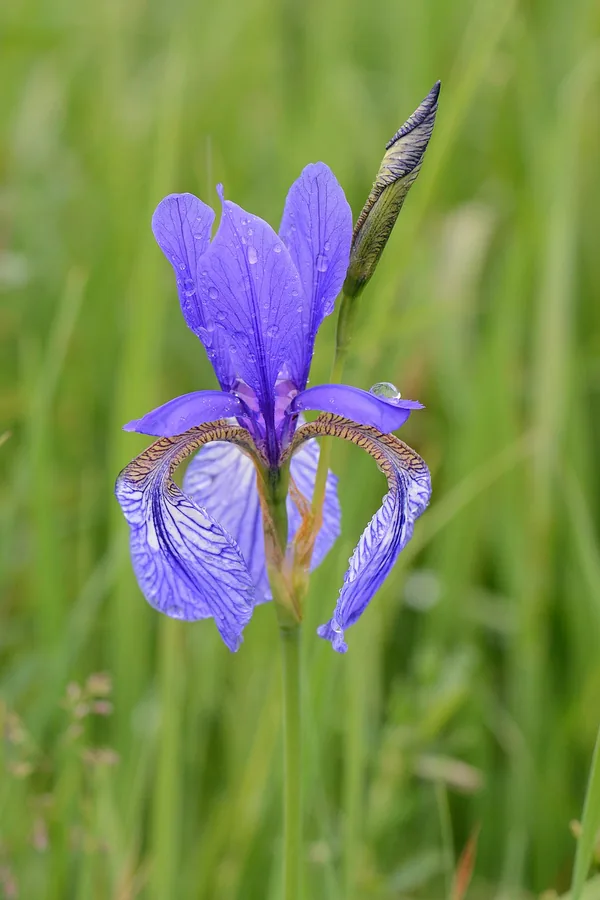
Overview
Siberian iris brings a quiet elegance that its showier bearded cousin rarely manages. Its slim, clump-forming fans read as soft vertical lines in a planting, and the late-spring flowers hover above them like a light, unhurried gesture. It is a plant that settles a border rather than shouts across it.
Few perennials give a designer this much freedom with a difficult site. Hardy to a remarkable -40°F (-40°C), it holds a scheme together through the harshest winters, and it welcomes the damp, boggy ground along a pond or stream that most plants refuse. That damp problem area becomes, almost overnight, the most composed corner of the garden.
Paired with sun and even moisture, it forms an upright, sculptural clump that anchors a scheme well past its bloom. Those fine, upright leaves keep their poise right through summer, giving the border a calm, grassy backdrop for whatever flowers alongside it.
Care
The short version: give it full sun to part shade, keep the soil evenly moist through the season, and plant it in rich ground that drains freely yet shrugs off a boggy patch. Divide the clump every 3 years or so, and this is a plant that largely keeps its own counsel.
Light
For flowers at their fullest, choose a spot in full sun, though the plant keeps its composure in partial shade. Count on 6 hours or more of direct sun daily; any less and the clump loses its upright grace and much of its bloom.
Water
Keep the soil evenly damp from spring into the weeks past flowering, the stretch when it performs. It is equally at home in wet, boggy ground beside water, and an established clump will accept a brief dry spell once it has a season or two behind it.
Soil
Set it in rich, moist, humus-laden soil with good drainage, though its adaptability stretches to sites far wetter than most border plants would abide. A pH between 6.0 and 7.0 keeps it at its best.
Temperature
Its range is extraordinary for a garden plant, holding steady from -40°F to 86°F (-40°C to 30°C). That reach lets a single planting look composed through bitter winters and hot midsummers alike.
Humidity
There is no humidity figure to manage here; the open air of the garden suffices. Free air movement matters more, since foliage left crowded and damp is what occasionally invites rot.
Feeding
A single feeding in early spring sets it up for the year. A balanced general-purpose fertilizer, or a generous layer of compost as growth begins, sees the clump elegantly through to fall.
Pruning
Once flowering ends, remove the spent stems to keep the planting looking considered. At dividing time, or in late fall as the leaves subside, take the foliage down to 6 to 8 inches.
Repotting
Lift and divide about every 3 years, or sooner when the show begins to fade. A hollow, bare center and a thinner scattering of flowers are the clump's polite request for more room.
Size & spacing
In maturity the clump reaches 2 to 4 feet (60 to 120 cm) tall and settles into 2.5 to 3 feet (76 to 91 cm) of width. Allow it that footprint and it holds its shape with air moving cleanly around the fans.
When to plant
Its year unfolds on a graceful, predictable rhythm. In colder regions the planting and dividing happen in spring, while southern gardens turn to fall. The flowers arrive in May and June to mark the turn of late spring, and the foliage sustains the scene through the seasons that follow.
Northern hemisphere
Southern hemisphere
Typical months for a temperate climate: start earlier in warm zones, later where spring frosts linger.
- Plant: Spring in cooler-winter regions; fall in the southeast
- Harvest: May to June
Hardiness
USDA hardiness zones: 3–8
Temperature: down to -40°C
Troubleshooting
This is an untroubled plant by nature, far more so than the bearded iris it is often confused with. When something does go awry, the cause tends to be a shaded position, a clump left to crowd itself, or an unusually wet spell. The remedies below are quiet, quick corrections rather than major interventions.
Soft, unpleasant rot at the base
Soft, sour-smelling collapse at the base signals bacterial soft rot, an ailment Siberian iris meets far less often than bearded iris. Pare away the affected tissue and discard it, then attend to the drainage and resist setting the crown too low. A well-drained, healthy site keeps the trouble at bay.
Fix:
- Remove and destroy affected tissue
- Improve drainage and avoid burying the crown too deeply
Sparse bloom and a loose, sprawling habit
A shy show of flowers over loose, sprawling foliage usually traces to too little light or a clump grown congested. Move it into a position with 6 hours of direct sun, and where the heart of the clump has gone bare, lift and separate it. A tidy division every 3 years keeps the planting looking its best.
Fix:
- Relocate or thin surroundings to provide full sun
- Divide the clump and replant healthy fans with at least two fans each
Ragged, notched margins along the leaves
Frayed leaf edges laced with glistening trails betray slugs and snails at work in the night. The blemish is purely cosmetic, so gather them by hand after dark and clear the damp cover they retreat to by day. Keeping the ground drier around the clump quietly persuades them to move on.
Fix:
- Hand-pick slugs and snails
- Reduce moist hiding spots near plants
Toxicity
For all its refinement, this is an ornamental to admire and not to eat, a point worth remembering in a home with animals. Every part holds irisin and terpenoids, most concentrated in the rhizome, and a pet that samples it may end up drooling and unwell. A pair of gloves is the sensible finishing touch when handling the cut roots, whose sap can leave skin irritated.
Toxic to
Cats · Dogs · Horses · Rabbits · Livestock · Birds · People
Cats Mild
A cat that chews it tends to drool and be sick, then grow subdued and indifferent to food. The rhizome carries the strongest dose, so a cat inclined to dig suffers the most.
Dogs Mild
Look for pronounced drooling and a queasy stomach, often alongside diarrhea and a flat, low mood. Dogs that unearth and chew the roots take the heaviest hit.
Horses Mild
A grazing horse may drool, feel unsettled in the gut, and pass loose droppings. Most give it a wide berth, yet keeping iris beyond their reach remains the wise course.
Rabbits Toxic
The same irisin and terpenoids behind the reactions in cats and dogs leave rabbits vulnerable, so keep iris well away from any hutch or run.
Livestock Toxic
Cattle, goats, and sheep may drool and suffer digestive upset from the leaves and roots, so the plant is best fenced off from any pasture.
Birds Toxic
The toxins carry an equal hazard for birds, so poultry and pet birds alike should be kept from the leaves and rhizomes.
People Caution
No part belongs on the table, and with the rhizome the most toxic, curious children are best kept at a distance. Contact with the cut roots can irritate skin as well, which is why gloves earn their place at dividing time.
Wear gloves when dividing or handling, as the sap can cause skin irritation.
Helpline numbers

United States
ASPCA Animal Poison Control: (888) 426-4435 (fee applies)
Poison Control: (800) 222-1222



Canada
Poison Centres: 1-844-764-7669
Varieties
The Siberian iris palette runs wide, from stately purples to modest whites, which makes it easy to match a cultivar to the mood of a planting. A few names stand out as reliable choices.
Caesar's Brother
A long-admired classic that carries firm, upright stems of deep purple to roughly 3 feet, and a decorated Plant of Merit.
Butter and Sugar
A gentle bicolor, its blooms marrying pale yellow falls to clean white standards for a soft, two-tone effect.
White Swirl
A serene pure white that lifts the light in a shaded stretch of the border.
Baby Sister
A petite selection at just 1 to 1.5 feet, ideal for the front of a scheme or a compact garden.
How to propagate
There are two ways to increase a favorite clump: divide it or raise it from seed. Division is the swifter route and the only one that holds a cultivar true to its character, which is why it tends to be the gardener's choice.
DivisionEasy
Late summer or early spring (after bloom) · 6 to 8 weeks to root; may take more than one season to bloom
Division is the graceful, dependable way to multiply a clump, and it withstands handling that would set back a bearded iris. Undertake it in late summer or early spring after the flowers pass: reduce the foliage to 6 to 8 inches, ease the clump apart with a clean, sharp blade into sections of at least two fans, settle them under 1 to 2 inches of soil, and keep the ground moist. Fresh roots establish in roughly 6 to 8 weeks, though a new division may hold its bloom for a season.
SeedModerate
Sow when ripe · Several seasons to reach blooming size
Seed is the patient path, better suited to the wild species than to named selections, since a hybrid will not come back true. Sow it the moment it ripens and give it time, for a seedling needs several seasons before it reaches flowering size.
Myths
Siberian iris asks for the same relentless division and borer control as bearded iris.
Not at all. It keeps to neat, self-contained clumps, offers borers no fleshy surface rhizome to invade, and stands clear of the soft rot that troubles the bearded sorts. Dividing about every 3 years is the whole of its upkeep, and it stays largely untroubled by pests between times.
Iris is a safe presence around pets.
It is not. Iris is toxic to cats, dogs, and horses, with the greatest share of the toxin held in the rhizome. A pet that nibbles it may be left drooling and sick, with a dull, listless mood and loose stools in its wake, so it is best positioned out of their reach.