Shrub · Bignoniaceae
Crossvine
Bignonia capreolata
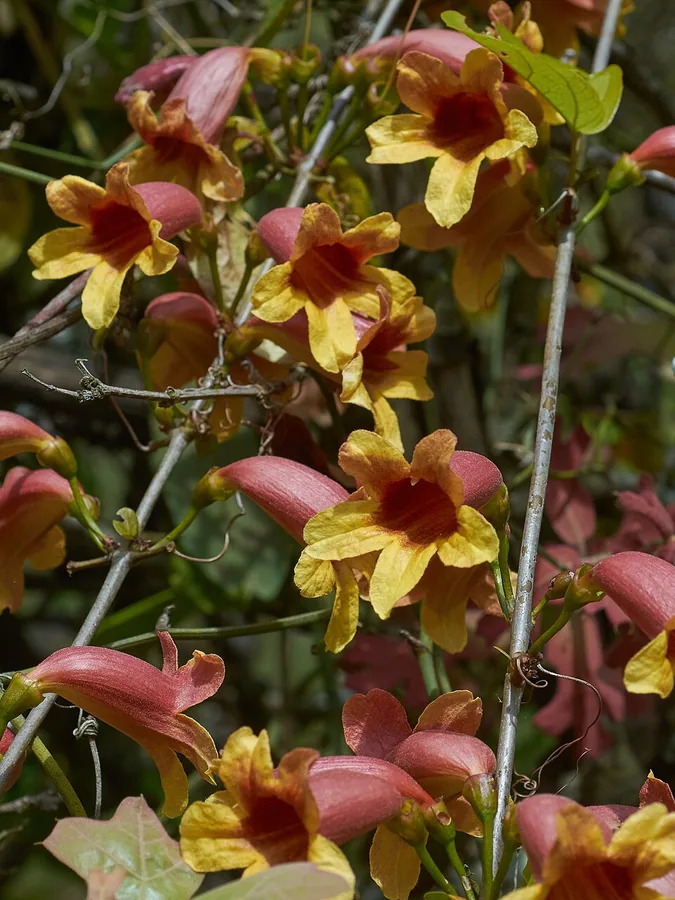
A native climber that turns a plain fence into a spring backdrop of trumpets, with hummingbirds as the regular guests.
Full sun
Every 7–14 days
USDA 5–9
30–50 ft · 9.1–15.2 m
Overview
Crossvine is the answer when a blank wall or a tired fence needs a sense of occasion. A fast, woody climber from the southeastern United States, it dresses vertical space the way a good curtain dresses a window, clinging to brick, timber, and ironwork by tendrils tipped with sticky disks so the structure seems to wear it. In early spring it arrives as a season opener, a flush of trumpet flowers that brings hummingbirds into view from the patio or the kitchen window.
It suits the gardener who wants the look without the upkeep. Place it in full sun or deep shade, on good soil or poor, and it settles into the scheme, riding out the years from zone 5 to zone 9 once it has found its feet. The single thing to design around is its appetite for space. Given room it reaches 30 to 50 feet and sends up suckers, so it belongs against a generous, well-built support rather than a delicate trellis.
It is often shelved beside the showier trumpet creeper, yet the two play very different roles in a garden. Crossvine opens the season earlier, keeps a more composed habit, and spares you the skin irritation its livelier cousin can bring to the planting.
Care
The short version: set it in full sun for the fullest display, give it a handsome, sturdy support to grow into, water deeply only while it settles, and prune hard just after the spring bloom so the planting stays elegant rather than overgrown.
Light
Crossvine takes a position anywhere from full sun to full shade, which makes it forgiving to place within a scheme. Sun is where it truly performs, repaying the spot with fuller cover and a far heavier show of spring trumpets. Tuck it into deep shade and it grows leggy and flowers little, so reserve it for a brighter corner where the display will read.
Water
While it is settling into its place, keep the soil evenly moist. Once established it is genuinely drought tolerant, asking for a deep drink only through a long dry spell. For most of the year, rainfall keeps it looking its part with no attention from you.
Soil
It makes no demands on soil. Average, well-drained loam or sandy ground suits it, and it adapts across a wide range, content anywhere from a pH of 6.0 to 8.0. Rich, organic ground grows it best, but it holds its own almost anywhere in the garden.
Temperature
This cold-hardy native takes roughly -20°F to 100°F (-29°C to 38°C) in its stride, covering zones 5 through 9. Winter cold leaves it untroubled, and a hot summer does nothing to spoil the look.
Humidity
Average outdoor humidity is all it asks, so there is no figure to manage. What matters to its appearance is good air movement, since crowded growth in still, damp air is what invites the occasional leaf spot to mar the foliage.
Feeding
Crossvine wants almost no feeding to look well. A light dose of balanced fertilizer or compost in spring is plenty for this vigorous native, and heavy nitrogen only swells the foliage at the expense of the flowers that earn it a place.
Pruning
Prune hard just after it finishes flowering to keep the vine shapely on its support, since cutting before the bloom costs you that season's display. Lift out root suckers as they appear so the planting stays where it was designed to be.
Repotting
Crossvine is a landscape climber and rarely lives long in a container, so it sits more naturally in the ground. Where it is grown in a pot, move it up only when it has plainly outgrown its space, shown by roots circling or escaping the pot, soil that dries quickly, and top growth that has stalled.
Size & spacing
Plan for scale. The vine climbs 30 to 50 feet (9 to 15 m) tall and spreads 6 to 9 feet (180 to 275 cm) wide, so reserve it for a setting where a large, fast climber is welcome and frame it with a strong arbor or fence worthy of the show.
When to plant
Hardy from zone 5 to 9, crossvine goes into the garden in spring or fall, while the weather is mild and the roots can take hold before the season turns severe. Its flowering runs from late winter to early spring, easing toward May or June in colder gardens, which makes it a graceful way to mark the change of season.
Northern hemisphere
Southern hemisphere
Typical months for a temperate climate: start earlier in warm zones, later where spring frosts linger.
- Plant: spring or fall
- Harvest: late winter to early spring (May to June in colder zones)
Hardiness
USDA hardiness zones: 5–9
Temperature: down to -29°C
Troubleshooting
Crossvine asks very little and rarely meets a pest or disease. The few issues that surface trace back to its vigor, a position with too much shade, or pruning out of step with the season. Match what the garden is showing you below and adjust early.
The vine outgrows its support and swallows nearby plants
Left to itself, crossvine climbs fast and its sticky-disk tendrils take hold of whatever is within reach, overrunning the look you planned. A shaded position makes matters worse, drawing the vine into a reaching, restless growth. Cut it back hard just after the bloom and design it around a sturdy arbor or fence scaled for a 30 to 50 foot climber.
Fix:
- Prune hard after flowering to reduce size
- Provide a sturdy, large support such as an arbor or fence
- Site in full sun for denser, more floriferous growth
New shoots popping up in the lawn away from the main plant
Stray shoots breaking the line of a bed are root suckers, crossvine's way of traveling underground. Lift or dig them the moment they appear, and run the mower over any that surface in the lawn. To keep the planting tidy, sink a root barrier or set the vine in a contained bed where a little wandering does no harm to the scheme.
Fix:
- Pull or dig up root suckers as soon as they are spotted
- Mow or cut suckers in lawn areas
- Install a root barrier if confining the plant
A leafy, healthy vine that barely flowers
When crossvine reads as lush green but withholds its trumpets, too much shade is usually the reason. Pruning out of season plays a part too, since cutting before the spring bloom takes the buds with it. Move or train the vine into brighter light, ease off the nitrogen, and prune only once the flowering is over.
Fix:
- Move or train the vine into more sun
- Prune only after the spring bloom, not before
- Avoid excess nitrogen fertilizer
Dark spots scattered across the leaves
Marks on the foliage are almost always just fungal leaf spot, a cosmetic blemish on a plant that otherwise shrugs off pests and disease. Thin the growth so air can pass, take off the worst leaves, and water at the base rather than overhead. Crossvine carries no serious insect or disease problems, so spotting like this rarely disturbs the display for long.
Fix:
- Improve air circulation by thinning growth
- Remove and dispose of badly affected leaves
- Avoid overhead watering
Toxicity
For a home with pets or children moving through the garden, the reassurance is simple: crossvine is not toxic. It is absent from the ASPCA's list of poisonous plants and counts as safe around cats, dogs, and people. The only thing to keep clear is the distinction from trumpet creeper, the related vine whose sap can irritate skin.
Safe for
People · Cats · Dogs · Horses · Rabbits · Livestock · Birds
Cats Safe
Crossvine is not on the ASPCA toxic list, so a cat that drifts through the bed and tastes a leaf comes to no harm. A large mouthful of any plant might bring a little drooling or a soft stool, but nothing beyond that.
Dogs Safe
Dogs can chew the foliage without trouble. The most a household might notice is mild stomach upset after one bolts a large amount, and it settles on its own.
Horses Safe
There is no toxin here to worry a horse. They graze around crossvine in safety, though no animal should make a steady diet of any single plant.
Rabbits Safe
Rabbits can browse the leaves without risk. Introduce any new green slowly, since a sudden helping of fresh foliage can unsettle a rabbit's gut.
Livestock Safe
Cattle, goats, and sheep face no danger from this vine. It holds none of the compounds that make a handful of pasture plants a concern.
Birds Safe
Crossvine poses no threat to birds, and its spring trumpets in fact draw hummingbirds into the garden, which take the nectar without any harm.
People Safe
This is the well-behaved crossvine, not its prickly cousin the trumpet creeper, so working around it leaves the skin untroubled. It is safe to plant where children and pets share the space.
No special handling required; as with any plant, large quantities of ingested foliage may cause mild, non-specific GI upset.
Varieties
A handful of named selections stand apart for their flower color and habit, and these are the ones a good nursery is most likely to carry.
Tangerine Beauty
Tangerine Beauty is the selection most gardeners reach for, draping itself in warm tangerine to apricot-orange trumpets and flowering more freely than the species.
Atrosanguinea
Atrosanguinea brings a quieter, more compact presence, with darker purplish-red flowers carried on narrow, lance-shaped leaflets.
Dragon Lady
Dragon Lady is the choice for a deeper note, prized for its red-orange flowers.
How to propagate
Crossvine is easy to increase, and much of the time it furnishes the garden on its own, self-seeding and rooting wherever a low stem rests against the ground.
SeedModerate
Fall or spring after pods mature · 1 to 2 growing seasons
Take seed from the long, bean-like pods once they ripen and sow it in fall or spring. Crossvine self-sows readily, so volunteers often appear to fill a scheme without any prompting. Allow a sown plant a season or two to settle before it begins to carry its weight in the garden.
Stem cuttingsModerate
Summer · Several weeks to root
Take softwood cuttings in summer and they root over several weeks. Root cuttings serve as well and are a documented method for this species, a useful way to repeat a selection you have come to rely on for the planting.
LayeringEasy
Spring to summer · One season
Layering is the easiest route by far, and the most in keeping with the plant's own habits. Pin a low stem to the soil in spring or summer and it roots within a season, much the way the vine naturally spreads as it sprawls through a border.
Myths
Crossvine and trumpet vine are the same plant.
They share a family, yet they bring very different things to a garden. Crossvine climbs by tendrils tipped in sticky disks, opens in early spring, and keeps a composed habit. Trumpet creeper is the unruly one, flowering in summer, with foliage and sap that can leave the skin itchy, so the planting reads quite differently depending on which you choose.