Shrub · Bignoniaceae
Trumpet Vine
Campsis radicans
Set against full sun and a strong arbor, the trumpet vine turns a summer garden into a hummingbird stage.
Full sun
Every 7–14 days
730–1095 days
USDA 4–9
Overview
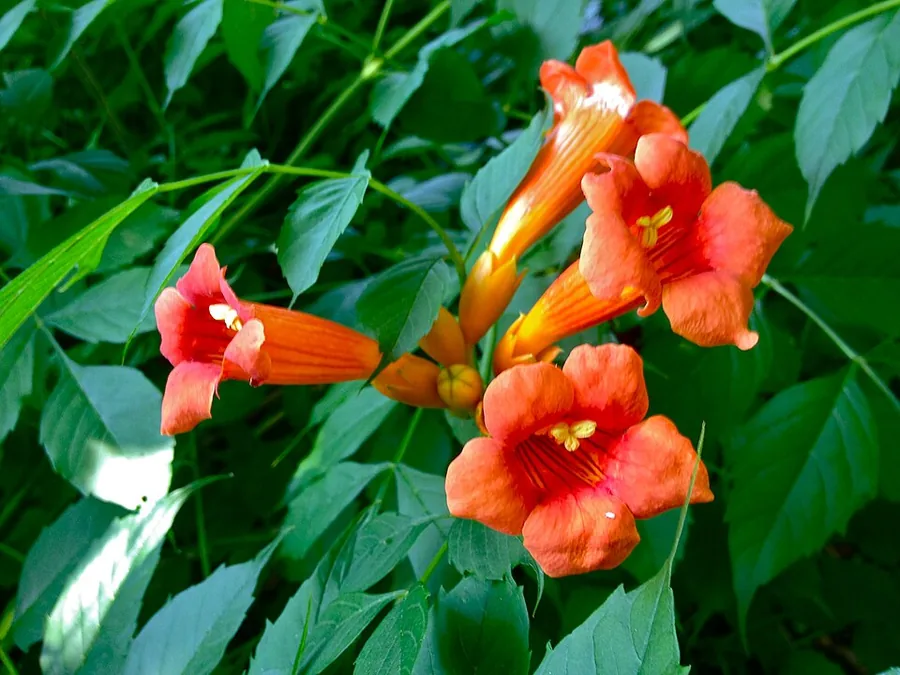
There is a certain kind of summer garden that seems to hum, and the trumpet vine is often at the center of it. A fast, woody climber from the eastern United States, it drapes an arbor or a boundary wall in orange-red trumpets from midsummer into fall, with hummingbirds threading through the flowers as part of the scene. Reaching 25 to 40 feet (7.5 to 12 m) on its own aerial rootlets, it reads as architecture as much as planting, and its hardiness across zones 4 to 9 lets it hold that role through cold, heat, and dry spells.
It is a plant with presence, and presence asks for the right setting. Given room, it colonizes by root suckers and self-seeding into broad stands, and its weight leans hard on whatever frames it, so it belongs in a spot chosen for scale rather than a tidy corner by the door. Think of it as the anchor of a large, informal garden, not an accent for a small courtyard.
The look comes together with a little forethought. A generous freestanding structure, lean soil, and a firm annual cut keep the vine handsome and the flowers coming, so the display stays intentional rather than overrun. One note for the daily routine: the sap behind the name cow itch vine can irritate skin, so gardening gloves belong in the same basket as the pruners.
Care
The short version: full sun, lean soil, and a support with real presence. Water young plants until they settle, then let them be, keep the fertilizer away, and prune hard in late winter so the display stays composed.
Light
Give it full sun, six or more hours a day, and it repays the position with its fullest flowering. It will grow in partial sun or light shade, but a shaded plant turns to leaf and loses the color that makes it worth the space.
Water
In its first season, steady watering helps a young plant settle into its setting, after which it asks for very little. Once established it is drought tolerant across dry to moist soils and lives on rainfall, an easy fit for a low-maintenance garden.
Soil
It is unbothered by ground, taking clay, sand, loam, or poor soil across a pH of 5.5 to 8.0. Lean soil actually suits the look best, since rich ground pushes growth and thins the flowers, and it takes dry to occasionally wet conditions in stride.
Temperature
Its range is generous, from -29°F to 100°F (-34°C to 38°C), which is what lets it anchor a garden across zones 4 through 9. A hard winter and a high-summer heat both pass without disturbing the display.
Humidity
There is no humidity to manage with this one. Ordinary outdoor air suits it, and it settles into a wide sweep of climates without any special attention to moisture.
Feeding
Leave the fertilizer out of the picture. Feeding brings more leaf and fewer flowers, so the plant looks its best kept lean, and hungry ground also keeps its enthusiasm from overwhelming the setting.
Pruning
A firm cut in late winter or early spring is what keeps the vine looking deliberate. Because it flowers on new growth, that cut never costs the display, and a yearly thinning of woody stems and removal of root suckers holds it to the structure you chose for it.
Repotting
This is a plant for open ground rather than a container on a terrace, so repotting rarely enters the picture. In the uncommon case it is potted, look for roots filling the pot and suckers slipping out of the drainage holes.
Size & spacing
Plan the space around a large presence: 25 to 40 feet (7.5 to 12 m) tall and 5 to 10 feet (1.5 to 3 m) wide. Give it a strong structure and generous room, and set it clear of anything it might fold into its own scene.
When to plant
This is a plant that keeps an unhurried calendar. Set it out in spring once frost has passed, or in fall where the season stays mild, and give it a firm cut in late winter before the new year of growth begins. The orange trumpets then carry the garden from June into September, arriving on fresh wood.
Northern hemisphere
Southern hemisphere
Typical months for a temperate climate: start earlier in warm zones, later where spring frosts linger.
- Sow: Late winter to early spring; seed needs cold stratification, though the plant is usually propagated from root cuttings or suckers rather than seed.
- Plant: Spring after frost, or fall in mild zones
- Harvest: Summer (June to September)
Hardiness
USDA hardiness zones: 4–9
Temperature: down to -34°C
Troubleshooting
For all its drama, the trumpet vine's problems are rarely about pests. They come from ambition: a plant that ranges past its bed, leans its weight on the structure, or spends a season in leaf rather than flower. Read the scene below to see which is playing out, then guide it back into shape.
A structure that shows the strain of the vine
The concern is those clinging aerial rootlets, which settle into mortar, wood, and any fine crack, along with a mature plant's woody weight, enough to bow a fence or a light trellis. Taken off a wall, it carries the surface with it. Give it a heavy freestanding support such as a metal arbor or masonry, never the house, and a hard yearly cut keeps the weight in hand.
Fix:
- Grow only on a very sturdy freestanding support such as a heavy metal arbor or masonry, not on house walls or wooden structures
- Keep the vine off buildings, gutters, and weak fences by pruning back hard
- Avoid clinging vines on wood, which can be damaged or rot from trapped moisture
New shoots appearing across the garden, well beyond the bed
This is aggressive suckering, the habit that shapes how the vine lives in a garden. Underground runners travel outward and bean-like capsules cast seed, so shoots and seedlings turn up across the beds and can crowd their neighbors out of the picture. Lift or pull each sucker as it appears, mow the ones that reach the lawn, and clip the seed pods before they open.
Fix:
- Dig or pull root suckers as soon as they appear, removing as much root as possible
- Mow suckers repeatedly where the plant adjoins lawn to exhaust them
- Remove spent flowers and seed capsules before they split to limit self-seeding
- Site it near concrete or mowable areas to make suckers easier to control
A leafy vine that never quite performs
A trumpet vine covered in foliage but short on flowers is usually young, shaded, or overfed. A newly planted vine can need a few seasons before it comes into its own, and shade or rich, nitrogen-heavy soil tips it toward leaf. Move it into full sun, set the fertilizer aside, and let time do its work, since the flowering only grows more generous with age.
Fix:
- Site or relocate in full sun (6 or more hours)
- Be patient; allow the plant to mature, as blooming improves with age
- Avoid nitrogen-rich fertilizer and grow in leaner soil
- Root-prune or restrict the roots slightly to encourage flowering
Toxicity
This is a vine to enjoy with a light touch rather than a worry. The real consideration is for people, since the leaves, flowers, and sap can raise the contact rash that gave it the name cow itch vine, while a curious pet meets only mild irritation. Keep gloves in the routine when you handle it and steer animals away from the foliage.
Toxic to
Cats · Dogs · Horses · Rabbits · Livestock · People
Safe for
Birds
Cats Mild
A cat that samples a leaf or flower may drool briefly or have a passing stomach upset, with the sap leaving its mouth or skin a little sore, and nothing more serious than that.
Dogs Mild
A dog that chews the foliage tends to get no further than some drooling and a short-lived stomach upset, perhaps with a bit of mouth or skin irritation where the sap touched.
Horses Mild
A horse that tries the vine may show mild mouth or skin irritation and a little digestive upset, though it stands as no real danger to it.
Rabbits Caution
How rabbits respond is barely recorded, so the graceful choice is to keep them clear of it rather than let them treat it as forage.
Livestock Caution
Grazing animals usually walk past it, and any irritation from a curious bite stays mild, yet it is better fenced off than offered as pasture.
People Caution
Handling the leaves, flowers, or sap can bring on contact dermatitis, with skin redness, itching, and blistering along with eye irritation, the very trait behind the name cow itch vine, so gloves and long sleeves are wise before any pruning.
Birds Safe
Birds face no hazard from it and come for the nectar rather than the leaves, with hummingbirds the most devoted callers at the blooms.
Not internally poisonous to pets, but the leaves, flowers, and sap can cause contact dermatitis with skin redness, itching, and eye irritation in sensitive people who handle the plant (hence the folk name cow itch vine). Wear gloves and long sleeves when pruning or handling.
Helpline numbers

United States
ASPCA Animal Poison Control: (888) 426-4435 (fee applies)
Poison Control: (800) 222-1222



Canada
Poison Centres: 1-844-764-7669
Varieties
Color and temperament both come in options here, which matters when the vine is meant to set a mood. A few named forms and a close Asian relative round out the palette.
'Flava' (Yellow Trumpet, f. flava)
This form sets aside the familiar orange-red for a softer show of yellow to orange-yellow trumpets.
'Madame Galen' (Campsis × tagliabuana)
A cross of C. radicans and C. grandiflora, it brings cantaloupe-orange to salmon-red flowers with a touch more polish, still suckering and self-seeding but running a little less wild than the species.
Campsis grandiflora (Chinese trumpet creeper)
The Asian species offers large orange-and-yellow flowers on a far gentler climber with fewer aerial rootlets, one that leans on added support to hold its place.
How to propagate
Few plants are so willing to make more of themselves, whether from cuttings, division, seed, or a stem that simply settles onto the ground. For most gardens the question is restraint rather than increase.
Stem cuttingsEasy
Summer (softwood) cuttings · 4 to 8 weeks to root
Softwood cuttings taken in summer root with ease, coming along in about 4 to 8 weeks, which makes this one of the simplest climbers to start from a cutting.
DivisionEasy
Dormant season or early spring · One season
The vine offers up its own rooted suckers, so the tidiest way to make more is to lift one in the dormant season or early spring and set it elsewhere, where it establishes within a single season.
SeedModerate
Spring after cold stratification · Several years to first bloom
Seed from the bean-like capsules germinates readily after a cold spell, sown in spring once stratified, though patience is part of it, as seedlings can take several years to reach their first bloom.
LayeringEasy
Spring to summer · One season
Where a stem rests on the soil from spring through summer, its rootlets and nodes anchor on their own, and the layered length is ready to separate within a season.
Myths
Trumpet vine is poisonous and a real danger to a dog or cat that chews it.
The reputation outpaces the risk. Campsis radicans does not appear on ASPCA toxic-plant lists, and eating it rates low, so a pet that nibbles it meets little more than drooling or a mild stomach upset. The genuine concern is contact dermatitis, a skin and eye reaction in people who handle the foliage or sap, not poisoning from within.
It is a refined, well-mannered climber for the face of a house.
It is far too spirited for that role. Spreading by root suckers and self-seeding into broad colonies, its clinging roots and heavy growth can mar siding, mortar, wood, gutters, and any slight support. Give it a strong structure of its own and prune it hard each year, and keep it well away from the house itself.