Shrub · Actinidiaceae
Hardy Kiwi
Actinidia arguta
A hardy climber offering smooth, grape-sized fruit to enjoy whole, no peeling ritual required.
Full sun
Every 5–7 days
USDA 3–8
25–30 ft · 7.6–9.1 m
Overview
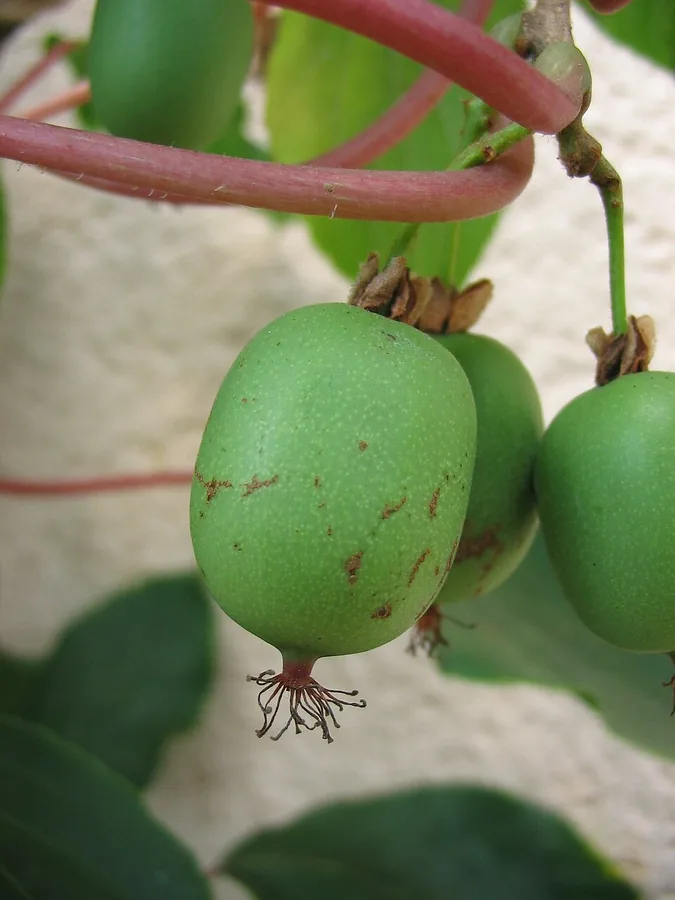
Hardy kiwi is the garden-friendly, cold-tolerant answer to the fuzzy kiwi at the market, and it earns its place as much for the leafy cover it throws as for the fruit. The berries come grape-sized with smooth, hairless skin, sweet and aromatic, meant to be eaten whole straight from the vine. Best of all for northern gardens, it stands up to winters as cold as -29°F (-34°C) that would end a regular kiwi.
This is a vine with real presence, so it belongs where it can make a statement rather than tucked into a corner. An established plant can reach 30 feet (about 9 meters) and gather enough weight to pull down a slight support, which is why a generous arbor or a sturdy T-bar trellis sets the right stage from the outset. That same appetite for space is behind its invasive listing in parts of the northeastern US, so keep it clear of wild ground and check local rules before it goes in.
The one design decision that shapes everything is pollination. Hardy kiwi is dioecious, meaning male and female flowers grow on separate plants, so at least one male has to share the setting to fruit the females. Give it a sunny, sheltered spot, a strong frame to climb, and a few unhurried years, and it settles into the routine of a heavy late-summer harvest.
Care
The short version: full sun and rich, well-drained soil kept evenly moist, staged on a trellis built heavier than the garden seems to need. Set a male among your females, prune firmly in winter, and give the planting a few years to find its rhythm before the first real crop.
Light
Hardy kiwi fruits best in full sun, which ripens the berries and fuels the vine's leafy cover. It will settle for partial shade, though the crop comes in lighter. A warm, sheltered corner of the garden also shields the early shoots from late frost.
Water
Keep the soil evenly moist, above all while the vine is establishing and while it carries fruit, watering roughly every 5 to 7 days. Water deeply rather than often. The rule that governs the rest is drainage, since ground that stays soggy invites root rot.
Soil
Give it fertile, well-drained loam rich in organic matter, though it takes clay, loam, or sand in stride. It leans slightly acidic, around pH 5.0 to 6.5. Drainage counts for more than texture, so work in compost and steer clear of any spot where water pools.
Temperature
This is a genuinely cold-hardy vine, holding through winter lows near -29°F (-34°C) and summer heat up to about 86°F (30°C). Its vulnerability is timing rather than cold itself, since a late spring frost can burn the tender new shoots once the vine has leafed out.
Humidity
Ordinary garden humidity in the 40% to 70% range suits it well, so there is no figure to manage. Open airflow around the trellis matters more, keeping the dense canopy from staying damp.
Feeding
Feed with a balanced complete fertilizer through spring and early summer while the vine is in active growth. Keep the nitrogen restrained, since too much drives leafy growth at the expense of fruit, the last thing a vine this eager needs.
Pruning
Hardy kiwi wants genuine pruning to stay productive and shapely on its frame. In winter, cut each fruiting stem back to 8 to 10 buds. Come summer, shorten the long, vigorous shoots again and keep the whole vine trained neatly to its trellis.
Repotting
This is an in-ground plant, grown on a trellis rather than in a pot, so it is rarely repotted. If you do start one in a container, move it on before the roots circle, stall, or dry out unusually fast, then settle it into the ground.
Size & spacing
Plan for scale. The vine reaches 25 to 30 feet (7.5 to 9 m) long and spreads 7 to 20 feet (2.1 to 6 m) wide, so give it a sturdy, dedicated frame and plenty of room to make its statement.
When to plant
Hardy kiwi keeps to the garden calendar. Start seed in late winter after a long cold spell, set young plants out in spring once hard frost has passed, then watch for fragrant flowers around June and grape-sized fruit ripening from late summer into fall.
Northern hemisphere
Southern hemisphere
Typical months for a temperate climate: start earlier in warm zones, later where spring frosts linger.
- Sow: Late winter (Feb-Mar) after 30-60 days cold stratification of seed
- Plant: Spring, after danger of hard frost has passed
- Harvest: Fragrant greenish-white flowers in late spring (around June); grape-sized fruit ripens late summer into fall (Sep-Oct)
Hardiness
USDA hardiness zones: 3–8
Temperature: down to -40°C
Troubleshooting
Most hardy kiwi disappointments trace to one of three roots: no fruit, wet ground, or a late frost. The early signs below tell you which is at play in your garden. Read the symptom, then act before it quietly costs you a season.
A tired, yellowing vine in heavy ground
When a vine sags and pales in a bed that never quite drains, root rot is usually behind it, brought on by wet ground that shuts oxygen out of the root zone. Lift a root to confirm, and the healthy firm white will have turned brown and soft. Rework the drainage or relocate the planting to a raised, free-draining position, and cut back the watering so the vine can find its footing again.
Fix:
- Improve drainage or move to a raised, well-drained site
- Reduce watering frequency
A lush canopy that never sets fruit
A hardy kiwi trained over a pergola can look flawless and still refuse to fruit, because the plant is dioecious and a female needs a male companion nearby, so a solitary vine stays purely ornamental. Time is a factor too, since a young planting often waits 3 to 5 years before its first harvest. Design the space around one male for every 6 to 8 females, leave the flowers open to the bees that drift through the garden, and let the seasons do their work.
Fix:
- Plant at least one male per 6-8 females
- Be patient; vines fruit only after several years of growth
- Ensure bees and other pollinators can reach the flowers
Early growth blackened by a late chill
A hardy kiwi leafs out ahead of the season, so a late spring frost can settle over the fresh growth overnight and leave the tender shoots blackened, wilting, and folded by morning. The setback rarely lasts, since the vine tends to resprout once the dead growth is trimmed away. Choose a planting spot that sits clear of the garden's low frost pockets, and keep a cover on hand for the nights a late chill is forecast.
Fix:
- Prune out blackened growth; vines usually resprout
- Cover or protect vines when late frost threatens
Toxicity
Reassuring news for households with pets: hardy kiwi is not toxic to cats, dogs, or anyone else who shares the space. The fruit is grown to be eaten, and the rest of the plant will not poison an animal that samples it. The one quirk worth knowing is that cats may be drawn to the foliage the way they are to catnip or silver vine, a harmless fascination rather than any danger.
Safe for
People · Cats · Dogs · Horses · Rabbits · Livestock · Birds
Cats None
A hardy kiwi over the patio poses no poisoning risk to a household cat, and its fruit is harmless. The quirk runs the other way: as with silver vine of the same genus, the foliage can charm a cat the way catnip does, so yours may lounge against the vine or nibble a young stem, which costs nothing but a shoot or two.
Dogs None
A dog nosing around the garden is safe here. A few of the grape-sized berries pass without trouble, though a whole heap of any unfamiliar fruit might bring on a brief, passing bout of loose stool.
Horses Safe
Horses can graze alongside the vine with nothing to fear, as neither the leaves nor the fruit hold anything toxic to them.
Rabbits Safe
Rabbits are safe too, and a little of the soft fruit makes a charming occasional treat, though their everyday diet should stay hay and greens rather than sweet kiwi.
Livestock Safe
Cattle, goats, and sheep can browse the foliage and windfall fruit at the garden's edge with no risk of poisoning from this plant.
Birds Safe
Birds take the ripe berries happily and unharmed, and in doing so they carry the seed off, part of why the vine finds its way beyond where it was planted.
People Safe
The smooth-skinned fruit is grown to be eaten whole like a grape, straight from the vine with no peeling, and it is perfectly safe for children and adults at the table.
Fruit is safe if a pet nibbles a few; very large amounts of any novel fruit may cause mild, temporary stomach upset.
Varieties
A short list of named cultivars covers most home gardens, divided between the fruiting females and the males kept purely to pollinate them. These are the ones worth choosing by name as you plan the planting.
Ananasnaya (Anna)
A beloved, heavy-cropping female chosen again and again for its sweet, aromatic fruit.
Issai
A partly self-fertile female that can set a modest crop even without a separate male vine sharing the space.
Geneva
An early-ripening female that crops well and brings the harvest to the table sooner in the season.
Meader Male
A male pollenizer that offers no fruit of its own and earns its place purely by pollinating the females around it.
Companions
Hardy kiwi grows best next to a male pollenizer and the bees that work its flowers, and worst when left to climb into trees and shrubs it can smother.
Plant near
Male Actinidia arguta cultivar: Required pollenizer; without a male nearby, female vines set no fruit.
Pollinator-attracting flowers: Bees and other pollinators improve fruit set on the kiwi flowers.
Keep apart
Trees and shrubs: The vigorous vine can climb and smother woody plants; keep it on a dedicated sturdy trellis.
How to propagate
Hardy kiwi can be increased more than one way, though only some methods hold the sex and quality of the parent. Choose the approach that suits the plan, whether you want a known cultivar or simply more vines to fill a run of fence.
Stem cuttingsModerate
Softwood cuttings in early to mid summer · About 6-10 weeks to root
Cuttings are the dependable way to carry a favorite named male or female forward true to type. Softwood cuttings taken in early to mid summer root in about 6 to 10 weeks, and starting from a known sex is what keeps a future harvest on the table.
SeedModerate
Sow in late winter after 30-60 days of cold stratification · Germinates in weeks; years to reach fruiting
Seed is the wild card of the group. Sown in late winter after 30 to 60 days of cold stratification, the seedlings appear within weeks, yet they grow up varied and of unknown sex until they first flower years later, so male or female stays a mystery until then.
LayeringEasy
Spring to summer · Roots within one season
Layering is the effortless route to a second plant. Pin a low cane to the soil any time from spring through summer and it will root within a single season, at which point you can free it and set the new vine wherever the garden needs it.
GraftingDemanding
Late winter to early spring · Takes within one growing season
Grafting is the connoisseur's method, used mainly to set a select cultivar onto vigorous rootstock. Worked in late winter to early spring, a graft that succeeds will take within one growing season.
Myths
The fruit is unsafe for household pets because cats respond to the plant as they would to catnip.
Cats can genuinely be drawn to Actinidia foliage, since silver vine shares its genus, but that fascination is a world apart from poisoning. The smooth-skinned, grape-sized fruit is edible and safe for cats and dogs alike.
A solitary hardy kiwi vine produces fruit entirely on its own.
Because most hardy kiwis are dioecious, a harvest calls for a male and a female together, roughly one male for every 6 to 8 females. The graceful exception is a partly self-fertile type like Issai, which sets at least a little fruit on its own.
Hardy kiwi calls for peeling, exactly as the fuzzy supermarket fruit does.
Its skin is smooth and hairless, nothing like the fuzzy kiwi from the supermarket. The whole berry is eaten like a grape, skin and all.