Herb · Lamiaceae
Lemon Balm
Melissa officinalis
A single brush past the leaves scents the whole space: lemon balm carries a bright, lemony freshness and asks for next to nothing.
Full sun
Every 5–7 days
50–86°F · 10–30°C
70–90 days
Overview
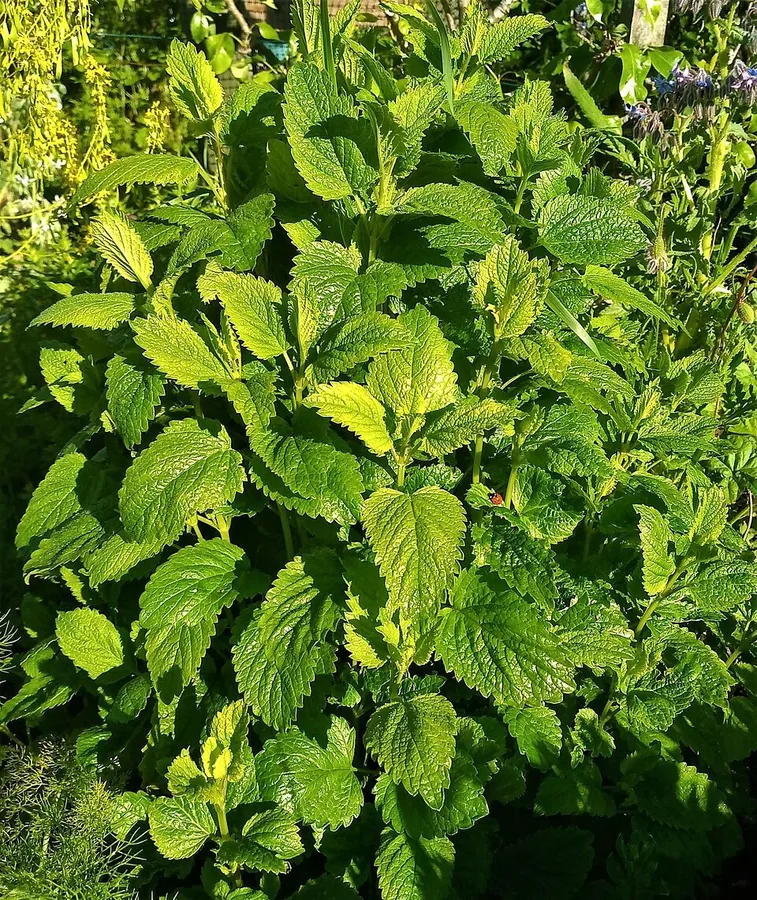
Lemon balm belongs to that small group of herbs that earn a place as much for atmosphere as for the kitchen. A hardy perennial in the mint family, it offers soft, crinkled leaves that give off a clean lemon scent the moment you brush them, which makes it a natural along a path, beside a doorway, or in a pot within arm's reach of a chair. It traveled here from the eastern Mediterranean and western Asia and has kept its place as a cottage garden staple for centuries, courted by bees and cooks alike.
What makes it so livable is how little it asks of a space. It settles into poor, sandy, or rocky ground, works in full sun or a pocket of shade, and takes a hard cut without complaint, so it slots easily into a busy plot or a low-effort corner. The one thing to design around is its appetite for spreading, by seed and by creeping root, which is why it looks its most polished in a pot or a clearly edged bed.
Woven into a daily routine, it rewards the smallest gesture. Gather the leaves before it flowers for the cleanest, sweetest lemon note in a pot of tea, a summer salad, or an evening dish. Let it bloom and the foliage coarsens, so a firm shearing after bloom brings back tender growth and returns the planting to its composed, well-tended look.
Care
The short version: set it in full sun to part shade in average, well-drained soil, water steadily while it establishes and far less once it settles. Feed it sparingly, gather leaves before it blooms, and shear it back after flowering to keep it lush and well-mannered.
Light
Lemon balm looks its best in full sun, where the foliage stays full and the scent runs strongest. It also settles into partial shade, a welcome option in a hot, bright garden, though too little light leaves it thin and inclined to flop.
Water
Keep young plants evenly moist as they find their footing, then ease off, since an established clump handles drought well and wants watering only about every 5 to 7 days in dry spells. What it will not abide is soggy ground, above all through winter, so give it a spot that drains cleanly.
Soil
It settles into almost any soil, from poor sand to clay to shallow rocky ground, so long as the drainage is sound. Average, well-drained loam at a pH of 6.0 to 7.5 suits it best. Rich soil, oddly, works against the look you want, growing plenty of leaf but a fainter scent.
Temperature
The plant is content between 50°F and 86°F (10°C to 30°C) through the season. As a perennial hardy to USDA zone 3, the roots weather a cold winter with ease and return with fresh growth each spring.
Humidity
Everyday outdoor humidity in the 40% to 60% range is all it wants. Air movement matters more than moisture here, since a crowded, still corner is what draws powdery mildew onto the leaves.
Feeding
This is a herb that thrives on very little feeding. A single light balanced feed in spring covers it, and heavier fertilizing only grows soft, leafy plants with a weaker lemon scent.
Pruning
Shear the plant after it flowers and clear the spent stalks to draw out fresh, fragrant growth while curbing its self-seeding. Harvesting the leaves often, before bloom, doubles as pruning and delivers the finest flavor.
Repotting
In a container, repot or divide every 1 to 2 years, ideally in spring. Roots circling the pot or slipping through the drainage holes, along with slowed growth and quick drying, all signal it has outgrown its home.
Size & spacing
A mature plant reaches 18 to 35 inches (45 to 90 cm) tall and spreads about as wide. Allow each one 18 to 35 inches (45 to 90 cm) of room so air moves freely and mildew keeps its distance.
When to plant
Fitting lemon balm to the seasons is an easy rhythm to keep. Start seeds indoors in late winter, move plants into the garden in spring once frost has gone, and gather leaves across summer, finishing the fullest harvest before it flowers around June to August.
Northern hemisphere
Southern hemisphere
Typical months for a temperate climate: start earlier in warm zones, later where spring frosts linger.
- Sow: 6-8 weeks before the last spring frost
- Plant: Spring, after the last frost
- Harvest: Small white to pale-yellow flowers in summer (about June-August); harvest leaves before flowering for best flavor
Hardiness
USDA hardiness zones: 3–9
Temperature: down to -40°C
Troubleshooting
Lemon balm rarely disrupts the picture. When it does, the cause is almost always crowding, still air, or its own drive to spread. Find the look that matches yours below, and a simple adjustment usually restores the planting.
Seedlings drifting well beyond the original planting
Allowed to flower, lemon balm sows itself generously and travels outward on rhizomes, so a composed clump gradually loosens into a colony over a season or two. Cut it back before the flowers set seed, and lift the stray seedlings while they are young. A pot keeps the planting where it was meant to sit, and the arrangement stays deliberate.
Fix:
- Deadhead and cut back before seed set
- Pull volunteer seedlings
- Grow in a container to contain spread
A pale, powdery haze dulling the foliage
When the leaves take on a chalky bloom, the culprit is powdery mildew, a fungus that arrives where plants sit close and the air hangs still. Lift out the worst leaves, open up the planting so a current can pass through, and keep water off the foliage. A sunny, breezy position usually restores the fresh green look on its own.
Fix:
- Remove and discard affected leaves
- Improve air circulation by thinning and spacing plants
- Avoid overhead watering
A loose, open silhouette once the flowering fades
Past its bloom, lemon balm tends to sprawl open and harden toward the base, leaving a thinner crown of leaves and a less tidy shape. One firm cut across the whole plant resets it, and fresh, compact growth follows within a few weeks. Make that shear a yearly ritual after flowering and the clump keeps its full, well-kept form.
Fix:
- Cut plants back hard after flowering to force fresh compact growth
Toxicity
Here is the easy part: lemon balm is safe throughout the home. The ASPCA lists it as non-toxic to cats, dogs, and horses, and as a kitchen herb it finds its way onto the table every day. The only patience it tests belongs to the gardener keeping its spread in check.
Safe for
People · Cats · Dogs · Horses · Rabbits · Livestock · Birds
Cats None
A cat can share the room with it in comfort. Should one sample a leaf, the potent oils might bring a brief, mild stomach upset, and nothing beyond that.
Dogs None
There is no cause for concern with a dog nearby. A curious chew of the lemony leaves does no harm.
Horses None
Horses come to no harm from grazing on lemon balm.
Rabbits None
Rabbits take the leaves in stride, and many welcome the fragrant foliage as a small indulgence.
Livestock None
Cattle, goats, and sheep may browse it at leisure with no ill effect.
Birds None
The foliage holds no danger for backyard birds or poultry.
People None
This is a herb of the kitchen, steeped into tea and folded into dishes. The leaves are safe for adults and children to eat.
Non-toxic culinary herb; leaves are edible and commonly consumed.
Varieties
The plain green species anchors most plantings, but a few selections earn their place for the color or scent they lend a space. These are the ones worth seeking out by name.
Aurea
Its gold and green marbling brings a lit-from-within quality to a planting, at its most luminous in cool weather and partial shade.
All Gold
A wash of solid golden yellow makes it a natural accent, holding that glow best where a little shade keeps the leaves from scorching.
Lime
It trades the familiar lemon note for a brighter, lime-like scent, a fresh twist for a fragrant border or a windowside pot.
How to propagate
Filling more of the garden with lemon balm could hardly be simpler. Divide a clump, root a cutting, or sow seed, and it will seed itself around the beds whether or not the idea was yours.
DivisionEasy
Spring or early fall · 4-6 weeks
Division is the dependable way to keep a named cultivar looking exactly as it should. Lift a mature plant in spring or early fall, ease the crown apart into pieces, and settle each one back into place. Every division roots and finds its footing in about 4 to 6 weeks.
Stem cuttingsEasy
Late spring to summer · 3-4 weeks
Soft stem cuttings ask almost nothing of you. Take a few from late spring into summer, rest them in a moist mix or a glass of water on a bright sill, and roots appear in roughly 3 to 4 weeks.
SeedModerate
Spring; surface-sow as seed needs light · 2-3 weeks to germinate, several weeks more to establish
Seed is the unhurried route, and it will not keep a cultivar true, given how freely the plant sows itself. Scatter the seed across the surface in spring rather than covering it, since light and warmth are what call it up. Sprouts arrive in 2 to 3 weeks, with several more before the seedlings truly settle.
Myths
Lemon balm is simply another kind of true mint.
It does keep company with the true mints in the family Lamiaceae, yet it stands in its own genus, Melissa, and is no Mentha. The lemon fragrance and the softer, gentler leaves give it a character all its own.
Lemon balm keeps to its place and won't roam like mint.
It ranges just as widely, only along a quieter path. Left to flower, it self-seeds freely and creeps on rhizomes, slipping past the border unless it is deadheaded or settled into a container.