Ornamental · Poaceae
Pink Muhly Grass
Muhlenbergia capillaris
Set it in full sun and lean, dry ground, and pink muhly grass drapes the garden in a rose-pink haze each fall.
Full sun
Every 7–14 days
USDA 6–10
2–3 ft · 0.6–0.9 m
Overview
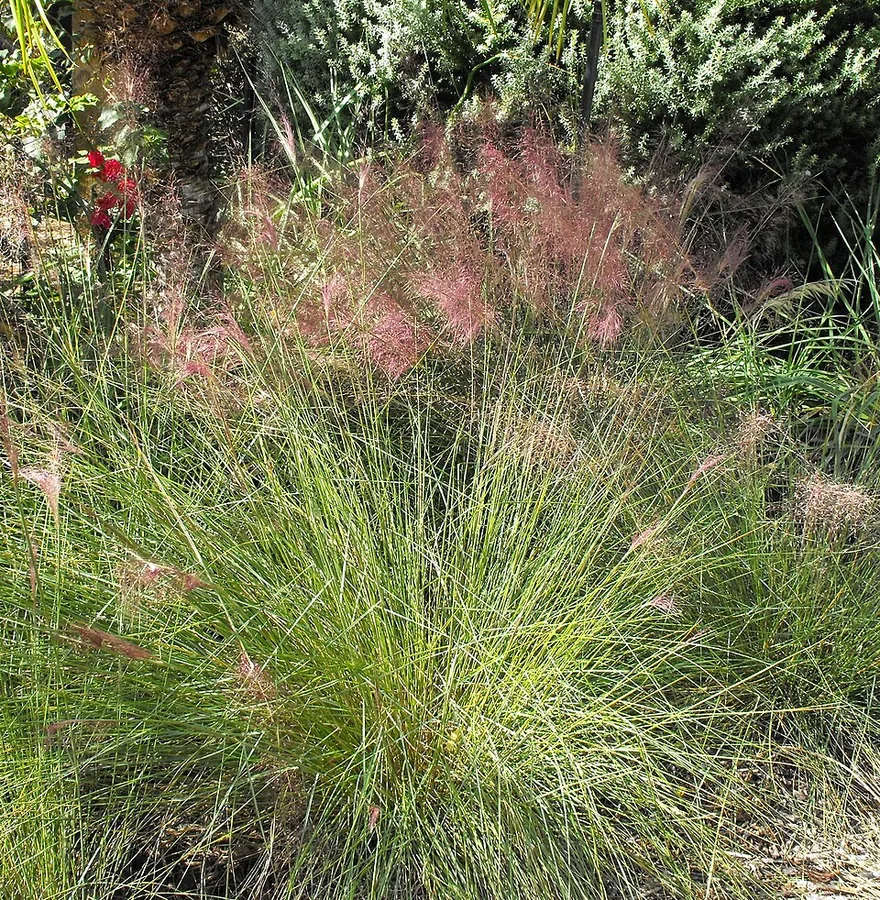
Pink muhly grass is a clump-forming native of the eastern and southern United States, kept in gardens for one memorable seasonal moment. Through most of the year it holds a quiet fountain of fine green blades, a calm green anchor at the edge of a border or path, and then autumn arrives and it lifts an airy cloud of rose-pink plumes that catches the low, slanting light. It belongs to the grass family and settles into a planting with almost no demands.
Part of its appeal is how gracefully it fits a real garden and a real routine. Once established it takes heat, coastal salt, and dry stretches in stride, and it stays clear of the pests and diseases that keep fussier ornamentals on a schedule. What it does ask is the right position, meaning full sun and lean, fast-draining soil, since a rich, damp corner leaves it loose and slumping rather than upright.
Massed along a drive, a fence line, or the back of a bed, its fall color reads from across the space, a soft drift of pink that carries the garden for weeks before turning to warm tan for winter. It keeps to its place instead of wandering, so it holds a composed edge in a design, and a single late-winter cut-back is nearly all the attention a season asks.
Care
The short version: full sun, lean and well-drained soil, and very little water once it has settled. Leave the fertilizer aside, let it stand through winter as a quiet backdrop, and cut it back hard in late winter before new growth begins.
Light
Give it full sun, 6 or more hours a day, and choose the position with that in mind. Sun is what builds the dense, upright clump and the heavy pink bloom that carries a fall garden, and it decides more than anything how good the planting looks. In shade the stems weaken, the plumes thin, and the clump loses its shape and falls open.
Water
Water it regularly through the first season while it settles into a new spot, and after that it asks for almost nothing. Established plants are highly drought tolerant and coast on rainfall in most gardens. The pitfall runs the other way, since a wet, soggy position rots the crown.
Soil
It belongs in lean, dry, well-drained soil, the sandy or rocky ground that leaves choosier plants sulking. Any pH from 5.5 to 8.0 suits it, and it even manages clay where the drainage stays sharp. Pass over the rich, amended beds, which only leave it loose and floppy.
Temperature
This is a hardy, adaptable grass, at ease across a wide range of roughly -9°F to 104°F (-23°C to 40°C). It carries summer heat without strain and comes through hard winters down to zone 6.
Humidity
Ordinary outdoor humidity is all it needs, with no figure to manage. Far more telling is good drainage and open air around the crown, since a lingering damp is the one condition it will not accept.
Feeding
Leave it unfed. This native is at its best in lean, low-fertility soil, and a feeding works against you by pushing soft, leafy growth and fewer blooms. Restraint is what keeps it upright and flowering through its season.
Pruning
There is just one task on the calendar. Cut the whole clump back to about 6 to 8 inches (15 to 20 cm) in late winter or early spring, before the new blades rise. Leave the old foliage standing over winter, where it earns its keep as a soft, tawny backdrop and a touch of cold protection.
Repotting
It seldom needs dividing or a new pot. After many years an aging clump may die out in the center, leaving a bare ring with fading vigor and fewer plumes, which is the moment to lift and divide it rather than repot.
Size & spacing
Plants reach about 2 to 3 feet (61 to 91 cm) tall and just as wide. Space them roughly that far apart, around 2 to 3 feet (61 to 91 cm), so each clump rounds into its full form and reads as a clean, rhythmic line in the planting.
When to plant
Pink muhly grass keeps a warm-season rhythm, greening up in spring and reserving its finest hour for fall. Sow seed indoors in late winter to early spring and set plants out after the last frost, and the pink plumes arrive to carry the garden from September into November.
Northern hemisphere
Southern hemisphere
Typical months for a temperate climate: start earlier in warm zones, later where spring frosts linger.
- Sow: Late winter to early spring
- Plant: Spring after last frost
- Harvest: September to November
Hardiness
USDA hardiness zones: 6–10
Temperature: down to -23°C
Troubleshooting
This is an unfussy grass, so real trouble is rare and nearly always comes down to the position rather than a disease. The signs surface in the bloom, the crown, or the base of the stems. Match what you see below, then adjust the setting behind it.
The plant rots or fades in soggy ground
A clump that softens at its heart and thins from the center is showing root and crown rot, the near-inevitable result of a low, wet corner where water lingers. This grass belongs in a fast-draining setting, not a boggy one. Give it sandy or rocky ground, raise it on a gentle mound where the border runs to clay, and let the soil dry between waterings so the crown stays sound.
Fix:
- Plant in well-drained sandy or rocky soil, or amend heavy soil and plant on a raised mound or berm
- Reduce irrigation; allow soil to dry between waterings
- Remove dead rotted portions and replant healthy divisions in a drier, well-drained site
White cottony clusters at the base of a stressed plant
Waxy white flecks gathered low at the leaf bases and crown mark muhly grass mealybug, the single pest that ever intrudes on this composed, low-fuss grass. Left unchecked, a colony dulls the planting and stalls its growth. Clear away the affected foliage during the late-winter tidy, ease off any fertilizer that pushes the tender growth the insect favors, and let resident predators keep it in check.
Fix:
- Cut back and remove heavily infested foliage in late winter
- Encourage natural predators and avoid excess fertilizer that flushes soft growth
Few or no pink plumes, and the clump flops open
When the fall display never arrives and the clump lolls open across a border, the setting is usually to blame, most often shade or overly rich soil. Too little sun softens the stems and mutes the flowering, while pampered, well-watered ground trades those signature plumes for a mound of loose green leaf. Reset the planting into a bright, open spot with 6 hours of sun, retire the feeding, and water sparingly so the grass grows lean and holds its poised, upright shape.
Fix:
- Relocate or plant in full sun (6 or more hours of direct sun) for the best plume color, density, and upright form
- Stop fertilizing and reduce watering; grow in lean, dry, well-drained soil
- Cut back in late winter so vigorous new growth emerges in the right conditions
Toxicity
For a home shared with pets, the news is easy: pink muhly grass is safe throughout. It holds no toxins for cats, dogs, horses, rabbits, livestock, or people, and it is absent from the ASPCA's list of harmful plants. The only note worth keeping is its heavy fall pollen, which can trouble people prone to seasonal allergies.
Safe for
People · Cats · Dogs · Horses · Rabbits · Livestock · Birds
Cats None
A household cat can share the garden with it comfortably, since the leaves and plumes hold nothing toxic. Graze a large mouthful and a cat may bring it back up, as grass so often prompts, but the story ends there.
Dogs None
The family dog is on safe ground here. A determined chewer might manage a passing bout of vomiting, the kind any grass can bring on, and little else.
Horses None
Horses may graze alongside it in ease, as the grass carries no toxins to trouble them.
Rabbits None
Rabbits are free to browse the foliage, which is nothing more than a gentle, harmless grass.
Livestock None
Cattle, goats, and sheep face no hazard from this native grass and may graze it at will.
Birds None
Birds come to no harm near it, and many drift in to pick at the seed heads across fall and winter.
People None
It is a pleasure to handle and plant, with no risk to the gardener. The lone footnote is the heavy fall pollen, which can stir seasonal allergies in those who are sensitive.
Not poisonous, but pets that nibble large amounts of grass may vomit, and the abundant fall pollen can aggravate seasonal allergies in sensitive people.
Varieties
The straight species, grown for its pink fall haze, suits most gardens beautifully, yet a few selections and close relatives are worth having in mind as you plan.
White Cloud
A selection that swaps the familiar pink for a softer white to cream haze and stands up to tar spot more gracefully than the species.
Pink Flamingos
A taller natural hybrid of M. capillaris and M. lindheimeri reaching 3 to 4 feet, its bright pink plumes settling into silvery-gray as the season turns.
Lindheimer's muhly (Muhlenbergia lindheimeri)
A larger relative from central Texas, a 2 to 5 foot silvery-plumed clumping bunchgrass that makes an elegant tall specimen.
Bamboo muhly (Muhlenbergia dumosa)
A relative of arching, semi-woody bamboo-like stems and lacy pale-green foliage that pours into a fountain 5 feet tall and wide.
How to propagate
Pink muhly grass is easy to bring on around the garden, whether you divide a clump already in the ground or begin fresh from seed.
DivisionEasy
Spring · One growing season
For more of it around the garden, the easiest path is to divide an established clump in early spring. Lift the whole crown, part it into sections, and settle each back into place. A division finds its feet over a single growing season and returns as a full, shapely plant.
SeedEasy
Spring (sow indoors late winter to early spring)
Seed is an easy alternative, and it stays where you want it, since this grass grows in a tidy clump rather than running by rhizomes. Sow indoors in late winter to early spring and move the seedlings out after frost. Allow them one to two growing seasons to reach their blooming stride.
Myths
Muhly grass needs rich, fertilized, frequently watered soil to bloom well.
The truth turns that on its head. Set in full sun and lean, dry, well-drained soil, this grass blooms at its fullest and keeps its upright poise, whereas rich, wet, fed ground yields only floppy leaf, thin flowering, and a risk of root rot. Restraint is what brings out its best display.
Sources
- USDA NRCS PLANTS Database
- NC State Extension Gardener Plant Toolbox
- Missouri Botanical Garden
- University of Florida IFAS Gardening Solutions
- Texas A&M AgriLife Extension (Texas Superstar)
- NC State Extension Gardener Newsletter
- ASPCA Animal Poison Control
- NC State Extension Gardener Plant Toolbox
- NC State Extension Gardener Plant Toolbox