Ornamental · Poaceae
Pampas Grass
Cortaderia selloana
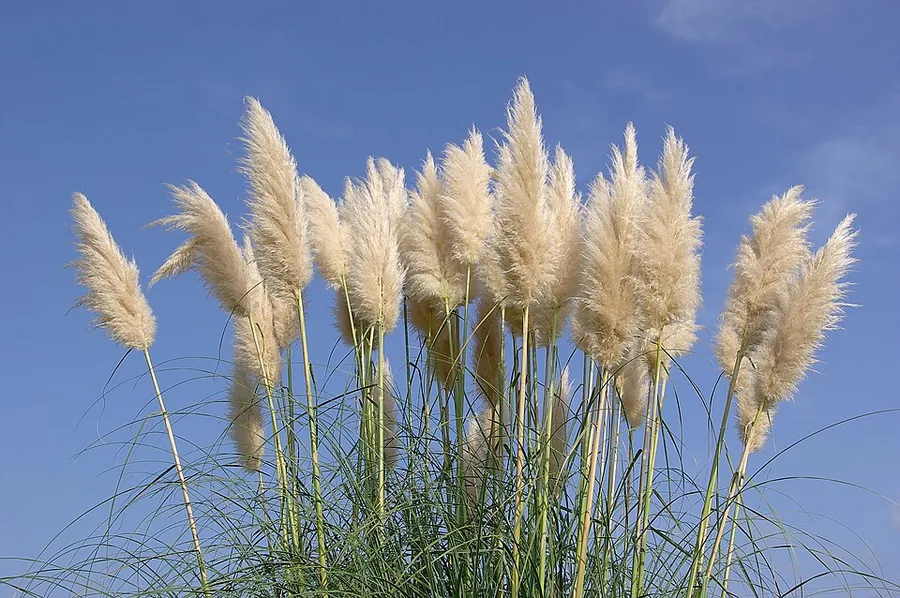
Little in a garden makes a statement like a pampas grass clump in full plume, yet those silver feathers ride on razor-sharp leaves.
Full sun
Every 7–14 days
USDA 7–10
6–12 ft · 1.8–3.7 m
Overview
Pampas grass is the tall, plume-crowned grass that gives a garden its sense of drama, the piece that anchors a wide border or screens a view with quiet confidence. It traces back to South America, answers to the botanical name Cortaderia selloana, and belongs to the grass family. Once established it asks almost nothing of a busy household, standing up to drought, heat, salt spray, and wind without complaint.
The plumes set the mood of a space. From late summer each clump lifts a fountain of silver-white feathers that hold their shape well into winter, softening a fence line, framing a terrace, or lending a coastal home its signature horizon-meets-garden calm across a spread that can top 12 feet. The same foliage brings a real caution, since every blade is edged with fine, razor-sharp serrations that cut bare skin on contact.
One point deserves thought before it earns a place in the design. In mild-winter regions along the Pacific coast and in Hawaii, pampas grass self-seeds into a serious invasive, crowding out native plants and feeding wildfire. Where it stays put it is a bold, low-effort feature that carries a whole planting scheme; where it does not, the graceful choice is to look elsewhere.
Care
The short version: give it full sun and well-drained ground, water it only while it establishes, and cut the whole clump down hard each late winter, with gloves and long sleeves on every single time.
Light
Pampas grass asks for full sun to plume well and hold its upright, sculptural line. It will accept partial sun or light shade, but too little light leaves the clump loose and floppy and thins out the very feathers that give it presence.
Water
Water a new plant regularly through its first season to settle the roots. After that it turns highly drought, heat, salt, and wind tolerant and needs little to no extra water, an easy fit for a low-maintenance garden. Keep it clear of wet, poorly drained spots, which shorten its life and invite winter damage.
Soil
This grass takes almost any well-drained soil, from clay to loam to sand to rocky ground, at anything from dry to medium moisture. It handles a wide pH band, roughly 5.5 to 8.5, so soil chemistry is rarely what stands between you and the look you want.
Temperature
It is hardy across a broad range, from about 10°F to 100°F (-12°C to 38°C), which covers zones 7 through 10. Cold below that line risks the crown, while the heat at the top of the range leaves it entirely unruffled.
Humidity
Ordinary outdoor humidity suits it, so there is no figure to manage. Air movement matters more than moisture in the air, and an open, breezy site is exactly the setting this wind-tolerant grass wears best.
Feeding
Feed lightly with a balanced general-purpose fertilizer in spring during the growing season. An established clump needs very little, and heavy feeding only pushes soft, weak growth that undermines its poised silhouette.
Pruning
Cut the whole clump back hard to about 1 to 2 feet (30 to 60 cm) in late winter, before new growth starts, using hedge shears, loppers, or power pruners. Always work in gloves, a long-sleeve shirt, and eye protection, since the serrated blades cut skin with ease.
Repotting
Pampas grass is rarely repotted and holds its place in a scheme for years. Move or divide it only when it outgrows its space, the center of the clump goes dead and thatchy, or the crowded crown starts lifting out of the soil.
Size & spacing
A mature clump stands roughly 6 to 12 feet (1.8 to 3.7 m) tall and spreads about 4 to 7 feet (120 to 205 cm) wide, so plan its spot with room to spare. Give it open ground, well clear of paths and play areas, so no one brushes the sharp leaves as they pass by.
When to plant
Pampas grass is a warm-region perennial at home in zones 7 to 10, and it keeps an easy seasonal rhythm. Set new plants out in spring so they root through the growing season, let the silver plumes rise from late summer into fall as the garden's crowning note, then cut the clump to the ground in late winter before fresh growth begins.
Northern hemisphere
Southern hemisphere
Typical months for a temperate climate: start earlier in warm zones, later where spring frosts linger.
- Plant: spring
- Harvest: late summer to fall, plumes persist into winter
Hardiness
USDA hardiness zones: 7–10
Temperature: down to -18°C
Troubleshooting
Pampas grass rarely gives way to a pest or a disease. Only two concerns truly shape how you live with it: the cuts its blades can leave and its habit of drifting beyond the bed you gave it. Both are simple to notice and simple to head off.
New clumps arriving well beyond the bed you planted
This wandering habit is invasive self-seeding, the plant's least gracious trait. A single plume can release well over 100,000 wind-borne seeds across a year, and stray root or rhizome fragments settle just as easily into moist ground, so newcomers appear downwind on disturbed, coastal, or open land. Lift young crowns whole while they remain small, and cut and bag the plumes before the seed matures rather than composting them or moving seed-laden soil into fresh corners of the garden.
Fix:
- Remove volunteer seedlings while young by digging out the entire crown
- Cut and bag flowering plumes before seeds mature and disperse
- Do not compost plumes or move soil containing seed
Stinging cuts across your hands and arms after a session with the plant
These marks are no sign of pests or disease, only the plant's own foliage at work. Each blade is finished with razor-sharp, finely serrated edges that draw across the skin the instant a handful is gathered, leaving cuts that are thin, clean, and deeper than expected. Dress for the task in thick gloves, a long-sleeve shirt, long pants, and eye protection, and let shears or loppers bring the clump down rather than pulling the foliage by hand.
Fix:
- Stop handling bare-skinned and wash and dress any cuts
- Always wear thick gloves, a long-sleeve shirt, long pants, and eye protection
- Cut the clump back with hedge shears, loppers, or power pruners rather than pulling foliage by hand
Toxicity
The reassurance comes first, the caution close behind. No part of pampas grass is toxic, and the ASPCA rates it safe for cats, dogs, and horses. The real hazard is physical, since the leaf edges are razor-sharp and slice skin like paper, so handle it in gloves and keep pets and children from running through the clump.
Safe for
People · Cats · Dogs · Horses · Rabbits · Livestock · Birds
Cats None
A household cat runs no risk of poisoning from this grass, so a passing taste stays harmless. The one thing to mind is the blade edge, which can nick a mouth, making it wise to keep a curious cat from chewing.
Dogs None
The family dog can live alongside this plant with no fear of poisoning at all. It only pays to keep an eager dog from bounding through the clump, since the serrated leaves can leave a thin cut on a nose or paw.
Horses None
A horse faces no toxic threat from pampas grass in the paddock. Even so, grazing near it can scrape a lip or tongue on the sharp-edged blades, so a clump set behind fencing is the more elegant arrangement.
Rabbits Safe
A rabbit meets no toxin in this grass to cause any concern. The stiff, cutting leaves are simply too coarse to tempt a nibbler, so the plant rarely draws its interest to begin with.
Livestock Safe
Cattle, goats, and sheep can share a field with this grass free of any poisoning risk. Most walk past it of their own accord, turned away by the harsh, blade-edged foliage that offers little worth grazing.
Birds Safe
Birds face no chemical harm and often find shelter within the dense plumes. The familiar caution holds, the edges are sharp, yet winged visitors seldom brush against them in passing.
People Safe
No part of the plant is poisonous to handle or keep close at home. The genuine concern is mechanical, since the razor-sharp leaf edges cut skin like paper, so gloves and long sleeves belong on hand whenever the work brings you near it.
Not poisonous, but the sharp-edged leaves can inflict deep cuts on skin. Wear gloves, long sleeves, and eye protection when planting, handling, or pruning, and keep pets and children from running through or chewing the foliage to avoid mouth and skin cuts.
Varieties
Pampas grass arrives in a handful of named forms that differ in size, plume color, and leaf markings. These are the ones most likely to find their way into a design.
Pumila
A compact dwarf that settles around 4 to 6 feet and weathers cold more gracefully, which has made it the most widely chosen form for smaller settings.
Rosea
Softens the familiar silvery-white plumes into a gentle wash of pink.
Sunningdale Silver
A tall, generous selection admired for the size and fullness of its silvery-white plumes.
Silver Comet
A variegated form dressed in crisp white-and-green striping along the foliage.
Gold Band
A variegated form whose leaves carry warm gold banding striped in yellow and green.
How to propagate
There are two ways to multiply pampas grass, though only one keeps those showy plumes true. Whichever you choose, the sharp leaves make gloves and long sleeves part of the ritual.
DivisionModerate
Late winter to early spring · 1-2 growing seasons
Division stands as the most reliable way to multiply pampas grass, carried out in late winter to early spring, and it alone keeps the showy female plants true to type. Allow a divided clump one to two growing seasons to settle in and take on its full presence. The crowns are dense and the leaves are sharp, so gloves and protective clothing come first before any clump is cut apart.
SeedEasy
Spring · 1 growing season to first flowering in favorable climates
The plant self-seeds with abandon, and in a kind climate a spring sowing can flower within a single growing season. The trade-off is variability, with many plain, less-showy male plants turning up among the seedlings. Set seed aside entirely wherever pampas grass is invasive, since raising it would only add to the spread.
Myths
All large, feathery pampas grass is the same plant.
The look may read as one plant, but two species answer to the name. The refined ornamental most gardens plant is Cortaderia selloana, quite apart from jubata grass, or purple pampas grass, which is Cortaderia jubata. Jubata grass is the far more aggressive invader, setting seed without any pollination and overrunning coastal and redwood-forest land. The pair look almost identical and share the same sharp serrated leaves, though jubata grass keeps to cool, foggy coasts while selloana also takes hot, dry inland heat in stride.
Pampas grass is poisonous to pets.
A common worry, but one the record sets aside. The ASPCA lists Cortaderia selloana as non-toxic to cats, dogs, and horses, and it holds no poison whatsoever. The single real danger is a mechanical cut from the razor-sharp leaf edges, never anything a pet could be poisoned by.