Tree · Betulaceae
Paper Birch
Betula papyrifera
Give it a cool, moist root run and paper birch answers with brilliant white bark that lifts a garden for decades.
Full sun
Every 3–7 days
USDA 2–7
50–70 ft · 15.2–21.3 m
Overview
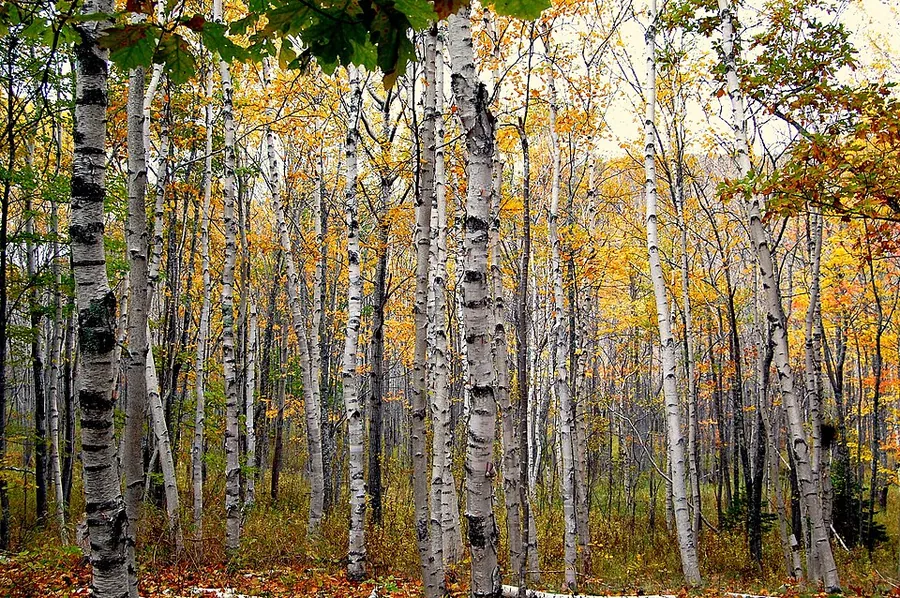
Set against a bare winter garden, few trees carry a scene the way a paper birch does, its bright white bark loosening into papery curls that catch the low light. A fast-growing native of the far north, it ranges clear across the continent through the cold woods of Canada and the northern states, which lends any planting a quiet sense of place. Indigenous peoples once shaped its waterproof bark into canoes, the story behind the name canoe birch and part of the tree's understated romance.
This is a tree of cold country, at ease with a hard winter yet quick to falter where summers turn hot and dry. It rises fast and stands tall, often reaching 50 to 70 feet (15 to 21 meters), though it keeps its place for decades rather than centuries, a graceful presence rather than a permanent one. Give it a cool, moist corner and it settles beautifully into a garden; press it into a baking city lot and it slips into early decline.
One thing shapes a paper birch's life in a landscape more than any other: the bronze birch borer, which seeks out trees under strain. Keep the roots cool, the soil moist, and the tree in good heart, and the elegant white column stays part of the view for years to come.
Care
The short version: give it full sun with cool, evenly moist, slightly acidic soil, a generous mulch to keep the roots cool, and steady water through heat and drought, and its white bark will grace the garden while the borer stays away.
Light
Paper birch wants full sun and will not linger in shade, a pioneer at heart that seeks out open ground. It accepts a measure of partial sun, but the more light it draws, the finer its bark and the stronger its frame in a garden.
Water
Keep the soil cool and evenly moist, since this is a tree with no taste for drying out. Water it deeply through heat and drought and lay a bed of mulch over the root run to keep it cool, because drought stress is exactly what draws the bronze birch borer. Dry, compacted ground has no place beneath it.
Soil
Offer it moist, well-drained, sandy or silty loam on the acidic side. A pH held between 5.0 and 6.5 keeps it in fine condition, while drifting much higher turns the leaves yellow with chlorosis.
Temperature
Cold suits it to the core, and it stands through winters down to -49°F (-45°C) without complaint. Heat is the trial instead, and it begins to struggle once summers climb past about 86°F (30°C).
Humidity
Ordinary outdoor humidity suits it well, so there is no figure to chase. What counts far more is good airflow through the canopy, which keeps leaf-spot fungi from settling in through a wet season.
Feeding
A balanced tree fertilizer in spring keeps a paper birch in strong form, and that strength is its finest defense against the borer. Feed it through the season as needed to hold that vigor.
Pruning
Time the pruning for summer through early fall, and keep well away from late winter and early spring, when fresh cuts bleed sap heavily. Lift out dead and borer-infested branches whenever they appear.
Repotting
not applicable - landscape tree
Size & spacing
This is a large tree, rising 50 to 70 feet (15 to 21 meters) tall with a spread of roughly 30 to 35 feet (9 to 11 meters). Set it where it has open room and a spot that keeps the roots cool and shaded within the wider composition of the garden.
When to plant
Paper birch is a cold-country tree, most at home in the northern zones where summers stay temperate. Plant it in the cool of spring or fall, and watch for the dangling catkins that open in spring, around April to May, to signal the season turning.
Northern hemisphere
Southern hemisphere
Typical months for a temperate climate: start earlier in warm zones, later where spring frosts linger.
- Plant: Spring or fall
- Harvest: Catkins in spring (April to May)
Hardiness
USDA hardiness zones: 2–7
Temperature: down to -46°C
Troubleshooting
Almost every concern with a paper birch comes back to a tree under strain and the pests that follow. Keep a watchful eye on the crown and the foliage through the season and act early, since the most serious change often begins quietly at the very top.
Crown fading from its highest branches, bark marked by D-shaped holes
When the crown that once framed a patio or driveway starts thinning from the top and small D-shaped holes appear in the bark, the bronze birch borer has moved in, and it is the gravest threat a paper birch faces. The larvae mine beneath the bark and interrupt the flow of water, so the tree fails downward from its highest point. The reassuring truth for anyone who plans a landscape around it: the borer only takes a tree already under strain, so a cool, well-watered, thriving specimen keeps its silhouette for years.
Fix:
- Prune out and destroy infested and dead branches
- Reduce stress by watering deeply and mulching to cool the roots
- Apply a registered insecticide when adults are active in June
- Maintain tree vigor; larvae do not survive in healthy trees
Leaves freckling brown by midsummer and shedding before their season
Brown spots and blotches that dull the summer canopy by July signal Marssonina leaf spot and anthracnose, fungi that thrive in a damp season and can bare the tree by late summer. Clearing and discarding the fallen leaves keeps the spores from returning, and opening the canopy for air movement keeps the foliage looking its best. Even after a hard defoliation, a healthy tree returns to full leaf the following spring.
Fix:
- Rake and destroy fallen infected leaves
- Improve air circulation and avoid overhead wetting
- Keep tree vigorous with proper watering and mulch
Faint pale markings on the leaves ripening to brown blotches
Pale patches that deepen into brown blotches across the canopy are the mark of the birch leafminer, whose larvae feed hidden between the leaf surfaces. Held against the light about ten days after bud break, a leaf reveals the small tenants at work. The blemish reads more dramatic than it is, and a well-watered tree carries the season's polish through it without missing a beat.
Fix:
- Treat with a registered systemic insecticide when larvae first hatch and begin feeding
- No control is needed once large brown blotches appear, as larvae have already left
Rumpled, yellowing leaves glazed with a sticky residue
Leaves that pucker and yellow beneath a sticky sheen are hosting aphids at the new growth. A modest gathering does no lasting harm, and the lady beetles and other visitors that arrive tend to restore order on their own. Should a colony swell, a firm pass of water from the hose sends it on its way and returns the tree to form.
Fix:
- Tolerate light infestations, as natural predators usually provide control
- Wash off heavy infestations with a strong stream of water
Toxicity
For a home shared with pets or grazing animals, paper birch brings no worry: it is not toxic to any of them. There is no poison in the leaves, bark, twigs, or sap, and the spring sap is even tapped and reduced into birch syrup. The most a curious taste brings is a mild, passing upset.
Safe for
People · Cats · Dogs · Horses · Rabbits · Livestock · Birds
Cats None
A paper birch holds nothing that could poison a cat, so it settles easily into a household with one. A stray nibble may bring a little drool or a passing upset stomach, the ordinary response to any plant a cat shouldn't taste, and nothing beyond that.
Dogs None
Dogs share a garden with paper birch without concern. A gnawed branch or piece of bark won't poison them, though a generous mouthful of leafy material can unsettle the stomach for a day.
Horses Safe
Paper birch keeps good company with horses, and the leaves and twigs are browsed now and then with no harm done. Nothing toxic lives in it, so it sits easily on pasture or along a paddock fence.
Rabbits Safe
Rabbits may nibble the bark and twigs in perfect safety. Wild rabbits and hares strip young birch through the winter as a matter of habit, and the tree carries no poison for them.
Livestock Safe
Cattle, goats, and sheep browse paper birch with no ill effect. Neither the leaves nor the bark holds anything toxic, so an animal reaching the lower branches comes to no harm.
Birds Safe
Birds are wholly safe around paper birch, and many make their living from it, drawn to the catkin seeds and the insects tucked in the bark. The tree offers them no risk at all.
People Safe
Paper birch is safe for people, with no poisonous part to it. The spring sap is even tapped and reduced into birch syrup, in the same tradition as maple.
No special handling required; ingestion of plant material may still cause mild stomach upset in pets.
Varieties
The wild species carries most gardens on its own, though a pair of named selections stand apart for the beauty of their bark and their staying power.
Renaissance Reflection
A refined selection sought after for its luminous white bark and stronger constitution, and for resisting the bronze birch borer better than the wild tree.
Varen (Prairie Dream)
A cold-hardy selection carrying bold white bark, chosen to keep its poise in the harsh, open landscapes of the far north.
How to propagate
Paper birch comes almost entirely from seed, since cuttings rarely take to the effort.
SeedModerate
Sow in fall or after cold stratification in spring · 1 to 2 growing seasons
Nearly every paper birch begins life from seed. Sow the fine seed in fall, or chill it and sow in spring, giving it light and open, moist mineral soil to rise on. A young tree asks for one to two growing seasons to find its footing in the landscape.
Stem cuttingsDemanding
Summer (softwood) · Variable; often unreliable
Cuttings seldom reward the effort with paper birch. Softwood cuttings taken in summer root poorly and stay unreliable at best, which is why the tree is raised from seed almost without exception.
Myths
A paper birch settles into any garden as effortlessly as a river birch.
It is a natural assumption that these two birches slot into the same garden role, yet they do not. Paper birch falls to the bronze birch borer far more readily than river birch, and its heart belongs to cold country. Set it in a hot, dry, or compacted city plot and it declines and dies young, where river birch carries the same heat with ease.