Shrub · Passifloraceae
Passionflower
Passiflora incarnata
Give it full sun and a wall to dress, and the maypop turns a plain fence into a summer-long stage for flowers and butterflies.
Full sun
Every 7–14 days
USDA 5–9
6–8 ft · 1.8–2.4 m
Overview
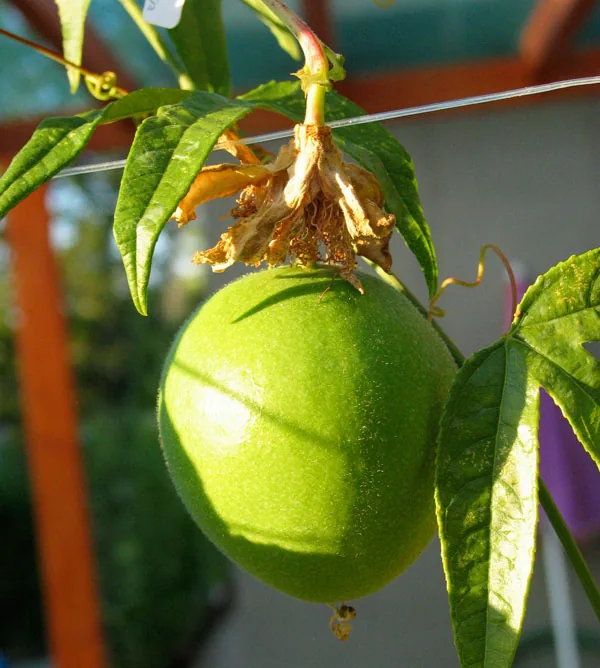
Passionflower, or maypop, is the vine to reach for when a fence, a pergola, or a bare boundary needs a season of drama. It climbs by tendrils and covers 6 to 8 feet (183 to 244 cm) in a single summer, dressing a structure with fringed blooms and, later, egg-shaped fruit. The flowering runs from July into September, so it holds a corner through the warmest, most-used stretch of the year, with the maypop ripening to a soft yellow into fall.
As a fixture, it is remarkably undemanding once it has taken hold. It works in full sun or a lightly shaded aspect, rides out a dry spell without fuss, and settles into clay, loam, or sand, which makes it easy to place against most walls and borders. Its one condition is good drainage, since a waterlogged position through winter is what unsettles the planting.
Beyond looks, the vine sets a mood. As a larval host for fritillary and zebra longwing butterflies, it draws the kind of movement that turns a patio or seating corner into a living scene through summer. The one thing to plan for is its habit of roaming, sending shoots up across the bed well away from where it began, so a considered spot keeps the whole picture composed.
Care
The short version: give it full sun to part shade, average soil that drains, and a deep but occasional drink once established. Set it against a strong support to climb and grant it the room, or the containment, that a vigorous spreader calls for.
Light
Passionflower gives its fullest display in full sun, though it accepts part shade with a lighter show. The brighter the aspect, the more flowers and fruit come, so save it the sunniest stretch of wall or fence you can offer.
Water
As it establishes, keep the soil at average, medium moisture, watering roughly every 7 to 14 days and letting the top half dry between drinks. Once settled it turns drought tolerant and asks for little. Keep it clear of wet, poorly drained ground, which rots the roots, above all through winter.
Soil
The vine takes to clay, loam, or sand with equal ease, which frees it to sit against almost any border. What it insists on is good drainage, since standing water is the one thing it will not abide.
Temperature
It stands up to a wide swing, from cold near -20°F (-29°C) to heat around 100°F (38°C). Toward the cold end of its range the top dies back in winter, and the roots send up fresh growth come spring.
Humidity
Ordinary outdoor humidity is all it wants, with no figure to manage. Airflow and drainage count for far more than moisture in the air.
Feeding
Offer a balanced general-purpose fertilizer two or three times through spring and summer, and leave it there. An already vigorous vine, pushed harder, only grows coarser and less composed.
Pruning
Expect to prune hard to hold this fast vine to its support and keep the display tidy. In cold zones the top dies to the ground each winter, so clear the dead growth and let the spring resprouts renew it.
Repotting
In a container it rarely needs repotting. Move it up only when roots fill the pot, escape the drainage holes, or growth stalls in tight quarters.
Size & spacing
One season can lift the vine to 6 to 8 feet (183 to 244 cm) tall with a spread of 3 to 6 feet (91 to 183 cm), enough to cloak a fence or frame an entry. Give it a solid trellis or wall and room to reach, or contain the roots where the space is measured.
When to plant
Passionflower keeps to warm-season rhythm and waits out frost before it comes into its own. Start seed indoors in late winter to early spring, place plants outside in spring once the cold has cleared, and enjoy flowers from July into September, with the maypop ripening through late summer and fall.
Northern hemisphere
Southern hemisphere
Typical months for a temperate climate: start earlier in warm zones, later where spring frosts linger.
- Sow: Late winter to early spring (6 to 8 weeks before last frost)
- Plant: Spring, after danger of frost has passed
- Harvest: Flowers July to September; egg-shaped maypop fruit ripens to yellowish in late summer to fall
Hardiness
USDA hardiness zones: 5–9
Temperature: down to -29°C
Troubleshooting
Most of what goes wrong with passionflower traces to two things: a vine that ranges beyond its allotted spot, or roots left standing in water. Read the early signs below against what the planting is showing. Some of it, such as caterpillar-chewed leaves, is simply the plant playing its part in the scene.
A flagging, yellowed vine in damp, cool ground
A vine that wilts and yellows in sodden ground is showing root rot, which takes hold when the soil stays waterlogged across a cool, wet winter. The confirmation is in the roots, gone dark, soft, and mushy underground. Set the display right by holding off water until the soil dries, correcting the drainage or moving the plant to a better-placed spot, and working organic matter into heavy soil so water clears.
Fix:
- Improve drainage or move the plant to a better-drained site
- Stop supplemental watering until soil dries
- Amend heavy soils with organic matter to improve drainage
An empty trellis in spring following a harsh winter
Where winters run to the edge of its range, a vine that never returns has met with cold injury, since the plant is not reliably hardy through USDA Zone 5. The tell is roots that stay silent through late spring after a severe winter, usually where the crown had no cover. Protect the planting by mounding mulch over the crown ahead of the cold, placing it against a warm south-facing wall, or keeping it in a container that moves to shelter in the harshest settings.
Fix:
- Mulch the root zone heavily before winter in cold zones
- Plant in a protected spot sheltered by a wall or structure
- In the coldest zones, grow as a container plant moved to shelter
Unexpected shoots straying far across the bed
A passionflower rarely stays where it is set, because it travels on root suckers and runners and sends fresh stems up across the bed, well beyond the spot you chose. Trace a stray back to the lateral roots and the story is clear. Lift the wanderers as they arrive, or design the planting from the outset around a defined bed, a generous container, or a root barrier so the display stays where you want it.
Fix:
- Dig out unwanted suckers as they appear
- Install a root barrier or grow in a contained bed or large pot
- Site it where it has room to roam or where mowing controls strays
Foliage nibbled away by orange-and-black visitors
Summer feeding on the foliage is the work of fritillary and zebra longwing caterpillars, and a passionflower is grown, in part, to host exactly this. The spiny orange larvae and the butterflies drifting through the planting are the scene as intended. Let it play out, since a well-established vine carries the display past the nibbling, and any spray would banish the butterflies that make the corner come alive.
Fix:
- Tolerate the feeding, since this plant is intended to feed butterfly larvae
- Healthy established vines outgrow the damage
- Avoid insecticides, which kill the butterflies you are hosting
Toxicity
Passionflower carries an easy conscience: it is not on the ASPCA toxic-plant lists, and the ripe maypop is good to eat. The caution stays narrow, since the leaves and unripe green fruit hold small amounts of cyanogenic glycosides, so keep pets, livestock, and children from eating green growth in any quantity.
Toxic to
Cats · Dogs · Horses · Rabbits · Livestock · Birds
Safe for
People
Cats Caution
The plant earns a non-toxic rating, though the leaves and unripe green fruit hold small amounts of cyanogenic glycosides. A cat that samples a little is unlikely to suffer for it, while a full mouthful of foliage can bring on drooling or a mild stomach upset.
Dogs Caution
A curious dog can chew a leaf or two without concern, given the plant's place off the toxic lists. Keep watch on one that works through green growth or unripe fruit, where the cyanogenic glycosides can unsettle the stomach.
Horses Caution
An occasional grazed leaf poses little risk. The caution belongs to foliage and unripe fruit taken in quantity, whose trace cyanogenic compounds can leave a horse off its feed or queasy.
Rabbits Caution
Rabbits are best kept clear of the foliage. The cyanogenic glycosides in green growth and unripe fruit make the leaves an unwise choice, so keep the plant away from the hutch.
Livestock Caution
Cattle, goats, and sheep can browse a stray vine without alarm, yet a large feed of leaves or green fruit is better avoided for the trace cyanogenic glycosides they carry.
Birds Caution
Wild birds and poultry are drawn to the ripe maypop, which suits them. Keep them from heavy feeding on the foliage and unripe fruit, where the cyanogenic compounds gather.
People Ripe fruit safe
The fully ripe maypop is a pleasure to eat, and the aerial parts have a long life in herbal teas. Leave the unripe green fruit alone and keep the leaves off the plate, since both hold small amounts of cyanogenic glycosides.
Only fully ripe fruit is safe to eat. The leaves and unripe (green) fruit contain small amounts of cyanogenic glycosides, so unripe fruit and large quantities of foliage should not be eaten.
Helpline numbers

United States
ASPCA Animal Poison Control: (888) 426-4435 (fee applies)
Poison Control: (800) 222-1222



Canada
Poison Centres: 1-844-764-7669
Varieties
Beyond the native maypop, a few related passionflowers find their way into gardens for their flowers, fragrance, or fruit. These are the ones worth knowing.
Passiflora caerulea (blue passionflower)
Its blue-and-white flowers and more evergreen habit see it through milder winters with more grace than the maypop.
Passiflora 'Incense'
This hybrid brings large, deep violet flowers and an intense fragrance to a planting.
Passiflora edulis (passion fruit)
Grown commercially for its edible passion fruit, this tropical species asks for warmth the maypop's cold hardiness does not require.
How to propagate
Passionflower offers three ways to build a planting, from a patient sowing of seed to the near-effortless division of the suckers it sends up unbidden.
SeedModerate
Sow indoors late winter to early spring, or outdoors after frost · Several weeks to germinate; one to two seasons to flower
The seed route asks for patience above all. Sow indoors in late winter to early spring, or outdoors once frost has passed, and expect germination to arrive slowly and unevenly across several weeks. A pre-soak of the seed eases things along, and a young plant needs one to two seasons before it flowers.
DivisionEasy
Spring · One growing season
The suckering habit that spreads the vine also makes division the easiest way to gain more plants. Lift and separate the suckers in spring, and each one settles into the garden over a single growing season.
Stem cuttingsModerate
Late spring to summer · Several weeks to root
Take softwood or semi-ripe cuttings from actively growing stems in late spring or summer. Kept warm and moist, they root over several weeks into new plants.
Myths
A passionflower vine is toxic in its entirety and therefore unsuited to homes with children or animals.
The reputation overstates the case, since Passiflora incarnata is not on the ASPCA toxic-plant lists and the ripe maypop is edible. Only the leaves and unripe green fruit hold small amounts of cyanogenic glycosides, so the caution concerns eating green growth in quantity, not welcoming the plant into a garden.
Caterpillars found dining on the foliage amount to an infestation best handled with a spray.
The vine is a larval host for Gulf fritillary and other fritillaries, so some leaf feeding is part of the plan for the planting. Spraying drives off the butterflies the plant is grown to support, and a healthy vine recovers the lost foliage on its own.