Shrub · Pittosporaceae
Japanese Pittosporum
Pittosporum tobira
The evergreen shrub that shapes a garden with sun, shade, drought, and hard shearing behind it and scents the spring like orange blossom.
Full sun
Every 7–14 days
USDA 8–10
8–13 ft · 2.4–4 m
Overview
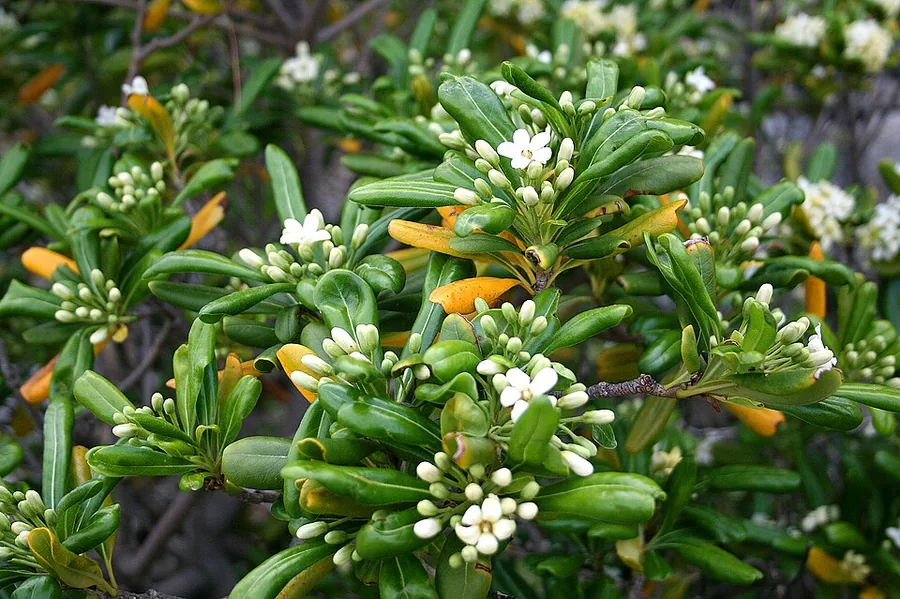
Japanese pittosporum is the quiet backbone of a well-composed mild-climate garden. It fills in fast as a dense, rounded evergreen that holds its form all year, and in late spring it turns generous with small creamy flowers that carry an orange-blossom scent right up to the door. That fragrance is the reason it goes by mock orange, though it has no tie to the true mock orange.
What makes it such a designer's plant is its willingness to sit wherever a scheme needs it. Settled in, it takes drought, heat, and salt spray in stride, works in a sunny forecourt or a shaded side return, and asks little of the soil so long as it drains. Clip it into an architectural hedge that lines a path, let it mound as a soft anchor in a bed, or lift it into a small tree that frames a view.
Left to grow, it reads as a substantial green wall, rising toward 8 to 13 feet (2.4 to 4 m) with a wider spread, ideal for screening a boundary or setting a backdrop for a terrace. The dwarf forms keep to a low, tidy line along borders and foundations. The one thing to plan around is drainage, since wet feet are what undo this shrub more than anything else.
Care
The short version: it settles into full sun through shade, prefers a deep soak now and then rather than constant watering once established, and takes any soil that drains well; give it a shear after flowering and keep its roots clear of soggy ground.
Light
Pittosporum is easy about aspect, settling into anything from full sun to full shade, which is what lets it carry a scheme from a bright forecourt to a dim side passage. It flowers most and grows densest in sun, yet it still furnishes a shaded corner where many shrubs would grow gappy.
Water
Water it deeply but infrequently, letting the top half of the soil dry between soakings so the routine stays light-touch. Established, it is genuinely drought tolerant, which suits a low-maintenance garden, while the real pitfall runs the other way, since soggy, poorly drained soil brings on fatal root rot fast.
Soil
Almost any well-drained soil will hold it, from clay to sand to loam, across a pH from 6.0 to 7.5, so it slots into most existing beds. Drainage is the one thing to settle before planting, because standing water is what undoes this shrub.
Temperature
It sits comfortably across a wide range, from about 10°F to 100°F (-12°C to 38°C), staying evergreen through mild winters and keeping its composure through summer heat, so the garden reads dressed year round.
Humidity
Ordinary outdoor air suits it and there is no figure to manage. Good airflow counts for more, since crowded, damp foliage invites leaf spot and sooty mold that dull the clean lines of a planting.
Feeding
One spring feed with a balanced general-purpose shrub fertilizer keeps it looking its part for the season. On high-pH soils watch for micronutrient shortfalls such as magnesium, and correct them if the leaves begin to yellow between the veins and lose their polish.
Pruning
Time the shear for just after the spring flowers fade, since next year's blooms form on old growth and a late cut removes them along with the scent. The plant takes hard clipping without complaint, which is exactly what makes it dependable as an architectural hedge or a trained small tree.
Repotting
A potted specimen framing a doorway or terrace wants a fresh, larger container every 2 to 3 years. Repot when roots circle the surface or push through the drainage holes, or when water runs straight through and growth stalls and the display flags.
Size & spacing
Left to its own devices it reaches 8 to 13 feet (2.4 to 4 m) tall with a spread of 4 to 18 feet (1.2 to 5.5 m), so plan real room when using it to screen a boundary or line a path. Dwarf cultivars keep far smaller for tight, tailored spaces.
When to plant
Pittosporum is an evergreen for the milder garden, comfortable roughly in zones 8 to 10. Set new plants in spring or fall while the weather stays gentle, and look for the scented flowers to arrive in late spring, around April and May, just as the terrace comes back into use.
Northern hemisphere
Southern hemisphere
Typical months for a temperate climate: start earlier in warm zones, later where spring frosts linger.
- Plant: spring or fall in mild climates
- Harvest: late spring (April-May)
Hardiness
USDA hardiness zones: 8–10
Temperature: down to -12°C
Troubleshooting
Pittosporum holds its good looks with little fuss, so when a planting slips it usually traces to pests leaving honeydew or roots left sitting in water. Read the early signs below against what the shrub is showing, and step in before a small blemish spreads across the scheme.
A whole shrub fading and slumping in spite of watering
A pittosporum that yellows, softens, and loses its poise all at once is almost always failing to root rot in ground that never dries. This is a shrub that will not abide wet feet, and once the roots turn dark and soft the loss is usually final. Ease off the water and repair the drainage, and lift out any plant past saving so the rest of the planting keeps its shape.
Fix:
- Improve drainage and stop overwatering immediately
- Remove and discard severely affected plants, as root rot is often lethal
- Replant healthy stock in a well-drained site where water does not accumulate
A dull black film dimming the leaves and stems
When a hedge that should read crisp and glossy turns to a dull black cast, the coating is sooty mold, and it is only a surface story. Aphids, cottony cushion scale, or mealybugs are feeding above and leaving the sticky honeydew the mold settles into. A thorough pass of horticultural oil clears the insects, and the film rinses away to restore the clean green backdrop the planting was meant to give.
Fix:
- Spray plants thoroughly with horticultural oil to smother scale, mealybugs, and aphids
- Repeat applications as directed and wash off sooty mold once pests are controlled
- Hose off light aphid populations with a strong stream of water
Small spots breaking up the smooth green of the foliage
Spots that interrupt an otherwise smooth wall of green usually mean fungal or bacterial leaf spot, which arrives where the foliage stays damp and hemmed in. Thinning the plant to let air pass through, watering low at the base, and clearing the most marked leaves restores the tidy look a designed planting depends on. It stays a cosmetic matter, never a threat to the shrub itself.
Fix:
- Improve air circulation by thinning and proper spacing
- Avoid overhead watering and keep foliage dry
- Remove and dispose of badly spotted leaves
Toxicity
Pittosporum is not among the seriously poisonous plants, which makes it an easy choice for a lived-in garden, though it is not something to eat. The leaves, stems, and seeds hold saponins that irritate the gut, so a pet that chews them may drool and turn queasy. Since no part is grown for the table, keep it clear of curious mouths.
Toxic to
Cats · Dogs · Horses · Rabbits · Livestock · Birds · People
Cats Mild
A cat that samples the foliage in a courtyard planting may drool, be sick, or lose interest in food for a while. The saponins account for it, and the upset tends to pass once the shrub sits somewhere the cat cannot reach.
Dogs Mild
A dog nosing around a border and chewing the leaves or seed pods usually ends up drooling with an unsettled stomach. It seldom becomes serious, though a large mouthful can spell a rough day of vomiting.
Horses Caution
A horse is unlikely to choose it, yet the same saponins can unsettle the gut if a bored animal browses a shrub within reach. Set the planting well clear of paddocks to keep things easy.
Rabbits Caution
This was never meant as rabbit forage. Its saponin-bearing leaves can leave a rabbit with a sore stomach, so it belongs well away from where one might graze.
Livestock Caution
Cattle, goats, and sheep usually pass it by, but a hungry animal stripping the leaves could take on the same digestive irritation. A boundary between the planting and grazing land settles it.
Birds Caution
Wild birds take the sticky seeds in the garden without any trouble, though the saponins make the foliage a poor offering for pet birds, so it is left off their fare.
People Caution
Nothing on the plant is grown for the table, and the saponins can leave a person queasy if leaves or seeds are swallowed. A watchful eye keeps small children from putting any part in their mouths.
No part of the plant is meant to be eaten; the saponins make even a curious nibble unpleasant, though it is not life-threatening in small amounts.
Helpline numbers

United States
ASPCA Animal Poison Control: (888) 426-4435 (fee applies)
Poison Control: (800) 222-1222



Canada
Poison Centres: 1-844-764-7669
Varieties
A few named forms appear far more than the plain species, chiefly variegated leaves and compact dwarfs that give a scheme its lighter notes and lower lines. These are the ones worth having in mind.
Variegata
Its gray-green leaves carry an uneven creamy-white edge that lightens the whole shrub and lifts a shaded corner more than the plain species can.
Wheeler's Dwarf
A neat mounding dwarf that settles at about 2 to 3 feet (60 to 90 cm), asks almost nothing in the way of pruning, and finishes a low border or a foundation planting with ease.
Cream de Mint
A compact cultivar whose tidy mint-green leaves are trimmed in creamy white for a soft, polished edge.
How to propagate
Pittosporum is easy to build up for a matched planting, and cuttings are the usual route since they root willingly and keep a cultivar true across a run of hedging.
Stem cuttingsEasy
Mid-July to September · Several weeks to a few months to root
The simplest way to build up a matching planting is from cuttings. Take semi-hardwood cuttings from mid-July through September, dip the ends in rooting hormone, and set them in a 50/50 blend of peat and perlite kept under high humidity. The plant roots willingly, allowing several weeks to a few months to take hold before the young shrubs are ready to place.
SeedModerate
When ripe seed is available · Slow; weeks to germinate and longer to reach planting size
The species can also be raised from seed once ripe seed is at hand. It is the slower course, needing weeks to germinate and longer still to reach planting size, and seedlings will not hold a named cultivar true the way cuttings do, so matched hedging is best kept to cuttings.
Myths
Japanese pittosporum is the same plant as true mock orange.
The two share a name and nothing more. Pittosporum tobira came by the label mock orange because its flowers carry an orange-blossom scent, yet it sits in the family Pittosporaceae and has no relation to the true mock orange, Philadelphus. They are separate shrubs from separate families whose blooms simply happen to perfume a garden the same way.