Shrub · Rosaceae
Raspberry
Rubus idaeus
Set in full sun and generous soil and pruned once a year, the raspberry turns a sunny border into a summer ritual of fruit by the handful.
Full sun
Every 3–7 days
59–77°F · 15–25°C
USDA 3–8
Overview
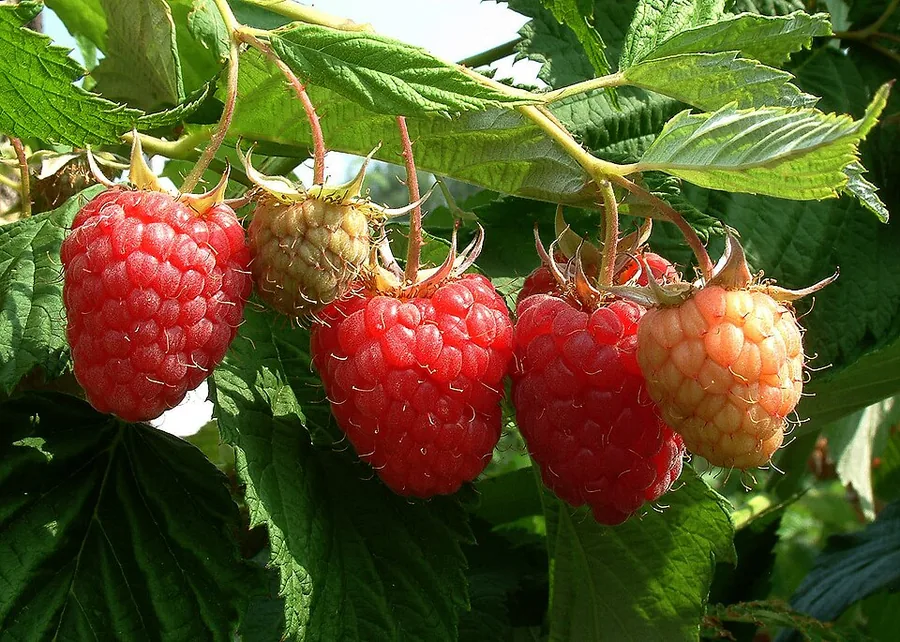
A raspberry cane at the edge of the garden is one of summer's quiet luxuries, the plant that turns a plain fence line into a place to linger. A member of the rose family, it hails from the cooler regions of the world and carries that easy northern hardiness into the plot, rated for zone 3 through zone 8. It settles in as an upright stand of canes and, given time, claims a little more ground each year, the way the best productive plants tend to.
Choosing a type is really choosing a rhythm for the season. Summer-bearing raspberries offer a single generous flush, early to midsummer, borne on last year's canes. Everbearing ones stretch the pleasure later, fruiting on their first-year growth from late summer into fall, and the type you plant sets the tempo of both your harvest and your pruning.
What raspberries ask for is uncomplicated: an open, sunny position, steady moisture, and air drifting through the row. In return they give years of fruit and a reason to step outside with a bowl each morning, though their roaming roots do call for a gardener willing to keep the patch in bounds. The canes wear sharp prickles, so a pair of gloves belongs with the harvest basket.
Care
The short version: a sunny spot, deep and lightly acidic soil enriched with compost, and roughly an inch of water each week. Prune to the cane type once a season, and either give the roots free run or set a tidy barrier to keep the planting elegant.
Light
Give raspberries the sunniest corner you can spare, full sun with six hours or more of direct light each day. They will tolerate a little shade, yet in dim positions the canes grow lax and the harvest falls off, so the brightest spot always pays.
Water
Keep the soil evenly moist, about an inch of water each week, with a little more while the fruit swells. The aim is steady, unhurried watering, since roots left in soggy ground rot and the berries lose their firmness.
Soil
Plant into deep, well-drained loam worked through with compost. Raspberries favor slightly acidic ground, a pH of 5.6 to 6.5, and pale new leaves are the first sign the soil has tipped too alkaline for comfort.
Temperature
Cool to mild weather flatters them most, roughly 59°F to 77°F (15°C to 25°C). The canes hold their own through hard winters down to zone 3, while a punishing summer can tire the plants and scorch the fruit, so a little afternoon shelter in a heat wave is welcome.
Humidity
Humidity asks nothing special of you, since 40% to 70% suits raspberries without fuss. Movement of air is the thing to prize, because still, heavy air trapped among the canes is where gray mold begins.
Feeding
A single feed sets them up for the year. As growth begins in early spring, offer a balanced fertilizer such as 10-10-10 or a top-dressing of aged compost or manure, and that one seasonal gesture is enough to carry a full crop.
Pruning
Pruning follows the type, and the ritual is a simple one. On summer-bearing plants, clear the spent floricanes as harvest ends and thin the fresh primocanes; everbearing kinds ask only for a low late-winter mow to yield a single generous fall crop.
Repotting
Raspberries belong in open ground rather than a container, so repotting seldom enters the picture. Should one be grown in a pot, move it to a larger home once the roots begin to circle and the soil dries too quickly to keep up.
Size & spacing
Canes rise to 3 to 6 feet (90 to 180 cm) and spread to 2 to 4 feet (60 to 120 cm), enough presence to anchor the edge of a bed. Leave the rows generous room and a trellis, both for airflow and to keep the prickled canes at a polite distance.
When to plant
Raspberries are planted at the very start of the season, while the canes still sleep and the garden is only beginning to stir. Put them in the ground in early spring, and the type you chose will carry the harvest from the first warm weeks of summer through into autumn.
Northern hemisphere
Southern hemisphere
Typical months for a temperate climate: start earlier in warm zones, later where spring frosts linger.
- Plant: Early spring while plants are still dormant
- Harvest: Summer-bearing types ripen early to midsummer; everbearing types crop late summer into fall
Hardiness
USDA hardiness zones: 3–8
Temperature: down to -40°C
Troubleshooting
Even a well-kept raspberry planting has its off days, and the trouble almost always settles on the fruit, the canes, or the youngest leaves. Spot it early and a single cut or a small shift in watering usually restores order. Match the symptom below, then act before it works along the row.
Soft berries dulled by gray mold
Soft, fuzzed fruit is the work of gray mold, the fungus Botrytis cinerea, which arrives when wet air lingers around crowded canes. Harvest often and set aside anything gone soft, as the spores travel quickly through fruit once it is stored. Open the planting up by thinning the canes, and water low at the base rather than across the leaves.
Fix:
- Remove and discard infected berries promptly
- Harvest frequently and keep fruit dry
- Improve air circulation by thinning canes
Wilting cane tips ringed twice
A wilting tip encircled by two rings is the mark of the raspberry cane borer, while dark, sunken nodes suggest a cane disease such as spur blight. Cut the affected cane well below the damage and remove it entirely, then clear away any wild brambles that shelter the culprits nearby. A yearly habit of pruning out old and infected canes, and keeping the rows slim, holds both at a distance.
Fix:
- Cut and destroy affected canes below the damage
- Remove all wild brambles nearby
- Maintain open, thinned plantings
New leaves paling between the veins
New leaves that yellow while their veins stay green point to iron chlorosis, brought on by soil that has turned too alkaline. A soil test will show the pH sitting above the comfortable range, and chelated iron offers a quick remedy while the ground itself is corrected. Work in organic matter, ease the soil toward a pH of 5.6 to 6.5, and go lighter with the lime.
Fix:
- Test soil and acidify toward pH 5.6 to 6.5
- Apply chelated iron as a short-term correction
- Incorporate organic matter
Toxicity
There is real ease in a plant this welcoming: nothing on the raspberry is toxic to animals or to people. Fruit and foliage are entirely safe, so a pilfered berry or a nibbled leaf changes nothing. The single caution is physical rather than chemical, the sharp prickles along each cane that can catch a passing hand.
Safe for
People · Cats · Dogs · Horses · Rabbits · Livestock · Birds
Cats None
Nothing on a raspberry can poison a cat, so a leaf sampled or a berry stolen from the bowl comes to nothing. The one thing to keep in view is the prickles, which may scratch an inquisitive nose.
Dogs None
A dog may eat the ripe berries with no trouble, and the leaves and canes are just as harmless. The sharp prickles are the only real concern to keep in mind.
Horses None
A horse may browse the leaves and berries without worry, since nothing in the plant is toxic. It pays to fence off the thorny canes so a soft muzzle stays unscratched.
Rabbits None
Rabbits take the leaves and berries in stride, and many are fond of the foliage. Only the prickly stems call for any care.
Livestock None
Cattle, goats, and sheep can graze raspberry safely, as the plant holds no toxin. Only the prickles merit a watchful eye.
Birds None
Birds delight in ripe raspberries and carry the seeds far across the landscape. Nothing on the plant can do them harm.
People None
For people, raspberries are among the loveliest of fresh fruits and wholly safe to eat, foliage included. The lone caution is the prickles on the canes, so gloves are worth having on hand at pruning and picking.
Most raspberry canes are armed with sharp prickles/thorns that can scratch or puncture skin; wear gloves and long sleeves when pruning or harvesting.
Varieties
Among the hundreds of raspberries in cultivation, a handful of dependable reds have earned a lasting place in the home garden. These are the ones worth planting by name.
Heritage
A dependable everbearing red that fruits on first-year canes for a graceful late-season crop.
Latham
A hardy summer-bearing red heirloom that has held its place in cold gardens for generations.
Boyne
A summer-bearing red so tolerant of cold that it flourishes in the far northern zones.
Caroline
A vigorous everbearing raspberry laden with large, richly flavored fruit well into autumn.
Companions
Raspberries do best beside aromatic plants that push pests away, and worst near their nightshade neighbors, which trade soilborne wilt back and forth.
Plant near
Garlic: Aromatic alliums may help deter some pests around the planting.
Marigold: Often interplanted to discourage nematodes and some insect pests.
How to propagate
Raspberries are generous with themselves, offering a method to suit every type, from the suckers the reds send up to the gracefully arching tips of the black and purple forms.
DivisionEasy
Early spring or fall while dormant · One growing season
The most effortless route to new raspberries is to lift the rooted suckers that rise around the crown. Take them in early spring or fall while the plant rests, replant the offsets, and a single growing season sees them established.
LayeringModerate
Late summer · One season to root
Black and purple raspberries prefer tip-layering. In late summer, draw an arching cane down to the soil and sink its tip below the surface; left undisturbed, it roots across the season into a new plant to sever and set elsewhere.
Stem cuttingsModerate
Spring to early summer · Several weeks to root
Root cuttings and softwood cuttings both take, lifted from spring into early summer and rooting within several weeks. Most gardeners set them aside, though, since dividing suckers is the simpler path.
Myths
Raspberries are toxic to dogs and cats.
In truth the plant is entirely welcoming to pets: fruit, leaves, and canes are all safe for cats and dogs, and a ripe berry makes a fine treat. The only real hazard is the prickles, which at worst leave a scratch on a curious nose or paw.
Every raspberry cane should be cut down each winter.
This holds only for everbearing types, which fruit on first-year canes and take happily to a full mow. Summer-bearing types fruit on second-year canes, so cutting them all away costs you the coming season's harvest.