Shrub · Malvaceae
Rose of Sharon
Hibiscus syriacus
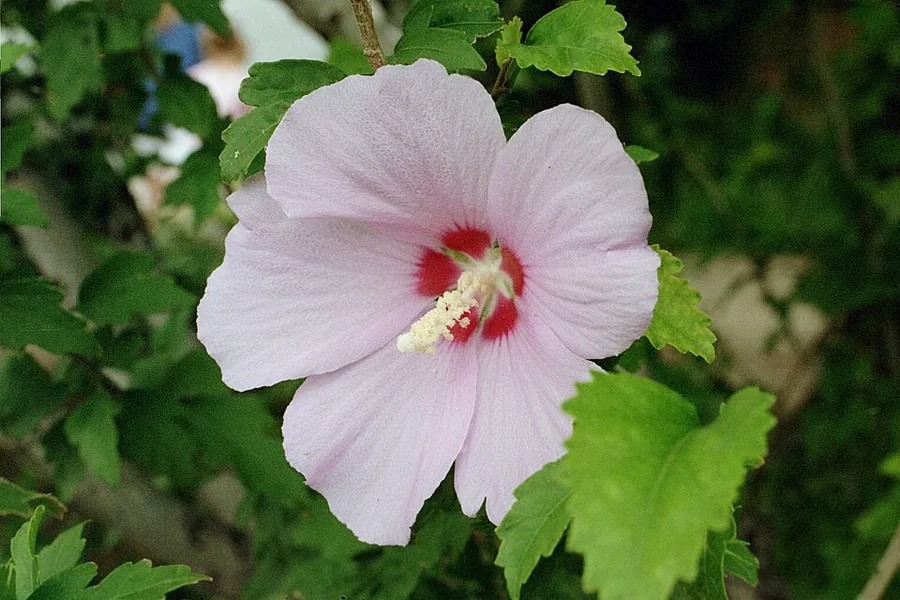
Set against an open, sunlit corner, this shrub turns the quiet end of summer into the garden's best season.
Full sun
Every 7–14 days
USDA 5–9
8–12 ft · 2.4–3.7 m
Overview
Rose of Sharon arrives on cue at the moment a garden most needs it, filling the lull of late summer with color when the borders have gone soft and green. An upright deciduous shrub from the mallow family, it holds its hibiscus-shaped flowers from June into October, giving a planting a long, dependable focal point. The palette reads beautifully against a wall or a lawn: white, pink, lavender, and a rare violet-blue, most with a contrasting eye that pulls the look together.
It also happens to be one of the most accommodating shrubs a designer can call on. Once settled, it takes heat, humidity, drought, and poor soil in stride and holds its shape through winters down to -20°F (-29°C). Because it grows fast to 8 to 12 feet (2.4 to 3.7 m), it earns a place as a living screen along a property line or a graceful anchor at the back of a mixed border.
One design note is worth keeping in mind: it self-seeds with a will, enough to be listed as invasive in a few states, and stray seedlings can unsettle a tidy scheme. Where a composed, low-maintenance planting is the goal, a sterile cultivar such as Diana delivers the same long season without the upkeep.
Care
The short version: give it a sunny, well-drained position, see it through its first season or two with steady water, then cut it back in late winter and let it set the tone for the late-summer garden.
Light
For the fullest display, give it full sun, the setting that best rewards a border built around it, though it accepts partial sun or light afternoon shade. A bright, open position keeps the flowering generous and the whole planting reading at its best through summer.
Water
In its first seasons, steady regular watering helps it settle into a spot and hold its form. Once established, usually after a year or two, it turns drought tolerant, an easy companion for a low-fuss garden that runs on medium moisture and ordinary rainfall outside of dry spells.
Soil
Undemanding about soil, it grows happily in average, well-drained ground of almost any pH, which makes it easy to place in most gardens. It shrugs off poor sites, asking only for good drainage, since standing wet is the one condition that spoils its poise.
Temperature
Few shrubs sit so easily across the seasons, holding steady from roughly -20°F to 100°F (-29°C to 38°C). It carries summer heat and humidity without flagging and comes through hard winters unaided, keeping a planting reliable year after year.
Humidity
Everyday outdoor humidity suits it, so there is nothing to manage on that front. What keeps it looking clean is air movement, so an open, uncrowded position, rather than a tight corner, keeps the foliage fresh and the picture uncluttered.
Feeding
In reasonable soil it wants little feeding, which keeps a border low-maintenance. A single application of balanced general-purpose fertilizer in spring is enough, and holding back on nitrogen keeps growth firm rather than the soft, floppy kind that draws aphids.
Pruning
Since it blooms on new wood, a late-winter or early-spring cut, before growth begins, shapes the shrub and sets up the season's flowers. Taking the stems back to 2 or 3 buds produces fewer but larger blooms and a tidy silhouette that reads well from across a garden.
Repotting
A container specimen on a terrace or patio seldom needs moving on. Step it into a larger pot only when the signs appear, roots circling or slipping from the drainage holes, water running straight through, or growth that has clearly slowed.
Size & spacing
Plan for a fast-growing shrub of 8 to 12 feet (2.4 to 3.7 m) tall spreading 6 to 10 feet (1.8 to 3 m) wide, and give it that room in the design. The space keeps air moving through the planting, keeps the foliage fresh, and lets the shape stand clear.
When to plant
Rose of Sharon keeps its own unhurried schedule, leafing out late in spring and saving its display for June through October, the stretch when a garden most wants a lift. Plant it in spring once frost has passed, or in early fall, and reserve pruning for late winter before the buds break, so the year's design stays intact.
Northern hemisphere
Southern hemisphere
Typical months for a temperate climate: start earlier in warm zones, later where spring frosts linger.
- Sow: late winter to early spring (8-10 weeks before last frost)
- Plant: spring after last frost, or early fall
- Harvest: June to October (mid to late summer)
Hardiness
USDA hardiness zones: 5–9
Temperature: down to -29°C
Troubleshooting
For all its presence in a border, this is a remarkably undemanding shrub, and the few issues it meets are cosmetic rather than serious. They tend to surface on the leaves and buds, so an unhurried walk past the plant in summer keeps a planting looking its best.
Summer foliage worn to lacework
Leaves that thin to lace across a border are the mark of Japanese beetles, which settle in groups on warm days and graze the tissue between the veins. Working through the plant in the early morning, lifting the beetles by hand into soapy water, keeps a planting presentable. It pays to leave the pheromone traps aside, since they invite more beetles than they remove.
Fix:
- Hand-pick beetles in early morning and drop into soapy water
- Avoid pheromone traps that attract more beetles
- Treat heavy infestations with an appropriately labeled insecticide following directions
Sticky, curling tips on the fresh growth
Fresh shoots that curl and turn tacky point to aphids, sometimes joined by whiteflies, gathering on the softest growth and leaving a sticky honeydew that can darken with sooty mold. A firm spray of water resets the growth, and insecticidal soap tidies what remains. Left to it, lady beetles and other allies usually restore the balance on their own.
Fix:
- Dislodge aphids with a strong spray of water
- Apply insecticidal soap or horticultural oil to affected growth
- Encourage natural predators such as lady beetles
Buds yellowing and falling before the show
Buds that yellow and drop before opening are a case of bud drop, and it follows a dry spell or uneven watering rather than any disease. The shrub stays sound; it simply lets buds go when the root zone swings between wet and dry. Even moisture through bud set and the hot weeks, held steady with mulch, keeps the display on track.
Fix:
- Maintain even soil moisture, especially during bud set and hot weather
- Mulch to conserve moisture and buffer soil temperature
- Avoid letting the root zone dry out completely while flowering
Spotted, blotchy leaves and a marked stem or two
A scatter of fungal leaf spots, blights, and rusts can dull the foliage, and canker fungi now and then lesion a stem. Damp weather and close, still air are what tip a healthy plant into trouble. Clearing the marked leaves, cutting out cankered wood, and opening the shrub so air moves freely keeps a planting looking crisp.
Fix:
- Remove and dispose of affected leaves and prune out cankered stems
- Improve air circulation and avoid overhead watering
- Apply a labeled fungicide only if problems are severe
Toxicity
For a garden shared with pets and children, Rose of Sharon asks for no compromises: it is non-toxic across the board. The ASPCA lists it as safe for cats, dogs, and horses, and the flowers are even edible for people, so it settles into a family landscape without a second thought.
Safe for
People · Cats · Dogs · Horses · Rabbits · Livestock · Birds
Cats None
Cats share the space safely; the most a nibbled leaf or flower brings is a passing upset stomach from the roughage, nothing more.
Dogs None
The ASPCA lists it as non-toxic to dogs, so a curious chew is nothing to design around.
Horses None
Horses are equally in the clear, and grazing on a few leaves in passing carries no special risk.
Rabbits Safe
Rabbits can browse the foliage without harm, though any change of diet is best eased in gradually.
Livestock Safe
There is nothing here to trouble cattle, goats, or sheep that wander past a planting.
Birds Safe
Backyard and wild birds are at ease around it, and many drop in at the flowers for nectar.
People Safe
People are safe too, and the flowers are edible, lovely raw in a salad or steeped into tea.
No special handling precautions for toxicity; as with any plant, ingestion of large amounts of plant material may cause mild, transient stomach upset.
Varieties
Part of the pleasure of designing with this shrub is the range of flower colors and forms on offer, from clean singles to soft, ruffled doubles that suit different moods and settings. The named selections below are the ones most often reached for.
Diana
Diana suits a refined, pale scheme with pure white single flowers that stay open into the evening, and as a sterile triploid it sets almost no seed.
Blue Bird (Oiseau Bleu)
Blue Bird, also known as Oiseau Bleu, makes a statement with large single flowers in true violet-blue, each lit by a red eye.
Minerva
Minerva brings a softer note to a border, blooming in gentle lavender-pink with a reddish-purple eye at the throat.
Aphrodite
Aphrodite adds depth with dark pink single flowers set around a deep red center.
Red Heart
Red Heart offers a clean, classic look, crisp white petals framing a prominent red center.
Lavender Chiffon
Lavender Chiffon lends a romantic touch with lavender semi-double, anemone-form flowers ruffled by an extra layer of inner petals.
How to propagate
Expanding a planting is straightforward, and the method sets whether a new plant echoes its parent. Cuttings and layering hold the flower color true, a real advantage when a scheme depends on a particular shade, while seed leaves the result open to chance.
Stem cuttingsEasy
Softwood cuttings in late spring to summer; hardwood cuttings in late fall to winter · Several weeks to root; transplantable the following season
Cuttings are the dependable way to repeat a favorite exactly, since they carry the parent's flower color into the new plant, a real help when a scheme rests on one shade. Take softwood cuttings in late spring or summer, or hardwood cuttings from late fall into winter, and they root over several weeks. Grown on, they are ready to place the following season.
SeedEasy
Sow late winter to early spring; the species also self-seeds outdoors · Germinates in a few weeks; flowers in 2-3 years
Seed is easy but unhurried, and the seedlings rarely repeat the parent's color, so it suits a gardener open to surprise. Sow from late winter to early spring and it germinates in a few weeks, though a plant needs 2 to 3 years to flower. The species also self-seeds freely outdoors, at times beyond what a tidy planting wants.
LayeringEasy
Spring to summer · One growing season to root before separating
Layering is the quiet, low-effort route. Bend a low branch to the soil in spring or summer, pin it in place, and it roots over a single season before you separate it as a plant of its own, ready to extend the scheme.
Myths
Rose of Sharon is unsafe to plant where dogs and cats roam.
There is no need to design around that worry. The ASPCA lists Hibiscus syriacus as non-toxic to dogs, cats, and horses, so a pet that samples a leaf or flower is in no danger, and the flowers are even edible for people. At most, eating a lot of any plant brings a brief stomach upset, nothing that should shape where it goes.
Prune Rose of Sharon in summer or fall for a fuller show.
The timing works against the plant. It blooms on new wood, the growth of the current season, so a summer or fall cut takes off the very stems set to flower. Prune in late winter or early spring before growth begins, and cutting back to 2 or 3 buds trades a little quantity for larger, more striking blooms.