Houseplant · Malvaceae
Money Tree
Pachira aquatica
Sculptural, pet-safe, and quietly elegant, the money tree brings easy polish to a bright corner.
Bright indirect
64–75°F · 18–24°C
USDA 10–12
6–8 ft · 1.8–2.4 m
Overview
The money tree, Pachira aquatica, hails from the wetlands of Mexico and Central and South America, where it rises into a full tree. In a room it holds to a well-mannered 6 to 8 feet (183 to 244 cm), its glossy hand-shaped leaves opening from the crown of a slim trunk like a small green canopy. Most arrive with several trunks braided together, a sculptural touch shaped by the grower that gives the plant its instantly recognizable silhouette.
As a piece for the home it earns its keep by being effortless to live with. It settles happily into corners that other plants would sulk in, fills a space quickly, and forgives a distracted week far more than an overzealous one. It is also one of the rare houseplants you can place freely in a home shared with cats, dogs, and small children.
It shows best given bright, filtered light and a watering habit that never leaves it standing in water. Meet those two and it slots into daily life with little fuss, anchoring a reading nook or softening a hard-edged console. Ask too much of it with harsh sun or a forever wet pot, though, and the look suffers as leaves drop or roots rot.
Care
The short version: set it in bright indirect light, water once the top of the soil dries, keep it warm and humid, and never let the pot sit in standing water.
Light
A money tree looks and grows its best in bright, indirect light, the kind near a window but out of the direct beam, which makes it an easy fit for most living spaces. It tolerates medium light and even some shade, so it can hold a dimmer corner, though the brightest spot short of harsh sun keeps it fullest.
Water
Let the top of the soil dry between waterings, then water it through. The plant is far unhappier with wet feet than dry ones, and standing water quietly undoes the roots. Let it run too dry, on the other hand, and it answers by dropping leaves onto the floor.
Soil
Plant it in a moist but well drained potting mix, something with peat, perlite, and a little loam or sand so water moves through cleanly. It asks little about pH, sitting content anywhere from 6.0 to 8.0.
Temperature
Keep it in the ordinary comfort of a lived-in room, between 64°F and 75°F (18°C to 24°C). As a tropical plant it has no patience for cold, so keep it clear of chilly drafts and frosty windows through winter.
Humidity
This is a tropical plant with a taste for high humidity. Average indoor air suits it, though it grows more lushly with a little extra, so gather it with other plants or set it near a humidifier in a dry, heated room.
Feeding
Offer a balanced houseplant fertilizer once a month through spring and summer while it is in growth. Ease off through fall and winter, when the plant quiets down and needs far less.
Pruning
Prune to hold the size and shape that suits the space, which it takes in stride. Those flexible young stems are the very ones growers braid together while they stay pliable, so any braiding belongs to the trunks' young, bendy years.
Repotting
Move it up a pot every 1 to 2 years, or sooner if roots begin circling or slipping out the drainage holes. Water that runs straight through and growth that stalls are the other cues that it is ready for more room.
Size & spacing
Indoors a money tree reaches about 6 to 8 feet (183 to 244 cm), though a modest pot keeps it far more compact and easy to place. Leave it some headroom and give it a quarter turn now and then so it grows evenly toward the light.
Troubleshooting
Money trees are forgiving companions, and nearly every misstep comes back to water or light. Dropped leaves, soft roots, and scorched patches each read as their own signal. Find the match below and adjust before a small lapse takes the shine off the plant.
Wilting plant with soft, brown roots
Root rot takes hold when soil stays wet long enough that the roots lose access to air. Lift the plant and the evidence is plain: brown, mushy roots with a sour smell, and a canopy that wilts even in soaked soil. Trim away every failed root and settle the plant into fresh, free draining mix in a container built to drain, and it can recover its poise.
Fix:
- Remove from wet soil and cut away rotted roots
- Repot into fresh well-drained mix in a pot with drainage
- Water only after the top of the soil dries
Leaves turning yellow and dropping
A money tree that starts yellowing and shedding is usually reacting to its watering rhythm. Soil left bone dry brings it on, and so do soggy, waterlogged roots, while a recent move to a dimmer or draftier corner of the room can unsettle it just as easily. Settle it into one considered spot, water only once the top of the soil dries, and offer a light feed through the growing season.
Fix:
- Adjust watering so the top of the soil dries between waterings but the rootball is never bone-dry or waterlogged
- Stabilize the plant's location and light exposure
- Raise ambient humidity and feed during the growing season if nutrient-deficient
Telltale stickiness, white fuzz, or gnats drifting above the pot
Kept indoors, a money tree can attract the usual sap suckers. Look for the cottony smudges of mealybugs, the small bumps of scale, clustered aphids, or fungus gnats drifting above damp soil. Wipe or rinse them away, reach for insecticidal soap or horticultural oil if they persist, and let the soil surface dry to close down the gnats.
Fix:
- Wipe off or wash off pests
- Treat with insecticidal soap or horticultural oil as needed
- Let soil surface dry to discourage fungus gnats
Sun-faded blotches marring the leafy canopy
Where a money tree sits in a bright window, direct sun can leave bleached or browned patches on the leaves turned toward the glass. The plant reads best in bright but filtered light, not the flat glare of midday. Draw it back from the window or soften the light with a sheer panel, then remove the leaves too marked to recover.
Fix:
- Move to a spot with bright indirect light or filtered sun
- Remove badly scorched leaves
Toxicity
For a home shared with pets and children, the money tree is reassuringly safe throughout. The ASPCA lists it as non-toxic to cats, dogs, and horses, and no toxic principle has been identified in the plant. It can hold the floor beside a curious dog or a toddler without a moment's worry.
Safe for
People · Cats · Dogs · Horses · Rabbits · Livestock · Birds
Cats None
A home with cats loses nothing by adding a money tree. The ASPCA lists it as non-toxic to cats with no toxic principle identified, so a leaf sampled by a curious cat does no harm.
Dogs None
Dogs share the space just as safely. The ASPCA names it non-toxic to dogs, so a pilfered leaf or a chewed stem won't poison them, though a sensitive stomach may protest a large mouthful of any greenery.
Horses None
Horses are covered by the same ASPCA listing. With no toxic compound present, an idle bite is no cause for concern.
Rabbits Safe
A rabbit meets nothing harmful in a money tree. It holds no toxic principle, so a stray nibble at most brings a little digestive grumbling from the unfamiliar leaf.
Livestock Safe
Grazers such as goats and sheep are in no danger of poisoning from this plant, which carries no identified toxin.
Birds Safe
A pet bird can occupy the same room as a money tree in comfort, since none of its parts are toxic to them.
People Safe
The money tree keeps comfortable company with children, with no toxic compound identified. Its large seeds are even eaten in parts of its native range, so a leaf in a small hand is nothing to fret over.
How to propagate
More money trees come easily from cuttings, fresh seed, or air layering, though cuttings tend to be the practical choice, since the plant so rarely sets seed indoors.
Stem cuttingsModerate
Spring to summer · Several weeks to root
Softwood or stem cuttings are best taken in spring or summer, while the plant is in active growth. Set them somewhere warm and humid, and roots follow over several weeks. That warmth and steady moisture is what carries a cutting from hesitant to established.
SeedModerate
When fresh seed is available · Germinates readily from fresh seed
The large saba nuts sprout with ease while the seed is fresh, so sow them the moment you have them. The complication is that houseplants rarely flower, and a plant that never flowers sets no seed, which leaves cuttings as the usual route.
Air layeringModerate
Spring to summer · Several weeks
Air layering makes a graceful third option, best undertaken in spring or summer. A section of stem is wounded and wrapped to stay moist, and roots form on the living plant over several weeks before the new plant is cut free.
Myths
The sculptural braided stem is the plant's own natural silhouette.
That signature braid is not the plant's own doing. Growers weave the young stems together by hand while they remain soft and pliable, and the trunks knit into one sculptural column as they thicken. The braid is a piece of nursery craft, not a natural growth form.
A well-placed money tree crowns a room with flowers in due course.
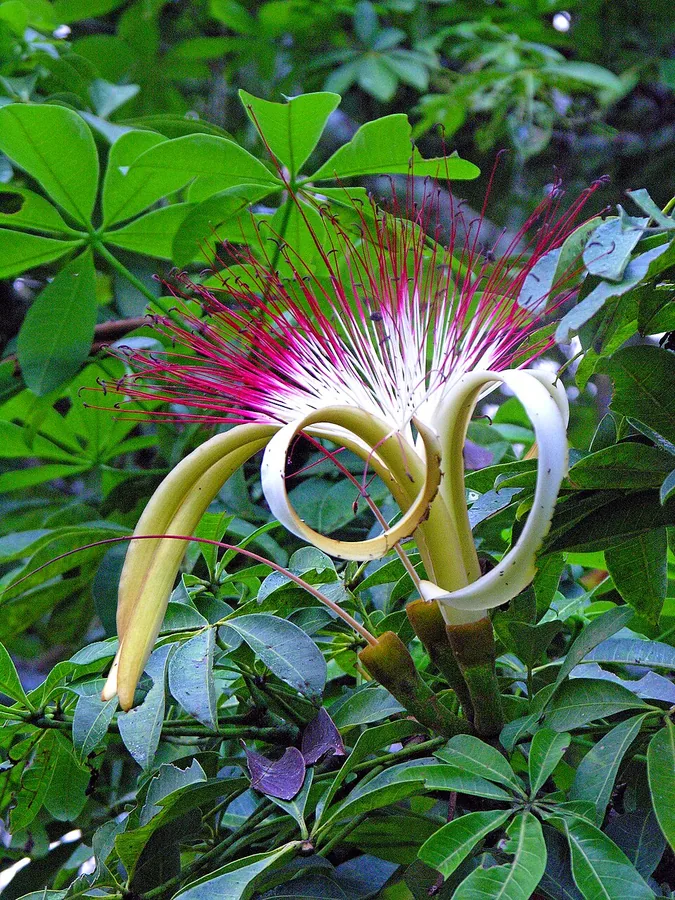
A money tree kept indoors is unlikely to give you flowers. Pachira aquatica seldom blooms in the home, and a braided specimen rarer still, holding its showy flowers for plants grown outdoors across several years. Indoors, the appeal is the glossy foliage, not the bloom.