Tree · Cactaceae
Saguaro
Carnegiea gigantea
A single saguaro turns a sun-baked garden into a sculpted desert landscape, all quiet grandeur and clean vertical line.
Full sun
Every 14–30 days
USDA 9–11
33–59 ft · 10–18 m
Overview
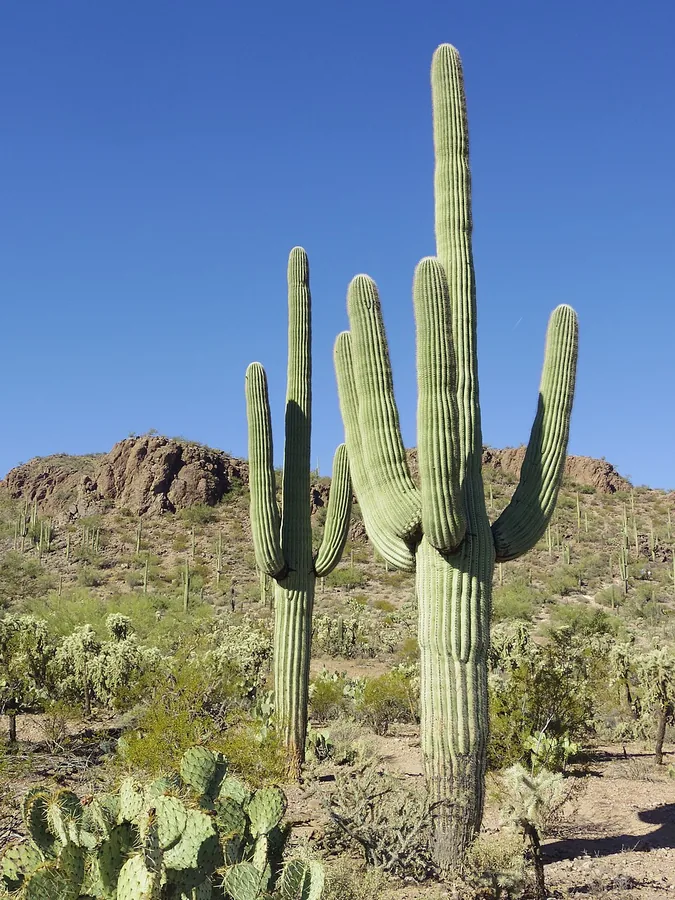
Few plants anchor a space the way a saguaro does. As the signature silhouette of the Sonoran Desert, it reads instantly as the American Southwest, its tall ribbed column and upraised arms standing like living architecture against an open sky. Set in a courtyard or a gravel garden, one mature specimen becomes the whole composition, calm and commanding at once.
This is a plant that keeps time in centuries, and that unhurried spirit is part of its appeal. A saguaro may spend 50 to 75 years before it lifts a single arm, so its presence in a garden feels like a fixture rather than a fashion. After the seasonal rains its pleated stem quietly fills and holds. Late spring brings white flowers that open after dark, followed by red fruit long gathered in the desert, a fleeting show against an otherwise steadfast form.
Styling a saguaro is really about setting and restraint. It belongs in hot, dry, frost-free ground with fast-draining soil, paired with gravel, boulders, and other desert plantings that share its spare palette. Give it space to be seen and it does the rest. Because wild plants are protected, the responsible choice is a nursery-grown specimen, chosen once and kept for a lifetime.
Care
The short version: a full-sun position, gritty fast-draining soil, and a light hand with water. Let the ground dry out completely between waterings, keep the plant nearly dry all winter, and site it clear of hard frost.
Light
Give the saguaro a position in full sun, the more open and unshaded the better. It was made for the bright, exposed desert and looks its most sculptural in a wide, sun-filled setting. Young plants take a little afternoon shade while they establish, then step fully into the light.
Water
Water deeply but seldom, and only once the soil has dried through completely in the warm growing season, which lands at roughly every 14 to 30 days. Through winter the plant prefers to stay nearly dry, a rhythm that suits a low-maintenance, water-wise garden. An established saguaro leans on natural rainfall and the reserve held in its stem, asking almost nothing of a daily routine.
Soil
Plant into gritty, sharply draining mineral soil, the rockier and sandier the better, the kind of lean ground that pairs naturally with gravel and stone. A pH from 6.0 to 8.0 suits it well. The one thing to avoid is soil that holds water at the roots, which no amount of good styling can excuse.
Temperature
The saguaro takes searing heat in stride, up to about 113°F (45°C), which makes it a natural for the hottest corner of a garden. Cold is its limit. It can weather a brief dip to around 23°F (-5°C), but a hard or lingering freeze damages the tissue, so a warm, sheltered aspect is the elegant choice.
Humidity
This is a plant for dry air, around 10% to 30%, at home in an arid climate rather than a humid one. Damp, muggy conditions work against it and invite rot, so it belongs in open, sun-warmed settings, never a steamy enclosure.
Feeding
Feeding is a light touch here. A dilute, low-nitrogen cactus fertilizer across spring and summer is all it wants, in keeping with its spare, undemanding character. Too much nitrogen only forces soft growth at odds with the plant's clean, upright line.
Pruning
The saguaro is best left untouched, needing no routine pruning to keep its form. Remove only an arm that is clearly damaged or diseased, and on a mature specimen bring in a professional, since the arms are massive and the spines unforgiving. Restraint is the whole aesthetic.
Repotting
Only young container plants call for repotting, about every 2 to 4 years while they remain small. Once a saguaro takes its place in the landscape it stays for good, an anchor you plant once and design around thereafter.
Size & spacing
Plan for scale. A mature saguaro rises to a commanding 33 to 59 feet (10 to 18 m) and spreads its arms 2 to 11.5 feet (60 cm to 3.5 m) wide, so it needs a generous, permanent stage of its own. Give it open ground and room to be admired, and it will hold that spot for generations.
When to plant
The saguaro's calendar is written by warmth, with no room for a hard freeze. Sow seed through the warm weeks of late spring and summer, and settle young plants into the garden only once frost has passed. The reward comes in late spring, when white flowers open at night and give way to red fruit through early summer.
Northern hemisphere
Southern hemisphere
Typical months for a temperate climate: start earlier in warm zones, later where spring frosts linger.
- Sow: Late spring into summer when soil is warm (21-27°C)
- Plant: Spring after all danger of frost has passed
- Harvest: Late spring to early summer (May-June); white night-opening flowers, followed by red edible fruit
Hardiness
USDA hardiness zones: 9–11
Temperature: down to -7°C
Troubleshooting
A saguaro asks for little, yet its two vulnerabilities are worth watching: too much water and a hard cold snap. Both announce themselves first at the stem and the base. Match what you see below and step in early, before a small flaw settles into the plant's long silhouette.
Soft, dark, weeping lesions marking the trunk or arms
This is bacterial necrosis, set off when Erwinia cacticida enters through a wound or frost crack and rots the tissue from within. Pare the affected flesh back to solid green tissue with a sterilized blade, then let the wound dry and callus in the open air. For a large landscape specimen, call in an arborist before any cutting begins.
Fix:
- Cut out infected tissue back to firm healthy green flesh using sterilized tools
- Allow the wound to dry and callus in open dry air
- Consult an arborist or extension specialist before treating large plants
A soft, discolored base and a plant beginning to lean
This is root and basal rot, brought on by overwatering or soil too dense to drain. The base turns soft where it should be firm, and the whole column may lean or fall, undoing a garden's centerpiece. Stop watering, let the soil dry completely, and if drainage is the fault, reset the plant into a gritty mineral mix.
Fix:
- Stop watering and allow the soil to dry completely
- Improve drainage or replant in gritty fast-draining mineral mix
- Cut away rotted tissue where accessible and let it callus
Yellowed or blackened banding near the tips after cold
This is frost damage, showing first on the growing tips and the most exposed surfaces after a hard freeze. Hold off on cutting for now. Let warm weather reveal how far the harm reaches, then trim away only what is plainly dead or rotting, preserving as much of the form as the plant allows.
Fix:
- Do not cut immediately; wait until warm weather to assess the extent of damage
- Remove only clearly dead or rotting tissue once freeze risk has passed
Toxicity
There is a reassuring simplicity to living alongside a saguaro. Nothing about it is poisonous, and its ripe fruit is edible, so there is no chemical worry at all. The caution is purely physical: its long, rigid spines puncture skin, and a mature plant is enormously heavy. Site it away from busy paths, handle it with thick gloves and proper tools, and keep children and pets from brushing past.
Safe for
People · Cats · Dogs · Horses · Rabbits · Livestock · Birds
Cats None
Nothing in the plant is poisonous, so a curious cat that investigates it comes to no chemical harm. The real concern is the spines, which can lodge deep in a paw or the face and often need a vet to remove, reason enough to site it beyond a cat's usual routes.
Dogs None
A dog that mouths the plant faces no chemical risk at all. The genuine hazard is a jabbed nose or a spine caught in the mouth, so a saguaro is best placed away from the paths a dog patrols each day.
Horses None
There is nothing toxic in a saguaro for a horse. Even a passing brush against the rigid spines can leave painful puncture wounds, which is why the plant belongs well clear of any paddock.
Rabbits None
A rabbit meets no toxin in the tissue itself. Those stiff spines can badly hurt a small animal, so a low arm within reach is worth fencing off from the garden's smaller residents.
Livestock None
Cattle, goats, and sheep take no poisoning from a saguaro. The single hazard is the spines, which can wound mouths and legs when animals crowd against the plant, so it is sited away from grazing ground.
Birds None
Birds come to no harm here, and many desert species make their homes within the plant, an unexpected charm in a garden setting. The spines trouble them little.
People None
The plant is not poisonous, and its ripe red fruit has been gathered and eaten for generations. The one real caution is the sharp spines, so it is handled with thick gloves and proper tools and given a respectful berth along a path.
The danger is physical, not chemical: large rigid spines can puncture skin and cause painful wounds, and mature plants are extremely heavy.
Varieties
The saguaro offers an elegant lack of choice. There is one classic form and a single rare curiosity that collectors prize, and those are the two you will hear named.
Typical columnar form
The classic form presents as a tall single trunk that in time sends up the familiar arms and grows to full tree scale, the shape that defines the desert skyline.
Crested (cristate) Saguaro
The rare crested version, born of an unusual mutation, tops out in a broad flattened fan instead of the usual rounded column, a collector's prize.
How to propagate
Raising a saguaro from seed is a study in patience rewarded. Starting it is simple enough; the pleasure lies in watching a slow, deliberate grower take shape over years.
SeedModerate
Warm season, late spring through summer · Germinates in 1-3 weeks but takes several years to reach a transplantable size
A saguaro begins from seed, sown fresh on a gritty mix and kept warm and lightly moist through the warm season of late spring and summer. Germination comes quickly, within 1 to 3 weeks, but the years that follow ask for patience, as the seedling grows slowly toward a size worth transplanting.
Myths
Owning or growing a saguaro is simply illegal.
Growing, selling, and planting one is entirely permitted. Arizona law reaches only the harvesting, removal, or destruction of native plants in the wild, which leaves cultivated and nursery-grown specimens perfectly legal. A saguaro chosen for the garden sits well within the rules.
A saguaro's exact age is written in its number of arms.
Arm counts vary far too much to read like a clock. Many saguaros need 50 to 75 years to raise a first arm and some never branch at all, so the arms reveal almost nothing about a plant's age. The number speaks to character, not chronology.