Houseplant · Cactaceae
Golden Barrel Cactus
Echinocactus grusonii
Set it in the sunniest corner and water it rarely, and this golden globe anchors a room with quiet ease.
Full sun
50–86°F · 10–30°C
USDA 9–11
12–35 in · 30–90 cm
Overview
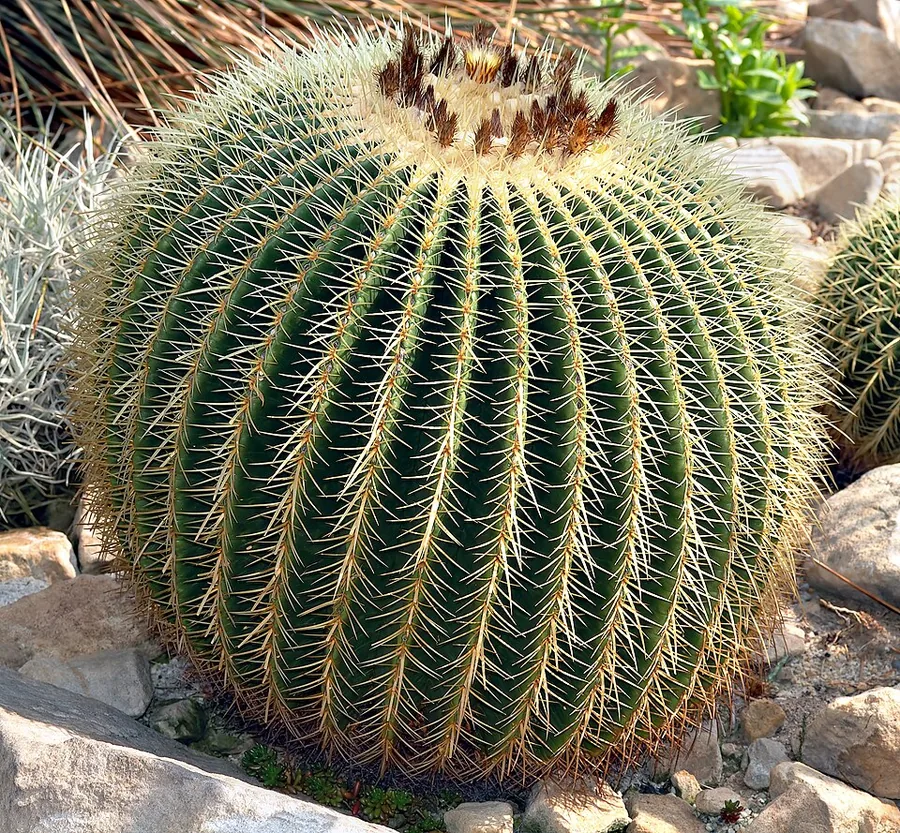
Few houseplants hold a room the way the golden barrel cactus does. Its rounded, ribbed form and warm golden-yellow spines read as sculpture, a single tidy globe that brings a note of the central Mexican desert to a bright modern interior. Give it a sun-filled windowsill and a well-draining pot, and it slots naturally into a pared-back shelf or a sunlit sill scene.
It grows slowly, which makes it a graceful long-term resident rather than a plant you'll be forever rehoming. Years pass before it approaches its full 12 to 35 inches (30 to 90 cm) across, so it keeps its proportions in a small space. On a sunny sill it holds its shape and color through the seasons, an easy fixture in a daily routine that asks for barely a glance.
It suits a home built around light and restraint, the kind of interior where less earns its keep. The one thing it won't abide is a damp pot, since at heart it's a desert plant meant to drink and then dry out. Match that rhythm and the golden barrel proves as low-maintenance as any plant you could style a room around.
Care
The short version: set it in the brightest spot in the room, use a gritty mix that drains fast, and water only when the soil is bone dry. Keep it nearly dry all winter, and handle it with thick gloves to stay clear of the spines.
Light
Give the golden barrel the brightest position in the home, ideally full sun at a south-facing window, where its form stays crisp. It manages in bright indirect light, but starved of sun the body stretches pale and loses the tidy round outline that makes it such an easy fit on a sill.
Water
Water only once the soil has gone bone dry, then soak it and let every drop drain away. Through winter dormancy keep it nearly dry. Standing moisture is the single thing that undoes this cactus, bringing on fast and often fatal rot at the roots and base, so a light hand is always the safer style.
Soil
House it in a gritty, sharply drained cactus mix that never turns soggy, paired with a pot that lets water pass freely. A pH anywhere from 6.0 to 7.5 suits it, so the feel of the mix matters far more than its exact acidity.
Temperature
It's at ease across a broad range, from 50°F to 86°F (10°C to 30°C), which covers the comfort of most rooms. Ordinary warmth keeps it content, though a cooler, drier spot for its winter rest suits it well.
Humidity
Dry air is exactly what this desert plant wants, so there's no humidity to manage and no misting to fold into a routine. The everyday air of a heated room suits it perfectly.
Feeding
Feed lightly through spring and summer while it's in active growth, roughly once a month. A dilute, low-nitrogen cactus fertilizer is all it needs, and feeding stops once growth slows for winter.
Pruning
There's nothing to prune on a golden barrel, which keeps its upkeep beautifully simple. A blade comes out only to remove damaged, rotted, or diseased tissue, and it should be clean and sharp when it does.
Repotting
Repotting comes around only every 3 to 4 years, or once the plant outgrows its container. Watch for roots reaching through the drainage holes, the barrel lifting in its pot, or soil that dries unusually fast, and reach for thick gloves to move it safely.
Size & spacing
This is a slow, compact grower that reaches 12 to 35 inches (30 to 90 cm) tall and about as wide at maturity. It takes years to arrive there, and a single barrel stands beautifully on its own as the centerpiece of a sunlit corner.
Troubleshooting
A well-placed golden barrel rarely disturbs the calm of a room, and the few issues it raises come down to water or light. A glance now and then at the base and the newest growth is all it takes, since that's where trouble first shows. Noticed early, most of it resolves without drama.
A soft, browning base gone slack and weak
A soft, darkening base signals root and base rot, the usual outcome of too much water or a mix that stays wet. Once the tissue turns to mush, the rescue is unglamorous but effective: lift the plant, pare away every rotted part with a clean blade, let the wounds callus, and reset it in dry gritty mix. Keep the watering can out of sight until fresh roots settle in.
Fix:
- Withhold water immediately
- Unpot and cut away all rotted tissue with a clean blade
- Allow cut surfaces to callus, then replant in dry gritty mix
- Resume watering only once roots re-establish
A blanched, drawn-out form gone off its round
When a barrel loses its neat silhouette and pales, the cause is etiolation, a reach toward light it isn't receiving. The stretched growth arrives lighter and taller than the crisp ribbing below, and that softened outline won't recover. Give the plant the sunniest position in the room, easing it into direct light across a week or two so the surface doesn't scorch.
Fix:
- Move to the brightest available position
- Introduce direct sun gradually to avoid scorch
Toxicity
A welcome note for homes with pets: the golden barrel cactus holds no toxins and sits safely alongside cats, dogs, and the rest of the household. Its one caveat is physical rather than chemical. The stiff golden spines can deliver a painful puncture, so give the plant a spot out of reach and move it with thick gloves or a folded band of newspaper.
Safe for
People · Cats · Dogs · Horses · Rabbits · Livestock · Birds
Cats None
There's no poison here to threaten a cat, so a shelf shared with one carries no chemical worry. The spines are the real consideration, since they can leave a painful puncture in a curious paw or nose, so give the plant a perch well out of reach.
Dogs None
A dog runs no poisoning risk from a nibble at this plant. The stiff spines are what deserve attention, since they can jab a mouth or a pawing foot, so place the pot somewhere a passing dog won't knock it.
Horses None
Nothing toxic troubles a horse here. The lone hazard is the sharp spines, which can wound the soft skin of a muzzle.
Rabbits None
A rabbit finds nothing poisonous in the flesh, yet the golden spines are far too sharp for so small a creature to explore up close.
Livestock None
Goats, sheep, and cattle face no poisoning from this plant. A mouthful of spines would injure them all the same, so it doesn't belong where they graze.
Birds None
No toxin here concerns a bird. The only thing worth minding is a landing among the stiff spines.
People None
It settles into any home safely, since nothing in the plant is poisonous. The single courtesy is to respect the spines when handling it, moving the pot with thick gloves or a folded band of newspaper.
The plant is densely armored with stiff, sharp golden spines that can cause painful puncture wounds. Handle with thick gloves or a folded band of newspaper and site it away from walkways, children, and pets.
Varieties
The barrel that dresses most sunny sills is the straight species, though a couple of named forms surface among collectors for those after something less expected.
Echinocactus grusonii var. albispinus
Its spines run white to pale rather than the usual golden-yellow, lending the whole plant a cooler, frostier presence.
Echinocactus grusonii 'Intertextus'
A neater, more compact form, its flattened spines interlacing tightly across the ribs.
How to propagate
Adding to a golden barrel collection is a patient pursuit, since the plant grows at its own slow tempo and rarely offers a shortcut.
SeedModerate
Spring, in warm, bright conditions · 1 to 2 years to reach a recognizable seedling
Seed remains the usual way this cactus is raised. Sow in spring in warm, bright surroundings and it germinates dependably. The one demand is patience, since a seedling needs 1 to 2 years to grow into a recognizable little barrel.
Offsets & pupsModerate
Spring to summer when offsets are firm · Several months to root after callusing
Offsets are a rare bonus, since this plant seldom produces them. When a firm pup does appear in spring or summer, cut it away cleanly, let the wound callus, and set it in dry gritty mix. Root formation then takes several months.
Myths
So familiar on every retail display, it must surely be flourishing across its homeland.
Its familiar place on the shop shelf tells only half the story. In its native Mexican range it is endangered and rare, its wild numbers worn down by habitat loss and over-collection.
Such a water-laden globe never asks for a drink.
The plump body does hold a reserve, but it still welcomes an occasional deep soak while it's in growth. Overwatering is the real killer, since moisture left to stand rots the roots and base.