Houseplant · Cactaceae
Bunny Ear Cactus
Opuntia microdasys
Set it on a sunny sill in a dry, gritty pot, and the bunny ear cactus quietly carries the look.
Full sun
Every 14–28 days
50–86°F · 10–30°C
USDA 9–11
Overview
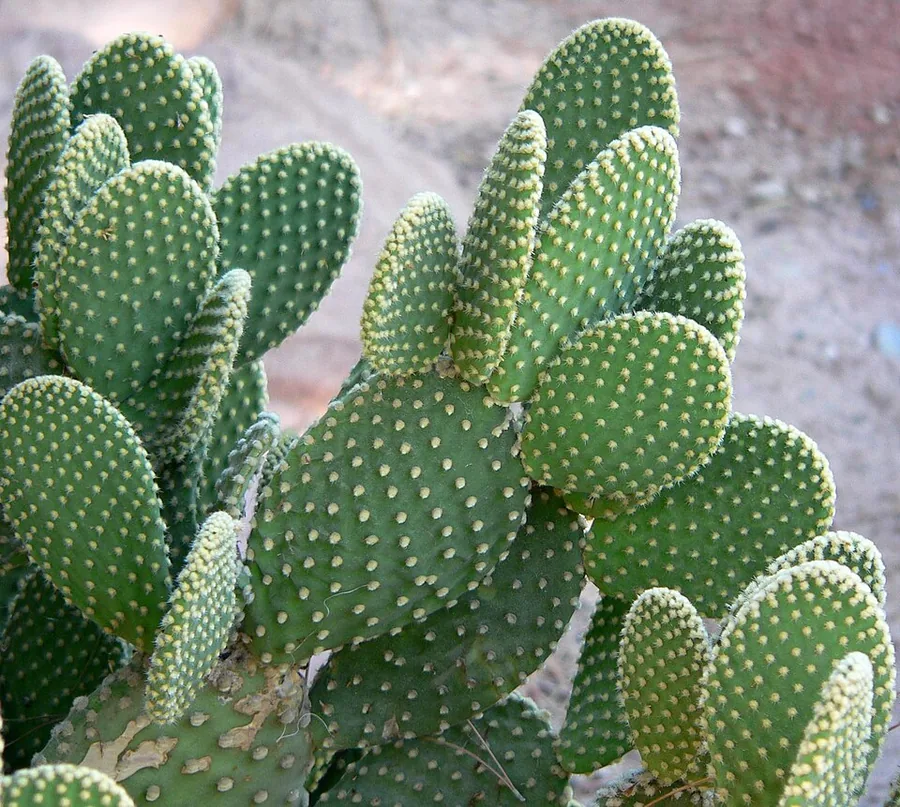
The bunny ear cactus takes its name from flat, paddle-shaped pads that grow in pairs and rise like a pair of upright ears, a silhouette that brings a little wit to a shelf or sill. A native of the Mexican deserts, it grows slowly into a low, branching clump that settles at around 12 to 24 inches (30 to 60 cm) indoors, a scale that flatters a desktop, a windowsill, or a grouping of smaller pots. Mature plants offer pale yellow flowers in late spring and summer, a seasonal grace note layered over its year-round form.
Part of its charm is the polka-dot pattern stippled across each pad, which reads as soft texture from across a room. Those neat tufts are clusters of glochids, tiny barbed bristles that pull free at the lightest brush and lodge in skin, lips, and eyes, and they are a chore to remove. It is a plant to style and admire at arm's length, handled with gloves rather than touched in passing.
It also suits a low-effort routine, which makes it an easy fit for a busy home. Bright light, a sharply draining pot, and long dry intervals between waterings are all it asks, and the one habit to resist is the well-meaning overwatering that brings on rot.
Care
The short version: give it the brightest sun in the room, a gritty and sharply drained mix, and water only once the soil has dried out completely. Handle it with gloves or tongs.
Light
Give it the brightest sun the room can offer, ideally a south-facing window, where the pads stay plump and well defined. Bright indirect light keeps it alive, but short on sun it stretches thin and pale and loses the tidy form that makes it worth displaying.
Water
As a desert plant it prefers to dry out completely before a deep drink that runs from the drainage holes. In the growing season that tends to mean about every 2 to 4 weeks, and far less through winter. Standing moisture is the surest way to undo it, so restraint serves the plant well.
Soil
Pot it in a gritty, sharply drained sandy or cactus mix that never lets water linger at the roots. A pH from 6.0 to 7.5 suits it, and a little extra perlite or coarse sand only sharpens the drainage.
Temperature
It is content between 50°F and 86°F (10°C to 30°C), a range most rooms hold without effort across the year. Keep it above freezing, since frost spoils the soft pads.
Humidity
Low household humidity is precisely what this desert native favors, so there is no target to chase. Dry air suits it well, while still, damp corners encourage rot.
Feeding
Feed it monthly through spring and summer with a diluted, low-nitrogen cactus fertilizer. Let it rest unfed through fall and winter, when forcing growth works against its natural rhythm.
Pruning
It asks for next to no pruning. Take a pad only to shape the plant or to start another, and always work with thick gloves and tongs, since the glochids release at the lightest touch and cling to skin.
Repotting
Repot only every 2 to 3 years, in spring, once roots reach the drainage holes or pads press the rim. A collar of folded newspaper and a pair of tongs make the lift painless, and the gritty mix can be refreshed in the same move.
Size & spacing
Indoors it holds a neat clump, rising slowly to about 12 to 24 inches (30 to 60 cm) tall and roughly as wide, a restrained footprint for a shelf or sill. Its unhurried pace means a single pot frames it well for years before it asks for more.
Troubleshooting
Almost every misstep with this cactus traces to water or light, so the cues are easy to read once you know them. Look at the pads and feel the soil before you reach for the watering can, since soft pads and dry pads ask for opposite responses. Match what you see below and act early.
Pads turning soft and brown at the base
A pad gone soft and brown at the base is a clear case of root and stem rot, the result of water lingering in heavy soil. The remedy is decisive rather than gentle: stop watering, lift the plant from its pot, and pare every soft section back to firm green tissue with a clean blade. Settle it into a fresh gritty mix and let it dry out completely before it is offered another drink.
Fix:
- Stop watering immediately
- Remove the plant and cut away rotted tissue with a clean blade
- Repot into fresh gritty cactus mix
- Allow soil to dry fully before watering again
Pale, stretched new growth
Pads that grow long, slim, and lean toward the window are stretching for light, the disorder gardeners name etiolation. The answer is a brighter address: the sunniest window in the room, or full sun. Raise the light over a week or two rather than overnight, since soft new pads will scorch if the change is too abrupt.
Fix:
- Move to the brightest available window or full sun
- Introduce direct sun gradually to avoid scorch
Pads thinning and creasing
Pads that thin out and crease are simply telling you the soil has stayed dry far too long, a quiet case of underwatering. A generous, thorough soak puts things right, with the surplus left to drain away. The pads recover their fullness within a few days, and the rhythm resumes: water again only once the mix has dried.
Fix:
- Water thoroughly and allow to drain
- Resume regular deep watering once soil dries
Toxicity
On the matter of poison the news is reassuring: this cactus holds no toxin, and the ASPCA does not list it as harmful to cats or dogs. The concern is physical instead. Its glochids, the soft-looking tufts of barbed bristles, release at a touch and settle painfully into skin, mouths, and eyes, so give it a spot beyond the reach of pets and children and handle it only with gloves.
Safe for
People · Cats · Dogs · Horses · Rabbits · Livestock · Birds
Cats Safe
No poison is at play, so a curious taste will not sicken a cat. The glochids are the real concern: a swat or a chew sends tiny barbed bristles into the paw, lips, and tongue, often followed by pawing at the mouth or face.
Dogs Safe
Chemically the cactus is harmless to a dog. The difficulty is physical, since a single sniff or bite drives dense barbed glochids into the muzzle and tongue, where they hold fast and resist removal.
Horses Safe
No part of the plant will poison a horse. The fine barbed bristles can still find a grazing nose or mouth, which is reason enough to place it beyond reach.
Rabbits Safe
There is no toxin here to trouble a rabbit. A nibble can still set glochids into the lips and mouth, so the kindest choice is to keep it out of reach.
Livestock Safe
Cattle, goats, and sheep face no chemical danger from this cactus. The barbed bristles are the lone hazard, settling into the mouth and muzzle of any animal that investigates the pads.
Birds Safe
Nothing in the plant is poisonous for a bird to swallow. A probing beak can still snag the tiny barbs, so a perch or pet bird is best kept clear of the pads.
People Safe
The plant is non-toxic, yet bare-handed contact is unwise. The soft-looking tufts are glochids that release at a touch and bury themselves in fingers, lips, and eyes, where they are painful and slow to remove, so thick gloves or tongs are the sensible habit.
The pads are covered in dense tufts of glochids, tiny barbed bristles that look soft and fuzzy but detach at the slightest contact and lodge painfully in skin, lips, mouth, and eyes. They are difficult to remove. Handle only with thick gloves or tongs and keep away from curious pets and children.
Varieties
Beyond the familiar golden form, a couple of named selections turn up, distinguished chiefly by the color of their glochids.
Opuntia microdasys var. albispina
Its glochid tufts arrive in white rather than the usual golden yellow, giving the pads a frosted, polka-dot finish.
Opuntia microdasys 'Rufida'
It wears reddish-brown glochids and is sometimes set apart as its own species, Opuntia rufida.
How to propagate
Among the easiest cacti to multiply, the bunny ear roots from a single pad, so one plant can furnish a whole collection of matching pots without any cost.
Stem cuttingsEasy
Spring to summer during active growth · 2 to 6 weeks to root
A single detached pad takes root with remarkable ease, so spring or summer, while the plant is growing, is the moment to multiply it. Twist or cut a pad away with tongs, let the wound callus over for several days, then stand it in dry gritty mix where roots form in 2 to 6 weeks. Keep gloves or tongs in hand at every stage so the glochids stay off your fingers.
Myths
Its fuzzy look means it is soft and safe to pet.
The tufts that look so soft are glochids, clusters of fine barbed bristles that loosen the moment you touch them and settle into skin, lips, and eyes, where they are painful and slow to draw out. Never handle this cactus bare-handed. Keep thick gloves or a pair of tongs within reach and use them every time.