Houseplant · Cactaceae
Cholla Cactus
Cylindropuntia fulgida
A sculptural desert presence for a sunny, low-effort garden, best admired from a respectful distance.
Full sun
USDA 8–11
3–13 ft · 1–4 m
Overview
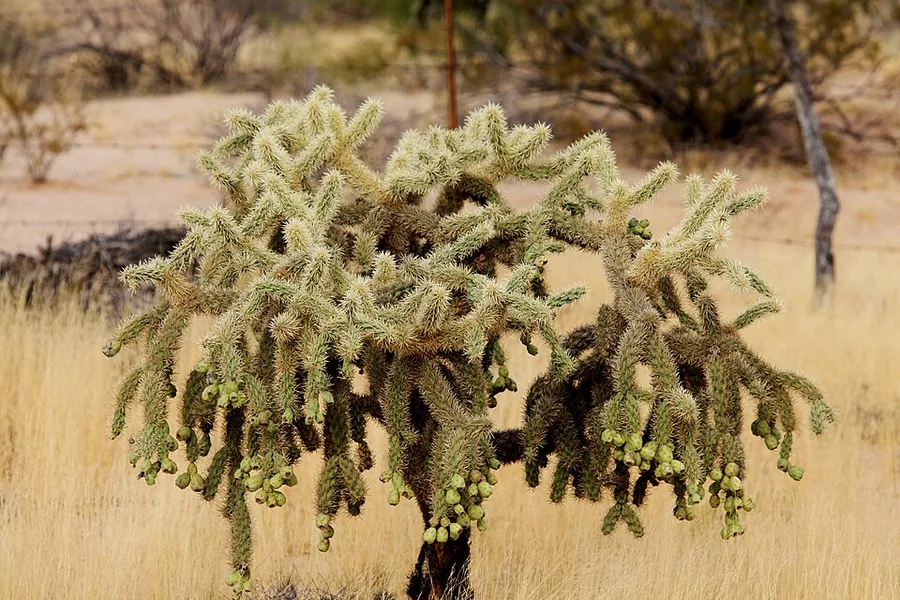
Cholla brings a quiet drama to an outdoor setting, its cylindrical, segmented joints stacking into a small spiny tree that reads as living sculpture. A creature of the arid Southwest, it stays composed through a wide temperature swing, from 23°F to 104°F (-5°C to 40°C), and rises in its own slow time toward 3 to 13 feet (1 to 4 m). Set against open gravel or a bright wall, it anchors a space the way a piece of architecture would.
Its signature is the way those joints hang on so lightly. The faintest brush frees a barbed segment, and it travels off on skin, fur, or a trouser cuff, the habit that earned it the name jumping cholla. The same easy-release joints are how the plant carries on, dropping to the ground and taking root where they settle, so think of placement as a long-term decision.
As a garden companion, cholla asks for almost nothing once it has found its footing. Offer it sun, sandy ground, and a sparing hand with water, and it carries on through conditions that would undo softer plants. The one real discipline is giving the spines their space, siting it where the daily flow of a household never drifts too close.
Care
The short version: full sun, a gritty fast-draining mix, and water only once the soil has gone fully dry. It takes a sweeping range of temperatures and asks for little beyond sharp drainage and a generous buffer of open space around it.
Light
Give cholla full sun in good measure, the way the open desert serves it. A little partial sun is within its tolerance, yet anything dimmer leaves the plant weak and far more inclined to rot, so the brightest corner of a garden suits it best.
Water
Water sparingly, and only once the soil has gone completely dry. This is a plant shaped by drought, and it rots quickly when its roots sit wet, all the more so in cool or shaded spots, so let it lean dry by a comfortable margin.
Soil
Set it into a gritty, sharply drained sandy or cactus mix that lets water pass straight through. Any pH from 6.0 to 8.0 agrees with it, which takes in most of the open desert ground it favors.
Temperature
Cholla holds steady across a striking span, roughly 23°F to 104°F (-5°C to 40°C). That resilience is what lets it live happily outdoors in USDA zones 8 through 11, where many cacti would not last a season.
Humidity
Low humidity is exactly its element, so the dry desert air of an open garden is ideal. Damp, still air invites rot, and there is no figure to aim for beyond keeping the surroundings on the dry side.
Feeding
Feed with a light hand through the spring and summer growth, offering a dilute low-nitrogen cactus fertilizer just once across the season. A richer diet forces soft growth the plant has no use for.
Pruning
Cholla calls for next to no shaping, only the clearing of dead or damaged joints. Always work with long tongs or thick gloves, since the barbed joints break free at the lightest touch and bury into skin.
Repotting
Refresh the pot only every 2 to 4 years, or sooner if the plant has plainly outgrown its container or begun to lean top-heavy. Roots slipping through the drainage holes, or soil that dries unusually fast, are the cues that the moment has come.
Size & spacing
A grown cholla stands 3 to 13 feet (1 to 4 m) tall and reaches 3 to 7 feet (100 to 200 cm) across. Allow it ample clearance so that no one passing by ever grazes the barbed joints.
Troubleshooting
Cholla seldom falters, and on the rare occasion it does, the joints tell you everything. Soft dark segments and thin shriveled ones lead in opposite directions, so take a moment to read the plant before you decide on water. Keep tongs in hand for any work you do.
Soft, darkening joints slumping at the base
When joints go soft and dark down low, you are looking at root and stem rot, and the usual cause is water lingering in soil that cannot drain. A sour smell at the base and joints that have lost their structure both confirm it. Hold off on watering, take the spoiled joints back to clean green tissue with tongs, let the cuts dry to a callus, and settle the plant into a fresh dry gritty mix.
Fix:
- Stop watering immediately
- Cut away rotted joints with tongs well into healthy tissue
- Allow cuts to callus and repot into dry gritty mix
Joints turning thin, puckered, and creased
Creased, deflated joints tell the opposite story: either prolonged drought or roots that have failed and can no longer move water up into the plant. As a rule the soil has gone dry for far too long. Return to a deep yet occasional soak through the growing season, and feel the roots to be sure they are still firm and doing their job.
Fix:
- Resume a deep but infrequent watering schedule
- Check roots are intact and functional
Toxicity
There is no toxin here to trouble a person or a pet, so poisoning is simply not part of the picture. The hazard is physical and nothing else. The barbed, detachable joints fasten into skin, mouths, and fur at the slightest touch, they hurt, and they resist coming out, which makes a wide buffer around people and pets and tongs-only handling the sensible plan.
Safe for
People · Cats · Dogs · Horses · Rabbits · Livestock · Birds
Cats None
There is no poison here for a cat to swallow. The risk lies entirely in the barbed joints, which snag in paws and faces and can settle into the mouth or tongue should a curious cat swat at the spines.
Dogs None
A dog that sniffs or mouths the plant faces no poisoning, yet the detachable spined segments hook on tightly and bury into the muzzle, the lips, and the paw pads, where they sting sharply and call for patient removal.
Horses None
Nothing in the plant will poison a horse. A horse browsing nearby can still press the barbed spines into its lips and gums, so place the cactus beyond the reach of any grazing mouth.
Rabbits None
A rabbit runs no poisoning risk, but the spines threaten small soft mouths and feet, and a tangle of fallen joints can pin a hopping rabbit in place.
Livestock None
Cattle, goats, and sheep face no poisoning, though the chain-fruit segments fasten onto legs and faces, and spines lodged around the mouth can keep an animal from feeding.
Birds None
No part of this cactus poisons a bird. Certain desert birds actually shelter their nests within the spiny joints for safety, which leaves the sharpness of the barbs as the lone concern.
People None
Not one part of the plant is poisonous to people. The barbed joints carry the whole risk: they let go at the gentlest brush and settle painfully into skin, and pulling them back out is slow and stubborn, so reach for long tongs and nothing else.
The real danger is physical: detachable, barbed spine joints (the 'jumping cholla') cling to and embed in skin at the slightest brush, are very painful, and are difficult and hazardous to remove. Keep well away from people and pet traffic and handle only with tongs.
Varieties
Cholla shares its genus with many cousins, and a couple of close relatives appear often enough to be worth knowing by name.
Cylindropuntia fulgida var. mamillata
Its joints read smoother and far less spiny than the heavily armed plant most people call to mind.
Cylindropuntia bigelovii (teddy bear cholla)
A near relative dressed in dense golden spines, its joints letting go even more freely than those of the chain-fruit cholla.
How to propagate
Cholla nearly multiplies on its own, its loose joints rooting wherever they come to rest. You can borrow that habit deliberately, or begin from seed if patience is something you can spare.
Stem cuttingsEasy
Spring to summer during active growth · 4 to 8 weeks to root
Rooting a loose joint is the simplest path to a new plant, and it goes most smoothly across spring and summer while growth is underway. Rest the joint until the cut end seals into a dry callus, settle it upright in gritty mix, and roots follow within 4 to 8 weeks. Handle it only with tongs, since the barbed spines seize on skin at a touch.
SeedModerate
Spring in warm conditions · Several months to a year for seedlings to establish
Seed is the slower and far less reliable approach. Sow in spring and hold the seeds in steady warmth to draw them up, then settle in for the wait, as seedlings need several months to a year to grow into solid young plants.
Myths
Cholla jumps and throws its spines at you.
Nothing leaps and nothing is launched. The barbed joints simply rest so loosely that the faintest brush, or even a passing static spark, lifts one away onto whatever made contact. The plant itself stays perfectly still while you carry off a segment without realizing it, and that is precisely where the jumping name began.