Shrub · Rutaceae
Japanese Skimmia
Skimmia japonica
A composed evergreen for the shaded garden, carrying fragrant spring flowers and bright winter berries.
Partial shade
Every 5–10 days
USDA 6–8
2–7 ft · 0.6–2.1 m
Overview
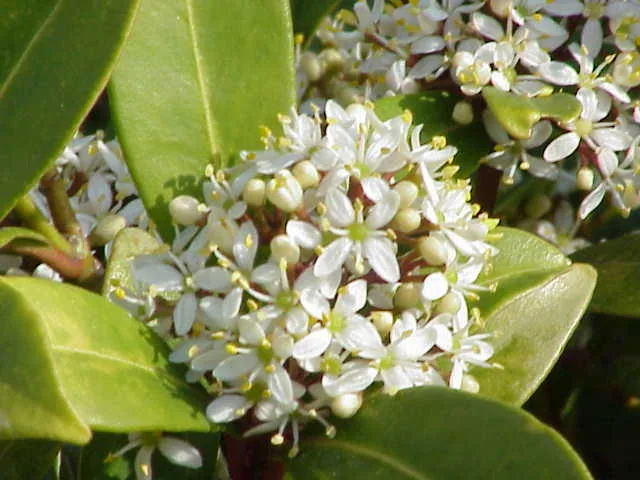
Japanese skimmia is the shrub that finally makes something of a shaded corner. Slow-growing and evergreen, it settles into the dim, north-facing edges of a garden where showier plants only sulk, and it turns them into a calm, furnished green. Its roots trace back to the woodlands of Japan and China, and a place in the citrus family lends the spring flowers a soft, spicy perfume that drifts across a doorway or a path. Through the year, glossy dark foliage keeps the picture composed, while clusters of red buds add a quiet note of warmth through the colder months.
There is one design consideration to plan around: most skimmias are either male or female. It reads less like a chore than a choice, because the males lend the fuller flowering display while the females hang the bright red berries that carry a border through winter. Pair a male with the females within pollinating range and the two settle into an easy partnership, one bringing the bloom, the other the fruit.
What skimmia offers a garden is presence in every season with very little asked in return, once its place suits it. Acidic, moist soil and steady shade are the whole arrangement. Miss them and the leaves yellow or scorch and the look falters, but get them right and the shrub anchors a shaded scheme from one month to the next, dependable behind whatever flowers come and go around it.
Care
The short version: a shaded position in part to full shade, acidic and humus-rich soil kept evenly moist, and a male plant nearby to set berries on the females.
Light
Skimmia belongs in part to full shade, and it resents direct sun, which scorches the leaves and undoes the look. A spot in dappled light, or one that catches gentle morning sun before falling into afternoon shade, flatters it best. It settles happily into deep shade as well, though the flowering softens where the light is lowest.
Water
Keep the soil evenly moist but well drained, which in practice means watering every 5 to 10 days, and a touch more through a heat wave. Its needs sit comfortably in the middle, so it never wants to stand wet. The one rule to hold to is never letting the root zone dry out entirely when the weather turns hot.
Soil
Give skimmia moist, humus-rich, acidic ground that still drains freely, and it rewards the effort. Aim for a pH of 5.0 to 6.5, on the acid side, and fold in plenty of organic matter as you plant. Let the soil drift alkaline and it locks up iron, and the leaves lose their color to yellow.
Temperature
This is a hardy shrub that takes the cold in stride, holding from -9°F (-23°C) at the low end to around 86°F (30°C) at the high. Hot, dry heat unsettles it far more than frost ever could. It is one more reason a shaded, sheltered position suits it so well.
Humidity
Ordinary outdoor air is all skimmia looks for, so there is no level to chase. Dry heat is the real complication, since it stresses the plant and draws in spider mites. Keeping the soil steadily moist matters far more to the overall picture than the moisture in the air.
Feeding
In spring, offer a balanced or acid-forming ericaceous fertilizer made for acid-loving shrubs. Once a season is plenty for so measured a grower. The acidic feed does double duty, holding the soil at the level skimmia prefers and keeping the foliage in good color.
Pruning
Skimmia asks for almost no pruning, which keeps a scheme low on upkeep. A light shaping after flowering, taking out anything damaged or straying, is all it wants. Beyond that, step back and let the naturally rounded form settle into its place.
Repotting
A container skimmia appreciates a move up every 2 to 3 years into a slightly larger pot of fresh acidic mix, which keeps a potted display looking its best. Roots circling the pot or reaching through the drainage holes are the signal, as is soil that dries faster than it used to.
Size & spacing
Allow for a mature shrub of 2 to 7 feet (61 to 213 cm) tall, spreading a little wider than high at 3 to 5 feet (91 to 152 cm). Give it that room and the rounded form fills out with balance, holding its own in a border without crowding what sits beside it.
When to plant
Skimmia keeps an unhurried calendar that suits a considered garden. Set new plants in place in spring or fall while the soil is easy to work, then let the display unfold: fragrant flowers open from late winter into spring, and the red berries color up on female plants in fall and hold their warmth through the whole of winter.
Northern hemisphere
Southern hemisphere
Typical months for a temperate climate: start earlier in warm zones, later where spring frosts linger.
- Plant: Spring or fall
- Harvest: Fragrant flowers late winter to spring (around April); red berries on female plants ripen in fall and persist through winter
Hardiness
USDA hardiness zones: 6–8
Temperature: down to -23°C
Troubleshooting
A skimmia that has the right setting, acidic soil and settled shade, mostly looks after itself, so when the picture slips it usually points back to the position or a sap-sucking pest. The foliage tells the story plainly enough. Match what you see below and treat the cause, and the composure returns.
Yellowing foliage with veins holding their color
When the leaves fade to yellow while the veins keep their green, the picture is interveinal chlorosis, and the usual cause is soil grown too alkaline for the roots to draw up iron, with poor drainage adding to it. Bring the pH down with elemental sulfur, feed chelated iron, and mulch with acidic organic matter to restore the color.
Fix:
- Lower soil pH with elemental sulfur or acidifying amendments
- Apply chelated iron and mulch with acidic organic matter
- Improve drainage
A fine mottling and gossamer threads over the leaves
A dull bronze speckling across the leaves with thin webbing beneath them points to spider mites, which arrive in hot, dry spells. A firm spray of water knocks them loose, and a follow-up of insecticidal soap or horticultural oil finishes the job. Keeping the plant watered and shaded from harsh sun keeps them from returning.
Fix:
- Spray foliage with water to dislodge mites
- Apply insecticidal soap or horticultural oil
- Improve air humidity and avoid drought stress
A sticky sheen, waxy stem nodes, and a film of sooty mold
Sticky honeydew and a film of black sooty mold mark a sap-sucking visitor, most often scale as raised waxy bumps or aphids gathered on soft new growth. Take out the worst-affected stems first to clear the picture. Then smother any scale with horticultural oil and clear the aphids with insecticidal soap.
Fix:
- Prune out heavily infested stems
- Apply horticultural oil to smother scale
- Use insecticidal soap for aphids
Bleached, scorched leaves on the sun-facing side
Skimmia is built for shade, so leaves that brown or bleach are almost always taking too much direct sun, the damage showing on the exposed side while the shaded foliage stays green. Move it to a shadier position, or give it morning sun with afternoon shade, and a layer of mulch eases it through the change.
Fix:
- Provide part to full shade or morning sun with afternoon shade
- Transplant to a shadier site if needed
- Mulch and water to reduce stress
Toxicity
For all its poise, this is a plant to place with care, because it is poisonous. The leaves and those glossy red berries hold alkaloids called skimmianine along with glycosides, and the fruit is the real concern precisely because it looks so ornamental. Swallowed, the berries bring on vomiting and drooling, and a large amount can reach the heart and nerves, so keep them well clear of children, pets, and grazing animals when you are choosing where it goes.
Toxic to
Cats · Dogs · Horses · Rabbits · Livestock · Birds · People
Cats Toxic
The leaves and berries hold skimmianine, so a cat that samples them tends to drool and be sick, and a large enough mouthful can unsettle the heart into a racing or uneven beat.
Dogs Toxic
A dog that chews the foliage or the red berries soon starts drooling and vomiting, and enough of it lets the alkaloids reach the heart and nerves.
Horses Toxic
A horse grazing the leaves or fruit is left drooling, off its feed, and queasy, with heart and nervous effects where a large amount is taken.
Rabbits Toxic
The alkaloids are not safe for a small grazer, and even a little of the leaf or berry sets off drooling and a churning gut, so keep skimmia beyond a rabbit's reach.
Livestock Toxic
Cattle, sheep, and goats fare badly on the foliage and berries, with salivation and digestive upset that can tip into heart and nervous effects after a heavy feed.
Birds Toxic
The berries look like easy pickings, yet the skimmianine within is poisonous, and a bird that swallows the fruit can sicken, so it is best treated as off limits.
People Caution
No part of the plant is food, and the ornamental red berries are the real hazard for a curious child. Swallowing them brings nausea and an upset stomach, with heart effects possible after a large amount.
Keep berries away from children and pets; wash hands after handling.
Helpline numbers

United States
ASPCA Animal Poison Control: (888) 426-4435 (fee applies)
Poison Control: (800) 222-1222



Canada
Poison Centres: 1-844-764-7669
Varieties
A handful of named skimmias appear again and again in good gardens, and the choice comes down to the effect you are after: flowers, berries, or both. These are the ones worth composing around.
Rubella
A favored male clone grown for the dark red flower buds that hold their color right through winter before opening to fragrant white flowers, though it sets no berries of its own.
Nymans
A female cultivar that carries generous crops of large, bright red berries wherever a male grows near enough to pollinate it.
Fragrans
A male cultivar chosen for the strong scent its white flower panicles bring to a spring garden.
Companions
Skimmia thrives next to other shade-loving, acid-soil plants that ask for the same conditions, which makes it an easy fit in a woodland border.
Plant near
Rhododendron: Shares the same acidic soil and part-shade conditions.
Camellia: Both are shade-tolerant broadleaf evergreens that thrive in acidic, moist, well-drained soil.
Hosta: Pairs well as a shade-garden understory companion with similar moisture needs.
How to propagate
More skimmia can be raised from cuttings or seed, though cuttings are the route most gardeners favor, since they hold the parent's character and, importantly, its sex.
Stem cuttingsModerate
Late summer to fall · Several weeks to a few months to root
Cuttings are the dependable choice. Take semi-hardwood cuttings in late summer or fall and root them under humidity, where they establish over several weeks to a few months. Since a cutting holds the parent's sex, remember you still want both a male and a female nearby if a border is to carry berries.
SeedModerate
Fall, from ripe berries · Germination can be slow and seedlings take years to mature
Seed cleaned from ripe berries can go in during fall, though it is a patient path. Germination is slow, the seedlings take years to reach flowering size, and they come up variable, so the sex of any one stays a mystery until it finally blooms.
Myths
A single skimmia will decorate itself with red berries unaided.
Skimmia is mostly dioecious, which means the plants come as separate males and females, and only the females carry fruit. A male has to grow nearby to pollinate them, at roughly one male to six females for a full show of berries, so a lone plant or a solitary male leaves you with none. Plan the pairing when you plan the planting.