Shrub · Clethraceae
Summersweet
Clethra alnifolia
Give it steady moisture and a little shade, and summersweet perfumes the late-summer garden long after other shrubs have bowed out.
Partial shade
Every 3–7 days
USDA 3–9
3–8 ft · 0.9–2.4 m
Overview
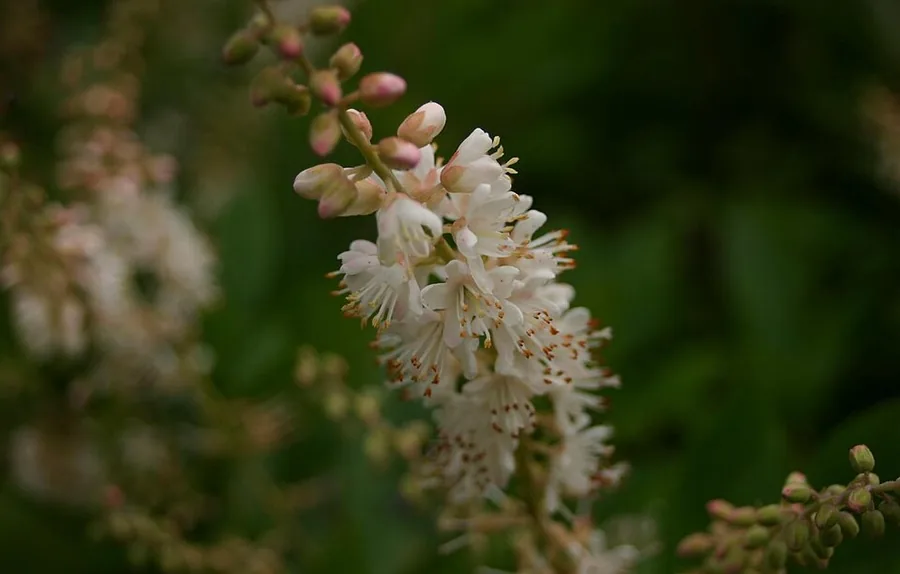
Summersweet is the shrub that keeps a garden in bloom once high summer has passed, sending up fragrant white or pink spikes through July and August when the beds around it start to fade. A member of the Clethraceae family, it grows wild along the eastern seaboard in damp woods and beside streams, and that watery background shapes where it belongs at home: the low, moist corners other shrubs refuse, turned into a scented feature.
It suits an easy, unfussy kind of garden. Hardy from zone 3 to zone 9, it holds its own through hard winters and shrugs off clay, salt, and standing water, so it settles happily into a rain garden or a damp streamside border. Through summer its flowers keep the planting alive with bees and butterflies, and by fall the foliage turns a warm golden yellow that carries the scene into the season's end.
Set it where the ground stays moist and acidic and it slips into the daily rhythm of a garden with almost no demands. Its one dislike is a hot, dry spot, where the leaves bronze and lose their poise. Give it a damp place with some afternoon shade, near a path or a seating corner where the scent can drift, and it grows into a fragrant, welcoming colony.
Care
The short version: partial shade to full sun, in moist to wet, acidic soil that never dries out, kept watered through the heat, pruned in late winter, and fed once in spring.
Light
Summersweet looks its best in partial shade, though it accepts anything from full sun to deeper shade. A little direct light coaxes out more flowers, yet it keeps blooming where many shrubs would quit, which makes it a graceful answer for a shadier corner that needs lifting.
Water
Keep the ground evenly moist to wet and never let it bake dry. Water every 3 to 7 days, and more often while a new plant settles in or through a dry spell. This is a streamside shrub at heart, so a damp footing suits it far better than thirst, and it earns its keep in the wet spots most plantings avoid.
Soil
Give it moist to wet, acidic ground with plenty of organic matter. A pH from 4.5 to 7.0 keeps it content, and unlike more particular shrubs it takes heavy clay and soggy, low-lying places in stride.
Temperature
Cold holds no threat here. The shrub is hardy from roughly -29°F to 100°F (-34°C to 38°C), carrying it through zone 3 winters and warm southern summers with the same composure.
Humidity
Ordinary outdoor air is all it asks, so there is no reading to track. What counts is moisture at the roots, since dry air over dry soil is what opens the door to spider mites.
Feeding
A single spring feeding keeps it looking its best. Reach for a balanced or acidifying fertilizer made for acid-loving plants to hold the soil on the sour side it favors.
Pruning
Because it flowers on new wood, prune in late winter or early spring to shape it and keep it in scale with its setting, with no cost to the coming bloom. Pull the root suckers as well, unless a spreading colony is the look you are after.
Repotting
Grown in the ground, summersweet rarely needs its roots touched. In a container, repot only when roots circle the pot, push out the drainage holes, or water runs straight through without soaking in.
Size & spacing
A mature shrub reaches 3 to 8 feet (91 to 244 cm) tall and spreads 4 to 6 feet (122 to 183 cm) wide. Leave room for that full width when you place it, and plan for the way it suckers outward past its first footprint.
When to plant
Summersweet is planted in spring or fall, while the weather stays mild and the roots settle in before the next stretch of heat or cold. The fragrant flowers arrive on their own through July and August, on growth the shrub makes that same season, timing the garden's best scent to its quietest weeks.
Northern hemisphere
Southern hemisphere
Typical months for a temperate climate: start earlier in warm zones, later where spring frosts linger.
- Plant: Spring or fall
- Harvest: July to August
Hardiness
USDA hardiness zones: 3–9
Temperature: down to -40°C
Troubleshooting
Nearly everything that dims a summersweet leads back to one thing: a spot that runs too hot and too dry for its taste. Read the foliage early and most of it eases once the moisture is right. Match what you see below, then step in before the shrub loses its looks.
Speckled, bronzing foliage veiled in fine webbing
A shrub losing its polish to stippling and bronze usually has spider mites, drawn in when its spot runs too hot and too dry. A firm rinse from the hose sends them packing, and steady soil moisture keeps the planting from tempting them back. For a heavier showing, insecticidal soap or horticultural oil restores the clean look.
Fix:
- Spray foliage with a strong stream of water to dislodge mites
- Improve soil moisture and avoid hot, dry sites
- Apply insecticidal soap or horticultural oil to affected foliage if needed
Wilt and fade in a hot, dry corner of the garden
When a summersweet looks tired and yellow, the story is drought stress, and it traces to where the shrub was planted rather than to anything in the routine. This is a plant that thrives on steady moisture and slips quickly in dry heat. More frequent watering keeps the root zone evenly damp, a layer of mulch holds that moisture, and a chronically unhappy shrub earns a move to a cooler, damper, partly shaded setting.
Fix:
- Increase watering frequency to keep soil evenly moist
- Mulch to conserve moisture and keep roots cool
- Relocate to a moister, partly shaded site if chronically stressed
Toxicity
Reassuring news for a garden shared with pets and small children. Summersweet stays off the ASPCA toxic-plant lists and counts as non-toxic and pet-safe. A stray nibble brings nothing worse than a brief, mild stomach upset, the same as with almost any garden plant.
Safe for
People · Cats · Dogs · Horses · Rabbits · Livestock · Birds
Cats None
A household cat can share the garden with summersweet in complete ease, as the shrub never appears on the ASPCA toxic list. Should a cat nose in and taste a leaf, the most that follows is a passing stomach upset, no different from any other plant.
Dogs None
The family dog can wander freely among these branches. The shrub holds no known toxin, though a dog that makes a meal of the foliage may drool a little or turn up a soft stool for a day.
Horses Safe
Horses grazing near a summersweet planting have nothing to fear, since the shrub carries no harmful compounds. A few leaves taken in passing leave them untroubled.
Rabbits Safe
Rabbits are welcome to browse at the edge of the border with no risk at all. The plant offers nothing poisonous, so an idle bite of leaf does no harm.
Livestock Safe
Cattle, goats, and sheep can pasture alongside summersweet without concern. Its foliage carries none of the toxins that trouble grazing animals.
Birds Safe
Songbirds and wild birds move safely through the shrub, which sets the garden humming as it draws bees and butterflies to its fragrant spikes. Nothing on the plant puts them at risk.
People Safe
Summersweet poses no danger to people either. It earns its place for beauty rather than the table, yet a curious child who tastes a leaf meets nothing worse than a possible mild stomach ache.
As with any plant, ingestion of large amounts of plant material may cause mild, transient stomach upset.
Varieties
A handful of named summersweet selections reach nurseries, sorted mostly by size and flower color to suit different corners of a garden. These are the ones worth knowing.
Hummingbird
A compact dwarf that settles around 2 to 4 feet tall and covers itself in dense white flower spikes, ideal for the front of a border.
Ruby Spice
Its deep pink flowers keep their saturated color through bloom rather than fading to a wash.
Pink Spire
Pink buds open to soft pink, fragrant spikes for a gentler palette.
Sixteen Candles
Upright white spikes rise cleanly above the foliage on a tidy, compact shape.
Companions
Summersweet pairs best with other natives that share its love of wet, acidic ground, the kind of partners that thrive in a rain garden or a damp, shaded border.
Plant near
Itea virginica (Virginia sweetspire): Shares the same moist, acidic soil and sun-to-part-shade conditions for wet-site and rain-garden plantings.
Ilex verticillata (winterberry): Native shrub that thrives in the same wet to moist soils and pairs well in naturalized and pollinator plantings.
How to propagate
Summersweet is easy to increase, and the suckering habit some gardeners resist is exactly what lets you carry the planting, and its scent, into new parts of the garden for free.
DivisionEasy
Late winter to early spring · 1 to 2 growing seasons
The simplest way to extend a planting is to lift the rooted suckers that gather at a clump's edge. Set them out in late winter or early spring, and each fills in as a full shrub over 1 to 2 growing seasons, ready to carry the scheme to a new corner.
Stem cuttingsModerate
Early summer (softwood) · Several weeks to root, then 1 season to establish
For a matched run of shrubs along a walk, take softwood cuttings in early summer and root them under mist or a humidity cover. Roots form in a few weeks, and the young plants take roughly a season more to establish.
SeedModerate
Sow collected seed in fall or after cold stratification · 1 to 2 seasons
Surface-sow the fine seed in fall, or after cold stratification, since it wants light and a chilling spell to stir. Allow 1 to 2 seasons to reach a garden-ready plant, and note that named cultivars will not repeat their look from seed.
Myths
Summersweet only blooms well in full sun.
It is one of the rare flowering shrubs that performs dependably in part shade. The fragrant, late-summer spikes still arrive in the shadowed corners where most shrubs give up, which makes summersweet a gift for a difficult, low-light bed.
Prune summersweet right after it flowers to get more blooms.
It sets flowers on new, current-season wood, so the moment to prune is late winter or early spring. A trim then costs the coming season nothing, letting you shape the plant to suit the space without sacrificing a single spike.