Ornamental · Brassicaceae
Sweet Alyssum
Lobularia maritima
A soft, honey-scented carpet that softens edges and borders from spring to fall while quietly working for the garden.
Full sun
42–56 days
USDA 5–9
3–10 in · 8–25 cm
Overview
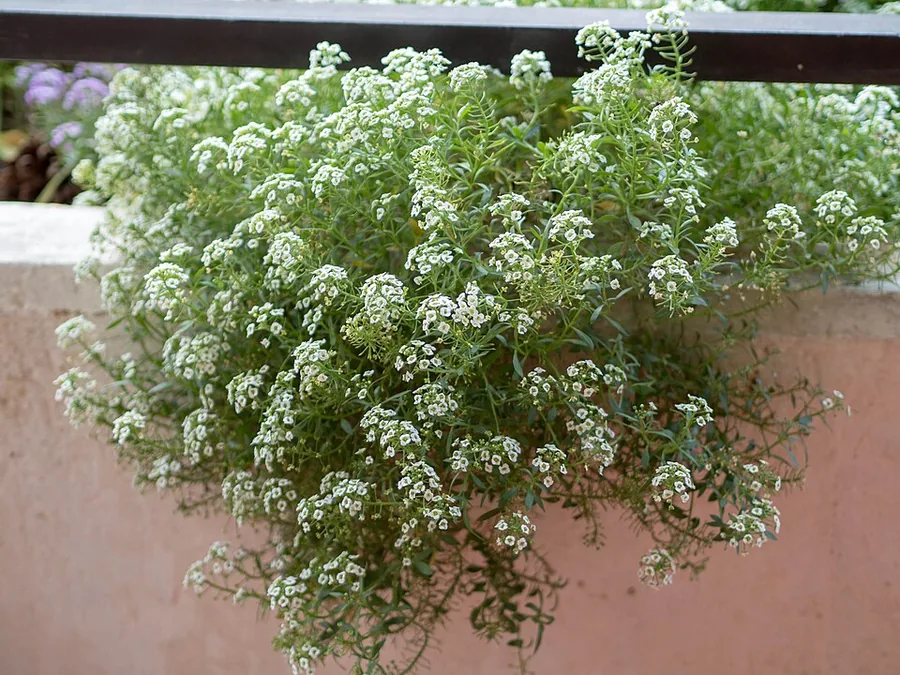
Sweet alyssum is the finishing touch a planting scheme often needs. Run it along a path edge or let it pour over the lip of a wall, and its low mounds settle into a gentle, honey-scented carpet in white, pink, or purple. A member of the cabbage family, it brings an unfussy cottage softness that reads as effortless from spring through fall.
Treat it as a cool-season annual and it rewards the mild, easy weeks of spring and fall, easing off during the hottest stretch before returning as the air cools. Staying under 10 inches tall and about a foot wide, it never competes for attention, filling the low spaces between taller plants and spilling softly over container rims and border edges.
Its charm goes beyond how it looks. The flowers draw in hoverflies and parasitic wasps whose young feed on aphids, so a ribbon of alyssum does quiet, useful work while it dresses the edge of a bed or a kitchen-garden path.
Care
The short version: full sun, average soil with good drainage, and a light touch with water and feed. Shear it back when summer heat pauses the show, and it returns to flower as fall settles in.
Light
Give sweet alyssum full sun and it flowers most generously, the surest way to keep that carpet dense where it lines a path or edges a terrace. A little afternoon shade eases it through hot-summer spells, and strong spring and fall light thickens the bloom.
Water
Water it regularly as it settles into its spot, then step back, since it grows drought tolerant once established and fits neatly into a low-effort routine. It will not abide standing water, so let the soil dry between drinks to keep it looking its best.
Soil
Average, well-drained soil is all it needs, and it stays handsome even in poor ground. The one condition it insists on is sharp drainage, since soggy soil undoes it at the crown.
Humidity
Ordinary outdoor air suits it, so there is no target to manage. Room to breathe matters more than any humidity level, since a crowded, damp planting invites downy mildew and dulls the display.
Feeding
A light feed through the growing season, about once a month, is plenty to keep the flowers coming. Overfeed and you trade bloom for leaf, so a restrained hand keeps the carpet in flower rather than in foliage.
Pruning
Deadhead the spent flowers to keep fresh ones opening, and tidy away any damaged or diseased growth to hold the neat line. When summer heat stalls the planting, a firmer shear resets it for a clean fall flush.
Size & spacing
Expect a low, tidy footprint of 3 to 10 inches (8 to 25 cm) tall and 6 to 12 inches (15 to 30 cm) wide. Set plants close enough to read as a continuous edge while leaving a little air between them.
When to plant
Sweet alyssum keeps to the graceful ends of the season. Start seeds indoors 6 to 8 weeks before the last frost, or sow directly a few weeks before that date, and it carries the border from spring through fall with a quiet interval in high summer. In mild climates, a fall sowing extends the display.
Northern hemisphere
Southern hemisphere
Typical months for a temperate climate: start earlier in warm zones, later where spring frosts linger.
- Sow: 6 to 8 weeks before the last spring frost
- Plant: A few weeks before to around the last spring frost; can also sow in fall in mild climates
- Harvest: Spring through fall, flushing in spring and fall and slowing in peak summer heat
Hardiness
USDA hardiness zones: 5–9
Temperature: down to -29°C
Troubleshooting
When sweet alyssum falters, the reason is almost always heat or overwatering, and both are easy to read early. Catch the signs below and you can step in before a tired patch spoils the look of a bed. Match the symptom, then act.
Wilting plants with rot at the stem and crown
The culprit is waterlogged ground. Stem and crown rot takes hold when soil stays wet or water gathers at the base, and the plant wilts even as its roots sit drowning. Lift the affected plants, correct the drainage, and pull back on watering.
Fix:
- Improve soil drainage
- Avoid overwatering and standing water
- Remove affected plants
Yellow leaves with downy growth underneath
Downy growth on the undersides of the leaves, with yellowing showing through on top, marks downy mildew. It arrives in cool, wet spells when the foliage stays damp. Open the planting for airflow, water at the base rather than overhead, and clear away infected debris.
Fix:
- Improve air circulation
- Avoid overhead watering
- Remove and discard infected plant debris
The display fades and plants brown in midsummer
This is heat stress, not a lost plant. Sweet alyssum is a cool-season annual, so its growth and flowering ease off once summer turns hot. Shear the plants back by about half, water and feed lightly, and the display returns as fall cools the air.
Fix:
- Shear plants back by about one-half
- Water and lightly fertilize to encourage a new flush
- Allow plants to rebound in cooler fall weather
Toxicity
For a home shared with pets, sweet alyssum sits easy: it is non-toxic. Cats, dogs, and the rest can live alongside it, brush past it, even taste it without harm. Its honey-scented flowers are just as safe in the hands of curious children.
Safe for
People · Cats · Dogs · Horses · Rabbits · Livestock · Birds
Cats None
Cats are safe alongside it, and a curious nibble of the leaves or flowers will not cause poisoning.
Dogs None
Dogs have nothing to fear, since the plant is non-toxic and a stray mouthful brings no harm.
Horses Safe
Horses can graze near it without concern, as the plant carries no toxins that affect them.
Rabbits Safe
Rabbits can sample the leaves and flowers safely, though any new green is best offered in small amounts.
Livestock Safe
Cattle, goats, and sheep are in no danger from it, with nothing in the plant to trouble grazing animals.
Birds Safe
Birds are safe around it, and the flowers draw the bees and butterflies that birds may hunt in turn.
People Safe
People are unharmed by it, and the honey-scented flowers are safe for children to handle.
Varieties
A short cast of named selections is worth knowing, sorted mostly by flower color and by how gracefully each holds its display through heat.
Carpet of Snow
A compact, low-spreading selection that stays around 3 to 4 inches tall beneath a sheet of white flowers.
Royal Carpet
A 1953 All-America Selections winner in violet-purple, holding to about 3 inches tall.
Snow Princess
A vigorous white sterile hybrid that carries its display through heat far better than the older selections.
Snow Crystals
A tetraploid with larger white flowers and better heat tolerance.
Easter Bonnet
An early-blooming series offered as a mix of colors.
Companions
Sweet alyssum earns its place beside vegetables by drawing in the insects that hunt aphids, which is why it's grown in flower strips next to crops like lettuce.
Plant near
Lettuce: Planted as insectary flower strips, sweet alyssum attracts hoverflies (syrphid flies) and parasitic wasps whose larvae prey on aphids, providing biological aphid control in lettuce and other vegetable crops
How to propagate
Sweet alyssum keeps itself going with little fuss, whether you begin with a seed packet or lift cuttings from a favorite hybrid to repeat a look you love.
SeedEasy
Direct sow several weeks before the last spring frost, or start indoors 6 to 8 weeks before transplanting; can also sow in fall in mild climates · Blooms about 6 to 8 weeks from seed
Seed is the simplest start. Scatter it on the surface and barely cover it, since the seeds need light to germinate, either outdoors a few weeks before the last frost or indoors 6 to 8 weeks before planting out. Flowers arrive in about 6 to 8 weeks, and it self-sows freely once it settles into a spot.
Stem cuttingsModerate
During active growth · A few weeks to root
Cuttings carry on the sterile hybrids, since cultivars like Snow Princess set little or no seed. Take them during active growth and they root in a few weeks into plants that repeat the parent exactly.
Myths
A sweet alyssum that browns and stops flowering in summer has died.
More often it is only pausing, a cool-season annual biding its time through the heat. Shear it back, keep it watered, and the cooler days of fall bring the flowers back. A ragged midsummer plant is resting, not dead.
Sweet alyssum needs heavy feeding to flower well.
Feed it hard and you get lush foliage with little to show. A light feed brings far better bloom, because this plant flowers best when it is left largely alone.