Shrub · Hamamelidaceae
Witch Hazel
Hamamelis virginiana
Give it moist, acidic soil and a place to spread, and witch hazel brings ribbon-like flowers to the garden just as the season slips into quiet.
Full sun
Every 5–10 days
USDA 3–8
15–20 ft · 4.6–6.1 m
Overview
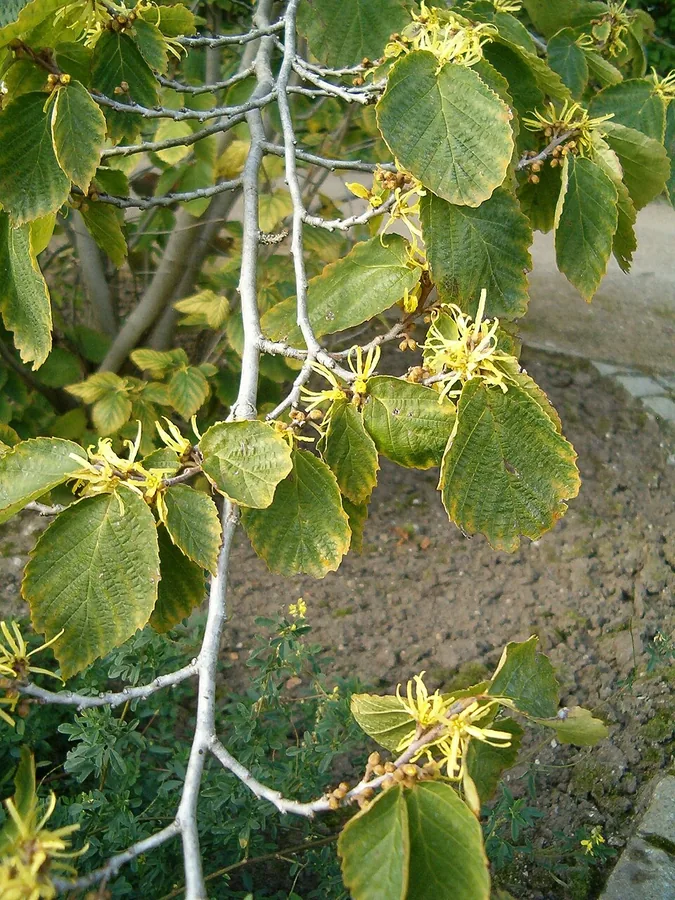
Witch hazel is the shrub that keeps a garden interesting when the calendar says the show is over. A native of eastern North American woodland, it opens spidery yellow flowers from mid-October into December, often after the leaves have gone, so a bare border suddenly has a focal point. The blooms lend a clean, sweet fragrance to cold air, and the shrub stands its ground through winters as low as -35°F (-37°C).
As a piece of the landscape it settles into a large, multi-stemmed shrub or small tree, filling 15 to 20 feet (4.5 to 6 m) of height and spread with an open, vase-shaped silhouette that suits a naturalistic corner or the far edge of a lawn. Its autumn foliage turns a warm yellow before it drops, and the same bark and leaves become the astringent witch hazel toner kept in the bathroom cabinet, distilled for the skin.
For all that presence it stays an easy, low-maintenance choice once established, the kind of shrub that earns its place without asking for daily attention. It wants acidic, steadily moist ground and a spot with reasonable light, and it takes cold, clay soil, and passing deer in stride. Drought is the one thing it will not tolerate, so a young plant deserves a watchful eye through dry weeks.
Care
The short version: full sun to part shade, in moist, acidic, rich soil that never dries out. Water through dry spells, especially while the plant is young, feed once in early spring, and leave it plenty of room to grow into its full spread.
Light
Witch hazel gives its best in full sun, where the flowering is fullest and the autumn color reaches its warmest. It accepts partial shade without protest, though thin light means fewer blooms and a greater chance of mildew settling on the leaves.
Water
Keep the soil consistently moist, as this is a shrub with no patience for drought. Water every 5 to 10 days through dry spells, and stay attentive to a young plant across its first summers until the roots reach deep enough to sustain themselves.
Soil
Give it moist, acidic, rich ground that still drains freely. A pH of 5.0 to 6.0 suits it best, and, unlike many shrubs, it accepts heavy clay, so a damp, stiff corner that stumps other plants can become its home.
Temperature
Few shrubs match this cold-hardiness. Witch hazel weathers the span from -35°F to 100°F (-37°C to 38°C), and that resilience is what lets it flower in late fall while the rest of the garden retreats.
Humidity
Ordinary outdoor humidity is all it needs, so there is no figure to fuss over. Air movement counts for more than moisture in the air, since still, crowded conditions are what invite powdery mildew onto the leaves.
Feeding
A single feeding sees it through. Apply a balanced or acidic slow-release fertilizer in early spring, then let the plant carry on across the season on its own.
Pruning
The shears can mostly stay put. Prune only to shape the plant, and do it in early spring, remembering that flowers form on old growth, so a heavy hand costs next fall's display.
Repotting
As a landscape shrub, witch hazel rarely needs repotting. If a young one is raised in a container, pot it on when roots begin circling or slipping out the drainage holes, or the top growth stalls despite steady water and feeding.
Size & spacing
Plan for room. The shrub reaches 15 to 20 feet (4.5 to 6 m) in height and spread, so give it clear distance from buildings and neighboring plants and let its open, vase-shaped silhouette settle into the space.
When to plant
Witch hazel keeps a rhythm all its own, flowering in late fall when the rest of the garden has wound down. Set it out in spring or fall so the roots find their footing before summer heat or hard winter, and then anticipate the fragrant flowers from mid-October onward, often lingering on bare branches after the leaves have gone.
Northern hemisphere
Southern hemisphere
Typical months for a temperate climate: start earlier in warm zones, later where spring frosts linger.
- Sow: Sow seed after warm then cold stratification; germination usually within a year.
- Plant: Spring or fall
- Harvest: Fragrant yellow flowers mid-October to December, often as or after leaves drop
Hardiness
USDA hardiness zones: 3–8
Temperature: down to -40°C
Troubleshooting
Witch hazel asks for very little, and the few things that surface are cosmetic rather than serious. Most of them appear on the leaves toward late summer. Find the match below, then decide, at your leisure, whether it is worth a moment's attention at all.
A pale film dulling the leaves
The culprit is powdery mildew, a fungus drawn to corners where the air hangs still and the shade settles in. Opening the shrub up by thinning a few crowded stems lets air move again, and clearing away the worst leaves tidies the look while you keep water off the foliage. It reads worse than it is, and a healthy plant carries on unbothered.
Fix:
- Improve air circulation by thinning crowded stems
- Remove and dispose of heavily infected leaves
- Avoid overhead watering
Small cone-shaped or spiny rises on the leaves
Those quiet swellings are the signature of witchhazel gall aphids, whose feeding coaxes the plant into forming a gall around them. They change the surface a little but leave the shrub's health untouched, so the composed choice is to let them stay. Should the look intrude on the planting, lift away the worst leaves and be done with it.
Fix:
- Tolerate damage, which is largely cosmetic
- Remove and destroy heavily galled leaves if desired
A scatter of chewed openings in the foliage
A little chewing here and there usually traces back to caterpillars and Japanese beetles passing through. Where their numbers stay modest, lifting them off by hand is all the planting asks of you. A settled witch hazel absorbs this kind of nibbling without any loss of presence, so light damage barely registers in the overall picture.
Fix:
- Handpick beetles and caterpillars when populations are small
- Tolerate minor feeding, which rarely harms established plants
Toxicity
For a home shared with animals, the verdict is an easy one: witch hazel is safe around pets, livestock, and people. The ASPCA does not count it among toxic plants, and a curious nibble tends to bring nothing worse than a brief, mild stomach upset. Its bark and leaves are, fittingly, the source of the familiar astringent skin toner, a preparation made for the skin rather than the stomach.
Safe for
People · Cats · Dogs · Horses · Rabbits · Livestock · Birds
Cats None
A household cat can share the space with ease. The most a stray nibble tends to bring is a little drool or a fleeting upset stomach, nothing that lingers.
Dogs None
Dogs move around it without concern. A curious chew, at worst, leaves nothing more than a passing bit of stomach upset.
Horses Safe
Horses can graze at the edge of a planting undisturbed, since the shrub holds no toxin known to trouble them.
Rabbits Safe
Rabbits sit easily alongside witch hazel. A taste of the leaves does no harm beyond, perhaps, a softer stool.
Livestock Safe
Cattle, goats, and sheep may browse the foliage safely, as it carries nothing poisonous to them.
Birds Safe
Birds come to no harm here, whether they take the seeds or simply settle among the branches.
People Safe
People are on safe ground too. The bark and leaves are distilled into the astringent skin toner, a preparation made for the skin rather than the table.
No special handling required; ingestion of any plant material may cause mild, transient gastrointestinal upset.
Varieties
Most witch hazel offered for the garden is the straight species, though a handful of selections reward a closer look for their scale or their flower color. These are the ones you are most likely to come across.
Harvest Moon
A vase-shaped selection that rises to 15 to 20 feet and drapes itself in clear lemon-yellow flowers.
Little Suzie
A compact form content at just 4 to 6 feet, offering soft yellow flowers on a neat, well-proportioned frame.
Mohonk Red
A quietly unexpected selection whose reddish-toned flowers step away from the yellow witch hazel usually wears.
How to propagate
Witch hazel takes its time and resists easy propagation, which is part of why a nursery plant carries the price it does. None of the routes are quick, so choose the one that suits your patience.
SeedDemanding
Sow after warm then cold stratification · Up to or more than a year due to double dormancy
Raising witch hazel from seed is a slow indulgence. The seed keeps a double dormancy, calling for roughly 60 to 90 days of warmth near 60°F (16°C) followed by another 90 to 120 days of cold near 40°F (4°C) before it stirs. Even then, germination usually asks for up to a year of waiting.
LayeringModerate
Growing season · One or more seasons
Layering is the more forgiving path. A low branch, bent down during the growing season and pinned into the soil by trench or simple layering, slowly sets roots of its own across a season or more before you part it from the parent.
GraftingDemanding
Late summer · One or more seasons
Named cultivars almost always arrive T-grafted onto Hamamelis virginiana rootstock in late summer, with the union taking a season or more to knit. Nurseries favor grafting because softwood cuttings prove notoriously reluctant and seldom take root.
Myths
Witch hazel is named for witchcraft or magic.
The name owes nothing to witches. It traces back to the Old English word 'wych', meaning pliant or bendable, a nod to the supple forked branches. Those branches were once cut as divining rods for dowsing water, and it is that old practice of 'witching' for water where the folklore genuinely begins.