Shrub · Hamamelidaceae
Chinese Fringe Flower
Loropetalum chinense
Set loropetalum in acidic soil with good drainage and it lends a garden colored foliage and fringed bloom with almost no upkeep.
Full sun
Every 5–10 days
USDA 7–9
6–8 ft · 1.8–2.4 m
Overview
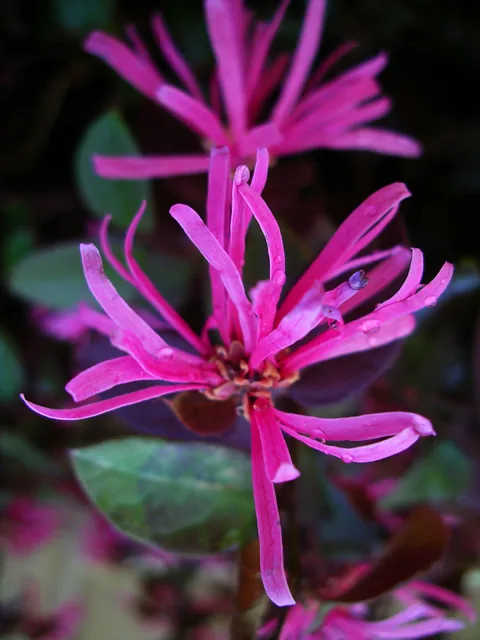
Loropetalum, the Chinese fringe flower, is the kind of evergreen shrub that gives a garden its character before anything comes into bloom, working on two registers at once: its colored foliage and the spidery, fringed flowers that arrive each spring. On the sought-after forms the leaves move through burgundy, deep plum, and near-black and keep that depth the year round, a standing color story where green-leaved kinds simply recede. When the tassel-like blooms open in pink, red, or white, they read as a seasonal accent rather than the main event.
Part of its appeal is how gracefully it slots into a planting and a routine. Once settled it takes drought in stride, sits happily in full sun or part shade, and asks for little more than a tidy-up once the flowers pass. Its one firm preference is acidic soil, and where it sulks the cause almost always turns out to be ground that has drifted too alkaline for the setting.
The detail to weigh before you place it is scale. The cultivar names conjure trim little mounds, yet many settle in far larger than the name suggests, and a vigorous form can rise toward small-tree presence within a few years. Match the variety to the space it will hold, and the planting keeps its proportion without a season of corrective work.
Care
The short version: a spot in full sun to part shade, rich acidic soil that drains cleanly, steady water while it settles and far less thereafter, and a light shaping just as the spring bloom fades.
Light
The color and bloom that make loropetalum worth a place are richest in full sun, though it settles well enough into partial sun or partial shade. Placed in deep shade the dark-leaved forms lose their depth and the flowering thins.
Water
While it finds its feet, water it steadily, about once a week and more when the heat turns fierce. Once established it becomes drought tolerant and asks for little, content to have the top inch or so of soil dry between waterings, with mulch holding what moisture remains.
Soil
This is the detail that decides everything. Loropetalum wants rich, moist, well-drained soil that runs acidic, ideally a pH between 5.0 and 6.5, worked through with organic matter. Neutral or alkaline ground ties up iron and dulls the leaves to yellow.
Temperature
It holds across a wide span, taking lows near 5°F (-15°C) and heat to around 100°F (38°C), the range of USDA zones 7 through 9 where it stays in the garden the year round.
Humidity
Ordinary outdoor humidity suits it, so there is no figure to meet. What counts far more is keeping the roots clear of standing water, the source of its more serious troubles.
Feeding
A single feeding in spring with an acidic, azalea- or camellia-type fertilizer suits it, and a medium dose is enough. That same feed helps hold the soil on the acidic side it favors.
Pruning
Pruning is light, occasional work. Since the flowers form mostly on old wood, shape it just after the spring bloom passes so the cut never costs the coming year's display.
Repotting
A container plant seldom needs moving on. Repot only when the signs appear: roots circling or slipping from the drainage holes, water running straight through, or new growth stalling in the pot.
Size & spacing
Reckon on a shrub near 6 to 8 feet (183 to 244 cm) tall and about as wide, with vigorous forms carrying well beyond. Leave each plant its full spread so air moves freely and the planting keeps its shape without a yearly wrestle.
When to plant
Loropetalum is a woody shrub you place once and live with for years, so the timing worth marking is the planting itself. Settle new plants in through spring or fall, once frost danger has passed, and look forward to the main flush of fringed flowers arriving from late March into April, with a scattering of rebloom carrying through the warmer months.
Northern hemisphere
Southern hemisphere
Typical months for a temperate climate: start earlier in warm zones, later where spring frosts linger.
- Plant: Spring or fall after frost danger passes
- Harvest: Late March to April with sporadic rebloom into fall
Hardiness
USDA hardiness zones: 7–9
Temperature: down to -18°C
Troubleshooting
Given the soil it wants, loropetalum keeps its poise, so most complaints are soil complaints wearing another face. The leaves and roots signal the fault early. Read what you see against the entries below and address the cause rather than the surface sign.
A wilting shrub, failing branches, and roots gone dark and soft
A shrub that wilts and sheds branches while its soil stays sodden is showing root rot, the quiet damage of ground that never drains. Ease a little soil aside and the roots come up dark and soft. The remedy is to hold back the water, open up the drainage, and lift any healthy survivors into a raised, free-draining bed, while a plant rotted to the core is more graciously replaced.
Fix:
- Improve drainage and reduce watering
- Remove and discard severely rotted plants
- Replant in raised, well-drained beds amended with organic matter
Knobby swellings along the stems as the branches beyond them fail
Rough, corky swellings gathered at the branch joints, with dieback beyond them, mark bacterial gall disease. The response is to cut each affected branch well below its gall and consign the prunings to the fire or the bin, disinfecting the tools between cuts so nothing travels along with them. Where a shrub is thoroughly overtaken, the kindest choice for the garden is to remove it entirely.
Fix:
- Prune out and destroy galled branches well below the gall
- Disinfect pruning tools between cuts
- Remove and replace severely infected plants
Foliage fading to yellow as the veining holds its green
When the newest leaves pale to yellow while their veins hold green, the culprit is chlorosis, the sign of soil grown too alkaline for the roots to draw up iron. It settles on fresh growth before anything else. A soil test points the way; from there, elemental sulfur or an acidic feed eases the pH back down, and a dose of chelated iron restores the color while the ground quietly recovers.
Fix:
- Acidify soil with elemental sulfur or an acidic fertilizer
- Apply chelated iron as a temporary correction
- Mulch with organic matter to lower pH over time
Toxicity
For a home shared with pets or children, loropetalum brings ease: it is not toxic. It appears in neither the major poison databases nor the ASPCA list, and the bitter tannins in its foliage tend to turn animals away before they eat much. It can hold its place in the garden without a second thought for who passes by.
Safe for
People · Cats · Dogs · Horses · Rabbits · Livestock · Birds
Cats None
A cat that drifts past and samples a leaf comes to no harm. The bitter tannins in the foliage usually see it off before a nibble becomes a meal.
Dogs None
A dog worrying a stray branch has nothing to fear, since the plant holds no toxin. The most a large mouthful might do is unsettle a sensitive stomach for a while.
Horses Safe
Horses may graze at ease beside the shrub, which carries nothing that would poison them.
Rabbits Safe
Neither the leaves nor the flowers put rabbits at risk, and the bitterness generally keeps them from lingering over it.
Livestock Safe
Cattle, goats, and sheep can browse nearby in safety, with nothing in the plant known to cause poisoning.
Birds Safe
Garden birds settle and forage among the branches without any trouble.
People Safe
The plant sits happily in a household with children, since no part of it is poisonous and a curious taste does no harm.
No special handling needed; foliage contains bitter tannins that discourage browsing.
Varieties
The market names these chiefly for leaf color and habit rather than flower, which is a fair reflection of where their charm lies. These are the cultivars you are most likely to meet.
Ruby (var. rubrum 'Ruby')
Its new leaves open a deep burgundy-red, a foil for the hot-pink fringe flowers it carries against them.
Purple Pixie
A low, weeping dwarf in purple and pink that slips as easily into a container or over a wall's edge as it does across the ground as cover.
Plum Delight
Reddish-purple foliage lends a warm ground note that lets the bright pink flowers come forward.
Ever Red (Chang Nian Hong)
The deepest-toned of the family, wearing near-black red foliage and red blooms, with a welcome habit of flowering again later in the season.
Zhuzhou
A vigorous purple-leaved form that, given free rein, will rise to tree-like proportions.
Companions
Loropetalum pairs naturally with the other acid-loving shrubs, which want the same rich, well-drained ground and gentle shade it does.
How to propagate
Extending a planting of loropetalum at home takes little effort, whether by rooting a few cuttings or by pinning a low branch to the soil and letting it root where it lies.
Stem cuttingsModerate
Late spring through summer · Roots in roughly 15 days to several months depending on cultivar and warmth
Through late spring and summer, take semi-hardwood cuttings from shoots that have begun to firm. Warmth around 75°F (24°C) at the roots keeps things moving, and new roots follow anywhere from about 15 days to a few months on, according to the cultivar and how warm the setting stays.
LayeringEasy
Spring to summer · Several months to root
The gentlest approach is layering, done through spring or summer. Draw a low branch down, pin it into the soil, and let it stay joined to the parent as it roots across several months, then part it into a plant of its own.
Myths
A Loropetalum in the garden puts household cats and dogs at risk of poisoning.
It is absent from the toxic-plant databases and from the ASPCA list alike. Loropetalum is treated as non-toxic to pets, so a household animal that samples the foliage is in no danger.
A dwarf Loropetalum remains a neat little mound for its whole life.
Many that carry the dwarf label quietly outgrow it, and the species and vigorous forms rise to 10 to 20 feet or more. Plan the setting around the true mature size, and confirm the cultivar before you settle it into a spot.