Houseplant · Crassulaceae
Burro's Tail
Sedum morganianum
Offer it bright light and dry feet, and this trailing succulent cascades over the pot for years.
Full sun
Every 14–30 days
50–77°F · 10–25°C
USDA 10–11
Overview
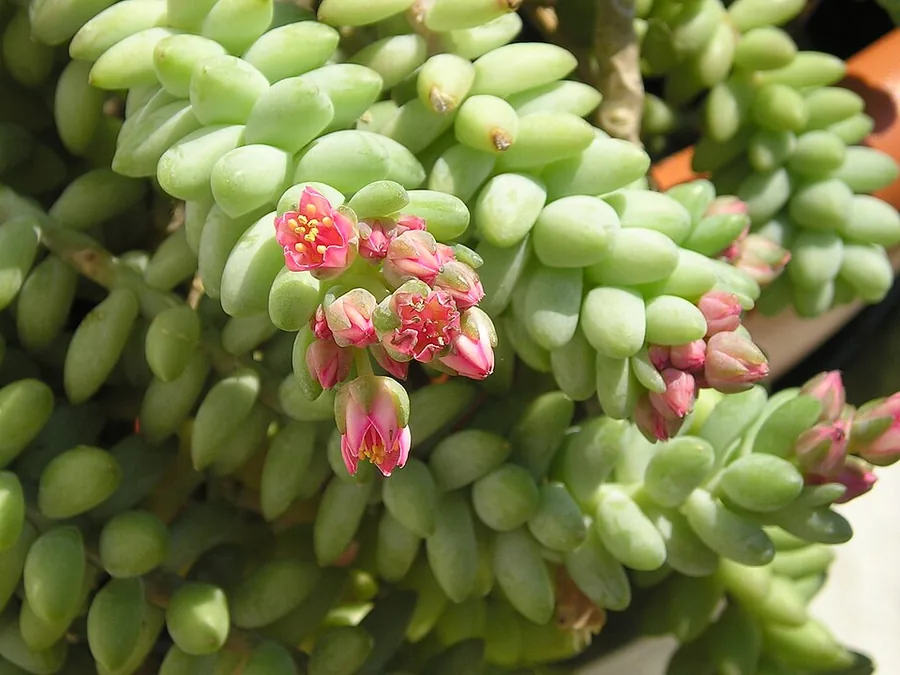
Burro's tail takes its name from the thick, plaited stems that drape like a tail past the rim of a pot, a silhouette that reads as quiet drama in any room. Its home ground is the rocky terrain of southern Mexico and Honduras, and that lineage accounts for the way it prefers to live. The fleshy blue-green leaves come packed with stored water, so the plant takes a missed drink in stride where a thirstier companion would falter.
The very thing that gives it presence also asks for a measure of care in placement. The crowded leaves sit only loosely attached and tumble off at the gentlest contact, which is why a hanging basket lifted clear of the everyday flow makes the ideal home for it. Settled in well, a single specimen can spill several feet, and come summer it may finish its stems with small pink to red flowers, a display that stays uncommon indoors.
Best of all, it lives on next to nothing. Bright light, a pot that drains freely, and long pauses between waterings keep it content, while the chief danger is generosity poured out as too much water. Keep it spare and leave it be, and it pays you back season after season.
Care
The short version: set it in the brightest place in the house, pot it up in a gritty cactus mix, and reach for water only once the soil has nearly dried out, holding back even more through winter to keep rot at bay.
Light
Burro's tail asks for bright light to full sun, the most luminous corner you can spare. A sunny windowsill draws the stems in dense and full, while a shadowed nook leaves them long and pale. When you carry it into stronger sun, ease it across over a week or so to keep the leaves from burning.
Water
Water sparingly, and only after the mix has nearly dried out, which tends to fall around once a month indoors. The fat leaves hold a reserve of their own, so when in doubt, hold off. Pull back further still through winter, since cold, sodden soil is the surest path to rot.
Soil
Set it in a gritty, fast-draining cactus or succulent mix, with a measure of extra perlite folded in for good measure. A pH falling anywhere from 6.0 to 7.5 will serve it well. The point that counts is letting water pass clean through rather than pool around the roots.
Temperature
It keeps content between 50°F and 77°F (10°C to 25°C), the ordinary spread of a lived-in room. A short brush with 40°F (4°C) is within its tolerance, but draw it indoors ahead of any frost, which it will not weather.
Humidity
Count it a low-humidity plant, perfectly settled in dry indoor air, with no figure to track and no misting to bother with. Close, stagnant air offers it nothing and only opens the door to rot.
Feeding
Offer food rarely, no more than once or twice over the spring-to-summer growing season, with a balanced or dilute liquid fertilizer. It is lean by temperament, and a heavy hand at feeding works against it.
Pruning
It calls for little to no pruning. Cut back any leggy or overlong stems simply to keep things neat, and go gently, since the stems snap readily and the leaves let go at a touch.
Repotting
Move it on only after the plant has wholly filled its pot, a moment that arrives rarely. The clues are roots pressing at the container and growth that stalls or looks crowded. Handle it as sparingly as you can through the change to keep the leaves where they are.
Size & spacing
Trailing stems can stretch 2 to 4 feet (60 to 120 cm) long and fan out 1 to 3 feet (30 to 90 cm) across. A hanging basket grants those tails the room to cascade and lifts them well clear of passing elbows.
Troubleshooting
Nearly every misstep with burro's tail comes down to a single pair of causes: a heavy hand with water or a room too dim. Catch the early cues laid out below and the source is usually settled before the plant pays for it.
Stems going soft and leaves turning see-through
What you are looking at is rot, and the usual culprit is water lingering at the roots with nowhere to go. Set the watering can aside, let the soil go bone dry, and trim out every soft or discolored stem before it travels further. Should the base be lost, take the firm tips and root them, then switch to a gritty mix that empties quickly and ease right off the water through winter.
Fix:
- Stop watering and allow the soil to dry out
- Remove rotted portions and repot into gritty, fast-draining mix
- Propagate healthy stem tips if the base is lost
Cottony white specks lodged where the leaves meet
Those soft white tufts settled into the leaf axils are mealybugs, sap feeders that tend to leave a tacky residue in their wake. Touch each to a cotton swab soaked in rubbing alcohol, set the plant apart from the rest of the collection, and stay with it until the last one is gone. Look over every new succulent before it earns a place on the shelf, and never let plants sit damp or pressed together.
Fix:
- Dab insects with a cotton swab dipped in alcohol
- Isolate the plant and repeat treatment until clear
Leaves letting go the instant the plant gets a nudge
Each plump leaf holds on loosely, so a passing sleeve or a knocked pot scatters them across the floor. Read this as the plant's nature rather than a fault to fix. Give it a quiet perch away from the flow of the room, carry it by the pot instead of the stems, and tuck the strays back into the soil where they quietly start new plants at no cost.
Fix:
- Place the plant where it will not be brushed against or knocked by passing traffic
- Handle by the pot rather than the stems
- Pot or scatter dropped leaves on soil, where they readily root into new plants
Stems thinning out with bare gaps along their length
Leggy, washed-out growth means the plant is straining toward light that never arrives, a condition known as etiolation. Shift it to a brighter window offering bright light to full sun, and ease into the change across a week or two so the stems are not caught off guard and burned. A bright sill keeps those trailing lengths dense and full.
Fix:
- Move to a brighter spot with bright light to full sun
- Acclimate gradually to stronger light to avoid scorching
Toxicity
A welcome note for a pet home: burro's tail is safe to share with animals and children. The ASPCA records it as non-toxic to cats, dogs, and horses, and the leaves hold no harmful compounds. A curious bite may bring a brief upset stomach, as so many plants can, and nothing more.
Safe for
People · Cats · Dogs · Horses · Rabbits · Livestock · Birds
Cats None
The ASPCA marks this one safe for cats, so it earns a place in a feline household. An inquisitive bite might prompt a touch of drooling or a passing queasiness, and nothing beyond that.
Dogs None
Dogs are in the clear as well, with no toxic compounds in play. A dog that mouths a dangling stem might face mild, short-lived stomach trouble at the very most.
Horses None
The ASPCA gives it a pass for horses too, so a grazing bite carries no genuine threat.
Rabbits Safe
With nothing toxic on board, a rabbit comes to no harm from a sample, though the juicy, water-laden leaves belong as an occasional treat rather than a daily green.
Livestock Safe
Goats, sheep, and cattle may taste it without consequence. Kept as a houseplant, it seldom finds its way into their reach to begin with.
Birds Safe
Pet birds share its company safely, and a nibbled leaf holds no poison. The fragile stems tend to scatter well before much is actually eaten.
People Safe
Nothing in it harms people, so a child who samples a fallen leaf faces no risk. Since it is not raised for the table, let it stay on the windowsill where it belongs.
Varieties
Burro's tail keeps one close cousin worth meeting, a tidier form that handles more kindly and grows with the same ease.
Sedum morganianum 'Burrito' (baby burro's tail)
Its leaves run shorter, rounder, and more snugly packed than the species, and they cling on with far more determination, which is what makes this the gentler one to live with and move around.
How to propagate
Few houseplants give back so freely. Every fallen leaf and every trimmed stem holds a new plant inside it, so a fresh supply to pot up or hand to a friend is never far off.
Stem cuttingsEasy
Growing season (spring to summer) · Several weeks to a few months to root well
For a full plant in the shortest time, stem cuttings are the fastest route. Snip healthy tips through the spring-to-summer growing season, set them aside to callus over for a day or two, then rest them on or settle them into a gritty mix. Roots establish across several weeks to a few months, sooner than a lone leaf manages.
Leaf cuttingsEasy
Growing season (spring to summer) · Several weeks to a few months, slower than stem cuttings
Each dropped leaf is a future plant in waiting. Rest the fallen leaves on the soil surface during the growing season and they put out roots and small plantlets unprompted. The method is dependable, though plan on several weeks to a few months, slower than a stem cutting.
DivisionEasy
When repotting during the growing season · A few weeks to establish
After a clump has crowded its pot, you can divide it at repotting time during the growing season. Each piece settles back in over a few weeks, turning one plant into two with almost no effort.
Myths
A pet home is no place for burro's tail because it poisons cats and dogs.
The ASPCA records Sedum morganianum as non-toxic to dogs, cats, and horses, so it belongs comfortably in a home with animals. A nibble might cause mild stomach upset, just as most any houseplant would, with nothing dangerous about it.
Without regular watering the plump leaves will quickly shrivel away.
This is a drought-tolerant succulent that banks water inside those fat leaves and prefers the soil to nearly dry out between drinks. Too much water is what kills it, leaving the roots and stems to rot, so hold off whenever you are uncertain.