Houseplant · Crassulaceae
Ghost Plant
Graptopetalum paraguayense
Set it in bright light with a dry rest between waterings, and the ghost plant keeps its poise on its own.
Full sun
Every 10–21 days
50–86°F · 10–30°C
USDA 9–11
Overview
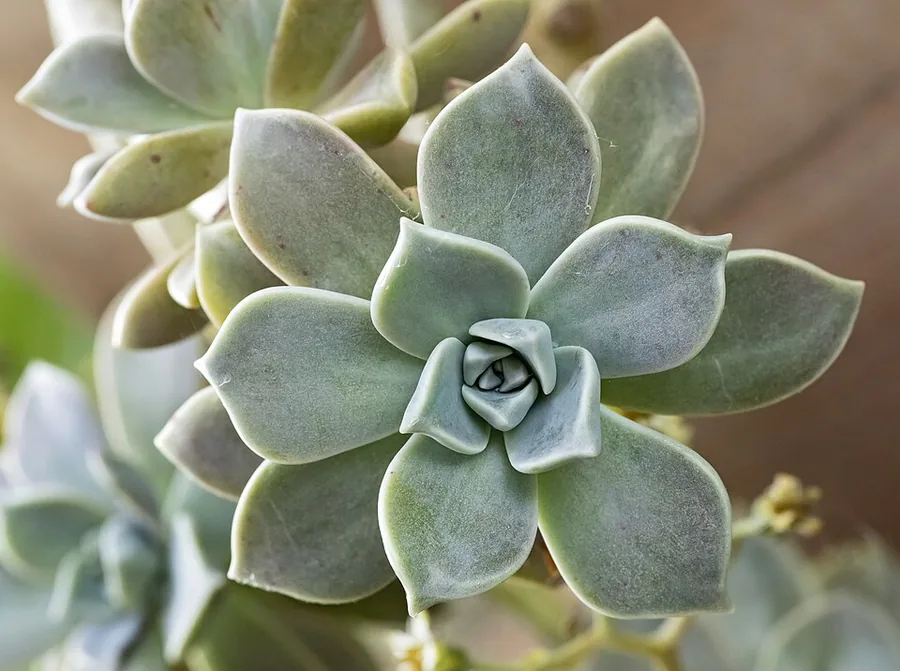
The ghost plant brings a quiet, chalky calm to a room, a low Mexican succulent whose pale, powdery bloom lends its rosettes that soft, ghostly cast. It keeps company in the same family as the jade plant and the houseleeks, holding its color in fleshy leaves that drift from gray-blue to soft pink. On a sunlit sill or a side table, it asks for very little and gives back an unfussy, understated presence.
Left to lengthen, its low rosettes trail and spill over a pot rim or a ledge, which makes it a natural for a raised shelf, a hanging planter, or the edge of a bright windowsill. The leaves loosen at the lightest touch, so it belongs where daily traffic stays gentle. That same habit rewards a patient corner, since nearly every dropped leaf roots itself and slowly fills the space around it.
Style it around strong light and very sharp drainage and it settles into a home with ease, content beside a sunny window through a busy week. Tuck it into a dim corner or leave it in damp soil and the look falters fast, the rosettes stretching out and the base going soft.
Care
The short version: a bright or sun-filled spot, a gritty mix that drains fast, and a deep soak only once the soil has run completely dry. Give it room and restraint, and it looks its best on a little neglect.
Light
Set the ghost plant in full sun or very bright light and the rosettes hold tight and keep their color. Bright indirect light will keep it going, but anything dimmer loosens the shape as the stems stretch and the leaves drift apart.
Water
Soak it well, then leave it until the soil is bone dry, a rhythm that usually lands every 10 to 21 days. The fleshy leaves carry their own reserve, so the real hazard is too much water, not too little. Overwatering is what tips it into rot.
Soil
Pot it in a gritty cactus or succulent mix that clears in seconds, never an ordinary potting soil that lingers wet. A pH from 6.0 to 7.5 suits it, so the feel of the mix counts for far more than its chemistry.
Temperature
It keeps its ease between 50°F and 86°F (10°C to 30°C) and takes summer heat in stride. It is not frost hardy, so bring it indoors or shelter it before the cold sets in.
Humidity
This is a low-humidity plant with no number to meet, at home in the dry air of most rooms. Damp, stagnant air works against it, so airy placement beats any misting.
Feeding
Feed it monthly through spring and summer while it is growing, using a diluted balanced or low-nitrogen succulent feed at half strength. Ease off through the cooler months, and skip rich fertilizer, which only pushes soft, weak growth that spoils the tidy rosette.
Pruning
Pruning stays light. Lift away dead leaves and trim leggy or stretched stems to hold a compact shape, and behead any rosette that has reached up too far so you can replant the top and keep the look full.
Repotting
Repot it every 2 to 3 years, or sooner once the rosettes spill over the pot edge, doing it in spring. Roots creeping from the drainage holes or soil that dries almost at once are the plant asking for a roomier home.
Size & spacing
It stays low, near 6 to 12 inches (15 to 30 cm) tall, and broadens as the stems trail, reaching 12 to 24 inches (30 to 60 cm) across. Leave that width in mind when you choose its spot, so new rosettes can fill in around the base.
Troubleshooting
Nearly every off day for a ghost plant comes down to two things: a pot kept too wet or a spot kept too dim. Each shows in the plant's look before it turns serious. Match the sign below and adjust the setting before rot or a stretch spoils the shape.
A softening base and leaves fading to glassy translucence
Behind the sagging, glassy leaves is root and stem rot, the usual result of a pot watered more often than it can dry. Lift the plant from its container and read the roots and lower stem for anything black, soft, or sour to the nose. Pare away the ruined tissue, set the sound rosettes or cuttings aside to callus for a few days, and settle them into fresh dry gritty mix for a clean start.
Fix:
- Stop watering immediately
- Remove the plant and cut away all rotted tissue
- Let healthy cuttings or rosettes callus for several days
- Replant in dry gritty succulent mix
Rosettes rising tall and loose with sparse foliage
The loose, drawn-out silhouette is etiolation, a plant leaning after light it never quite receives. Its stems tip toward the nearest window while the neat rosettes unfurl and lie flat. Move it into a spot with several hours of direct sun, behead the stretched rosette to replant the top, and let the bare stem answer with a flush of new offsets.
Fix:
- Move to a brighter location with several hours of direct sun
- Behead the stretched rosette and replant the top
- Propagate the bare stem to produce new offsets
Sun-scald blotches following a sudden shift outdoors
Those brown blemishes are sunburn, the toll of a sudden shift from gentle interior light to open sun. They gather on the most exposed leaf surfaces within a day or two of the change. Draw the plant back into bright but sheltered light, lift the sun gradually across a week or two, and let it release the scarred leaves in its own time.
Fix:
- Move to bright but slightly shaded light temporarily
- Acclimate gradually to stronger sun over one to two weeks
- Leave scarred leaves in place until they are naturally shed
Toxicity
For a home shared with animals or small children, this one sits easy on the conscience. The ghost plant is non-toxic through and through, listed by the ASPCA as safe for cats and dogs, with no toxin to concern other pets or people. A stray nibble brings, at most, a little passing stomach upset from the bulk.
Safe for
People · Cats · Dogs · Horses · Rabbits · Livestock · Birds
Cats None
A household cat can share a shelf with it in peace. Should one taste a leaf, the most it invites is a brief bout of fullness, since nothing in the plant is poisonous.
Dogs None
Dogs pose no cause for concern around it. With the ASPCA calling it non-toxic, a chewed leaf tends to end in nothing worse than a passing spell of stomach upset.
Horses None
Horses meet no toxin in this succulent, curious a stable snack though it makes. A chance mouthful passes without harm.
Rabbits None
Rabbits keep company with it untroubled. Its fleshy leaves hold no toxin, so an inquisitive bite comes to nothing.
Livestock None
Grazers like goats and sheep face no poison in this plant. A few leaves lost to the herd amount to a non-event.
Birds None
Birds encounter nothing toxic here. A pecked leaf may leave a faint powdery mark on the beak, which brushes off and signifies nothing.
People None
For people, children among them, both handling and an accidental taste are safe. The chalky bloom lifts onto the fingertips yet does no harm.
The powdery (farinose) coating on leaves rubs off easily when handled, which is cosmetic and harmless.
Varieties
Only a couple of forms turn up with any regularity, and each trades the plain gray-blue rosette for a touch more color to play with. These two reward a second look.
Graptopetalum paraguayense 'Pink Form'
Under strong light or cool nights its rosettes take on a pink to rose flush, where the plain form keeps a composed chalky gray-blue.
×Graptosedum (Graptopetalum × Sedum hybrids)
These sedum crosses carry the ghost plant's line into brighter tones and a looser, more trailing habit for a shelf or basket.
How to propagate
Few plants furnish a home as easily as this one. A single leaf, an offset, or a beheaded rosette will each take root with almost no attention from you.
Leaf cuttingsEasy
Spring through summer during active growth · 3 to 6 weeks to root and form new rosettes
Across spring and summer, twist away a whole healthy leaf, let the broken end callus for a few days, and rest it on dry gritty mix. Roots and a small rosette arrive in about 3 to 6 weeks, the very same way stray fallen leaves quietly furnish new plants wherever they settle.
Offsets & pupsEasy
Spring through summer · 2 to 4 weeks
Through spring and summer the plant offers up rosette offsets along its stems. Ease one free, let it callus a moment, and pot it, and it takes its place within 2 to 4 weeks.
Stem cuttingsEasy
Spring through summer · 2 to 4 weeks
In the warm months, behead a rosette with a short length of stem and let the cut callus over. Returned to soil it roots with ease, finding its footing in roughly 2 to 4 weeks.
Myths
A plant this chalky and dry in appearance clearly calls for constant watering.
That pale, powdery finish is a natural waxy bloom, part of the plant's chalky charm rather than a plea for water. It keeps its own supply within those plump leaves and prefers to run dry between drinks. Watering to chase the dusty look is the quickest way to rot it.
The plant shares the pet toxicity common to so many succulents.
A good many succulents earn their place on a high, out-of-reach shelf, yet this one asks for no such caution. The ASPCA lists the ghost plant as non-toxic to cats and dogs, so a curious nibble need not unsettle a pet-friendly home.