Houseplant · Crassulaceae
Hen and Chicks
Sempervivum tectorum
Give it sun, grit, and almost no water, and this composed little succulent quietly holds a room together.
Full sun
USDA 3–8
6–12 in · 15–30 cm
Overview
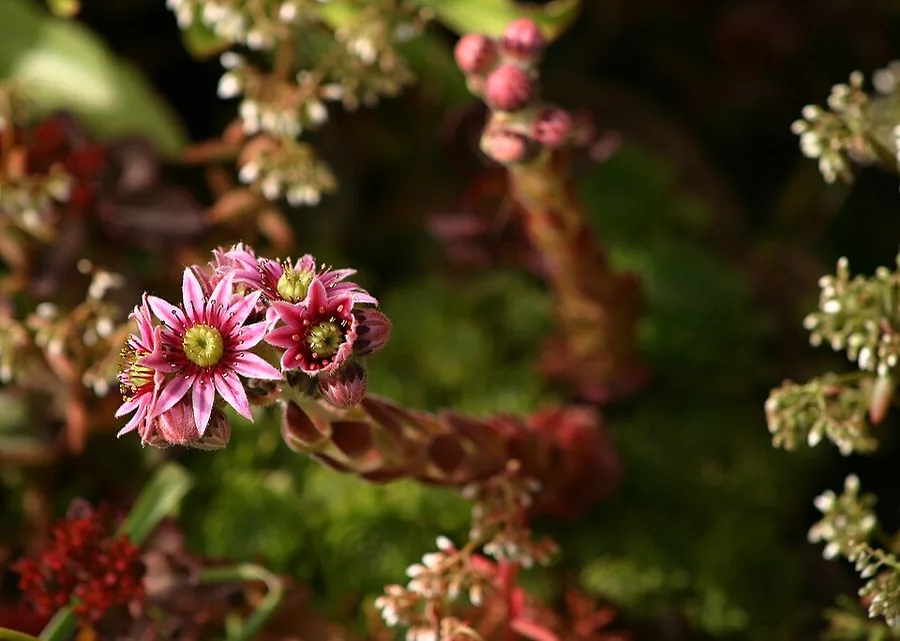
The name paints the picture: a central rosette, the hen, framed by a brood of smaller offsets, the chicks, gathered close on a sunlit sill or a low table by a window. This is an alpine succulent from the mountains of Europe, and its botanical name, Sempervivum, means always living, a fitting note for a plant that reads as calm and permanent in a space. For centuries it lived on European rooftops, and it still brings that same unfussed, weathered charm indoors.
What makes it such an easy companion for a busy home is exactly what a well-meaning owner gets wrong. It asks for poor, gritty soil and next to no water, so the attentive routine of frequent watering and rich mix, the habit of a devoted plant parent, is the very thing that undoes it. A little benign neglect suits it, which makes it ideal for the mantel, the shelf, or the desk you pass rather than tend. Each rosette flowers once and steps aside for its chicks, so the arrangement quietly refreshes itself and never asks to be replaced.
Care
The short version: set it in bright light with a fast-draining gritty mix, and water only once the soil has dried out completely. It wants little feeding and settles more happily into a low-touch routine than an attentive one.
Light
Set it in full sun for the richest color and the neatest, most sculptural rosettes, which is where its ornamental appeal lives. It accepts partial sun or light shade, but too little light loosens the rosettes and drains away the reds and purples that give it presence in a room.
Water
Water it sparingly, only once the mix has dried out completely. This is an alpine succulent that carries its own reserves, so overwatering is the one habit that undoes it. Ease right off through winter, when moisture lingering at the crown turns to rot.
Soil
Give it a gritty cactus or succulent mix that drains at once and never sits soggy. It is unbothered by pH, content anywhere from 6.0 to 8.0, and it prefers lean ground to anything rich, which keeps potting simple.
Temperature
Its range is remarkable, holding steady from -40°F to 86°F (-40°C to 30°C), so it suits a cold porch or an unheated room as readily as a warm sill. Summer warmth is no trouble either, provided drainage stays sharp.
Humidity
It favors dry air and takes low household humidity in stride, which makes it an easy fit for most interiors. Damp, still air is the thing to avoid, since it invites rot and rust where rosettes sit close.
Feeding
It asks for little at the table. A dilute low-nitrogen succulent feed once or twice across spring and summer covers it, and skipping even that does no harm. Poor soil is its native element, and it would rather not be pushed.
Pruning
There is next to nothing to tend. After a hen flowers and fades, lift out the spent rosette and clear the dried outer leaves; the surrounding chicks quietly close the gap in the arrangement.
Repotting
Move it into a fresh pot every 2 to 3 years, or sooner once the offsets crowd and spill over the rim in a way that starts to look untidy. Roots at the drainage holes or a mix that dries faster than before are the cues to refresh it with new gritty mix.
Size & spacing
The rosette clumps keep a low, tidy profile, reaching 6 to 12 inches (15 to 30 cm) tall and spreading 6 to 18 inches (15 to 45 cm) wide as the chicks multiply. Given room, a colony drifts outward and gradually dresses the surface it sits on.
Troubleshooting
Nearly every setback with hen and chicks traces to a single habit, which is too much water. Get the drainage and the watering rhythm right and there is little else to keep an eye on. Match what you see below, then act before rot works into the rosette.
A soft, darkening rosette that sinks at the center
A rosette that has gone soft and dark is showing crown and root rot, the near-inevitable result of too much water or a mix that holds it. Lift out the spoiled rosettes and set the watering aside until the container dries through. The firm offsets are still sound, so settle them into fresh gritty mix with brisk drainage and the display carries on.
Fix:
- Remove and discard affected rosettes
- Withhold water and let the mix dry fully
- Salvage firm healthy offsets and replant in fresh gritty mix with sharp drainage
Orange-brown raised spots marking the leaves
Those orange-brown spots are rust, a fungus that finds its opening where a planting stays damp and packed too close. Clear away the marked leaves and rosettes, then loosen the arrangement so air can move freely between them. Keeping water off the foliage and dividing a dense colony returns the planting to good order.
Fix:
- Remove and dispose of affected leaves and rosettes
- Improve airflow and spacing
- Avoid wetting the foliage when watering
A rosette lifts a stalk, flowers, then fades
A rosette that rises on a stalk, blooms, and then fades is following its monocarpic life cycle, not failing. The hen flowers a single time and departs, leaving a ring of chicks arranged around her to take up the display. Trim away the spent rosette and let the offsets close the composition, or relocate them to refresh another corner.
Fix:
- Remove the spent flowered rosette
- Allow surrounding offsets to fill the space
- Replant detached offsets if desired
Toxicity
A reassuring note for any home: hen and chicks is non-toxic across the board. The ASPCA counts Sempervivum among its safe succulents, and no harmful compound is on record. It suits a house with cats, dogs, or children without worry, though it remains a piece for the shelf rather than the plate.
Safe for
People · Cats · Dogs · Horses · Rabbits · Livestock · Birds
Cats None
A household cat can share a room with it easily, as no toxic compound is on record. Should a curious cat nibble a rosette, the worst outcome is a brief, mild stomach upset.
Dogs None
A dog is welcome anywhere the plant sits, with no poison in play. A large mouthful of any greenery may loosen the stomach for a day, but nothing here does real harm.
Horses None
No toxic principle troubles horses, so a stray taste from pasture or a garden planter passes without consequence.
Rabbits None
Rabbits come to no harm near hen and chicks, since the fleshy leaves hold nothing dangerous. It remains a plant for display, though, rather than a staple in the feed bowl.
Livestock None
Cattle, goats, and sheep are untroubled by grazing this plant, which carries no toxin to disturb a ruminant gut.
Birds None
Pet and garden birds may pick at the rosettes without harm, as nothing in the foliage is poisonous to them.
People None
A fixture of rooftops and windowsills for generations, the plant is entirely safe around people, and there is no need to keep it beyond a child's reach.
Varieties
Most hen and chicks distinguish themselves by the color their rosettes take on through the season, which is the detail to weigh when matching one to a palette. A few named cultivars are worth knowing when a particular shade is the goal.
Sempervivum tectorum 'Rubin'
Its rosettes settle into a deep ruby-red to purple that carries elegantly through the whole season.
Sempervivum tectorum 'Sunset'
With maturity the foliage warms into glowing orange-red sunset tones, a natural centerpiece for a sunlit sill.
Sempervivum tectorum subsp. tectorum 'Triste'
It wears a muted, dull reddish-brown that reads as quiet and understated rather than bold.
How to propagate
Few plants are simpler to multiply, and much of the time it obliges on its own by putting out chicks. Splitting a clump or sowing seed are options too, depending on how quickly you want to furnish more of a space.
Offsets & pupsEasy
Spring to early summer · 2-4 weeks to root
Lifting offsets is the graceful, effortless route, and the one most growers reach for when refreshing a display. From spring into early summer, twist a rooted chick free of the mother rosette and press it into gritty mix, where it takes hold across roughly 2 to 4 weeks. It is worth remembering the monocarpic habit here: the hen departs after flowering, and these chicks are how the colony renews the arrangement.
DivisionEasy
Spring · 2-4 weeks
Division suits a clump that has grown too dense for its container or its corner. In spring, lift the whole mat and part it into single rooted rosettes, then replant each where it earns its place. They settle back into the composition within about 2 to 4 weeks.
SeedModerate
Spring · Several months to a year
Seed is the unhurried route, rewarding chiefly when the aim is to raise plants in quantity for a larger scheme. Sow in spring and allow the season to unfold, since seedlings need several months to a year to become anything of note, and named cultivars seldom come true from seed.
Myths
The ASPCA Hens and Chickens listing proves Sempervivum tectorum was tested and cleared as pet-safe.
That particular entry belongs to Echeveria elegans, a tender Mexican succulent of an altogether different genus. The cold-hardy Sempervivum, the true houseleek, sits on its own within the ASPCA roster of non-toxic succulents. Both are safe, simply under separate listings.
Houseleeks have to come indoors for the winter.
They rank among the hardiest succulents in any collection, carrying an RHS H7 rating and holding through cold far below freezing across USDA zones 3 to 8. In cold regions they keep a garden or terrace furnished all year. Wet, not cold, is what undoes them, so the single winter task is keeping the crowns clear of soggy mix.
The whole plant is dying when the central rosette throws up a stalk and collapses.
Only that one rosette is bowing out of the arrangement. Each hen is monocarpic and departs after flowering, yet she leaves a ring of chicks to carry the look forward. The colony endures through its offsets, and often reads fuller and more settled than before.