Houseplant · Crassulaceae
Echeveria
Echeveria
Set it where the light runs bright and the soil drains fast, and this rosette succulent quietly styles itself.
Full sun
50–77°F · 10–25°C
USDA 9–11
3–12 in · 8–30 cm
Overview
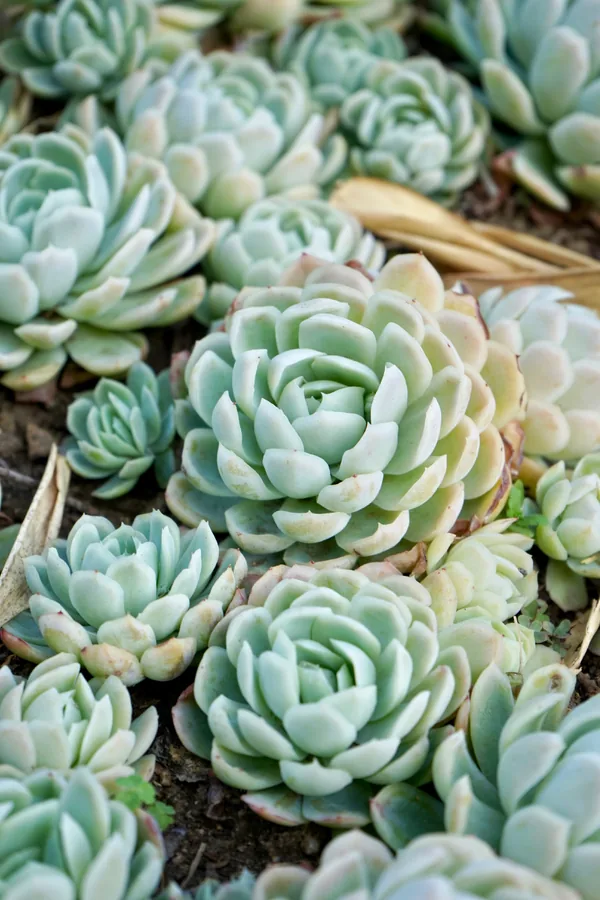
Echeveria is a rosette-forming succulent from the dry highlands of Mexico and Central America, and it has become the quiet anchor of the modern sunny windowsill. It brings a calm, sculptural presence to a room in cool shades of blue-green, lavender, and silver, a low and composed shape that flatters a minimalist shelf as readily as a sun-warmed kitchen counter. A frosted finish from its farina coating softens the look and reads beautifully against pale ceramic or raw clay.
Its appeal as a houseplant lies in how lightly it fits into a daily routine. The plant carries its own reserves, so it slips into a busy week without protest and asks for little beyond a bright perch. Place it in strong light against a gritty mix and it holds a tidy form, often warming to pink or red at the leaf tips when a south-facing room floods with sun.
It keeps to a small footprint, usually 3 to 12 inches (8 to 30 cm) across, which makes it an easy guest on a desk, a sill, or a clustered tablescape. Over time it sends up offsets around its base, so a single pot can grow into a gathered arrangement of rosettes. Give it the right corner with good light and restrained watering, and it rewards the styling with almost no upkeep.
Care
The short version: a bright perch, a gritty fast-draining mix, and a deep soak only once the soil has dried out completely, with light feeding through the warm months.
Light
Echeveria asks for full sun to very bright light, several hours of it a day, to keep its composed rosette and its color on display. A sunny south or west window is the natural home for it indoors. In a dim corner the rosette stretches tall and the color drains away, and the look falls flat.
Water
Soak the soil through, then leave it until it has dried out completely before the watering can returns. This is a desert plant that rots fast in wet soil, so pour at the base and never let water settle in the heart of the rosette. When the day is uncertain, give it a few more before reaching for water.
Soil
Set it in a gritty cactus or succulent mix that drains in seconds rather than holding water around the roots. A pH between 6.0 and 7.0 suits it. Sharp drainage matters above all, so work in perlite or coarse sand if the mix feels heavy in the pot.
Temperature
It keeps its best form between 50°F and 77°F (10°C to 25°C), comfortable at ordinary room warmth. Frost is its undoing, so any plant summering outdoors should come in well ahead of the first cold snap.
Humidity
Low, dry air is exactly the climate it favors, so there is no humidity to chase around the room. Steamy bathrooms and kitchens are the wrong setting, since moisture trapped around the leaves invites rot.
Feeding
Feed it lightly through spring and summer, while the plant is in active growth. A dilute balanced or low-nitrogen succulent fertilizer a few times across the season is all it wants. Let the feeding rest in winter as growth slows.
Pruning
Upkeep is light. Lift away the spent lower leaves and trim faded flower stalks to keep the rosette looking its best. If one has stretched and gone leggy, behead the top and re-root it to bring back the compact shape.
Repotting
Move it into a slightly larger pot every 2 to 3 years, or sooner once offsets crowd the rim and roots reach through the drainage holes. Take the moment to refresh the gritty mix and look the roots over for any soft, rotted spots.
Size & spacing
A mature rosette stays small, reaching 3 to 12 inches (8 to 30 cm) tall and about as wide depending on the species. Its slow, compact growth makes it an effortless fit for a windowsill, a small pot, or a place within a mixed succulent dish.
Troubleshooting
Nearly every echeveria misstep comes down to the spot it lives in: too little light or a watering can that visits too often. Read the rosette and the base together, and the room itself usually tells you what to change. Find the look that matches below, then adjust the setting early.
Leaves turning soft and glassy above a darkening base
Soft, glassy leaves and a base that gives under a fingertip signal root and crown rot, the quiet result of a watering can that has been too generous for the pot it sits in. Once the rot works into the crown, the original specimen is past saving, and no amount of attention brings it back. Set the watering aside, pare away every soft part, and begin again by re-rooting a clean top cutting or a healthy pup in dry gritty mix.
Fix:
- Stop watering and let the plant dry
- Cut away rotted tissue and dust with no further water until callused
- Re-root healthy top growth or offsets in dry gritty mix
Small white tufts settling into the leaf joints
Those powdery white tufts gathering in the leaf joints, with their faintly sticky trace, are mealybugs, sap-feeders that find the rosette a comfortable hideaway. Touch each one with a cotton swab dipped in 70 percent isopropyl alcohol, give the plant a rinse, and move it away from the rest of the display for a while. Look it over each week until the tufts stop returning and the collection stays clear.
Fix:
- Dab insects with a cotton swab dipped in 70 percent isopropyl alcohol
- Rinse and isolate the plant
- Repeat treatment weekly until clear
A rosette drawing upward, leaves pale and loosely spaced
A rosette that climbs and loosens has slipped into etiolation, the look a plant takes on when its corner of the room runs short on light. The stem rises, the leaves drift apart toward the nearest window, and the sculptural shape that earned it a place on the shelf goes soft. Shift it to a brighter spot or bring in a grow light, then behead the leggy top and re-root it to recover that tidy silhouette.
Fix:
- Move to a sunnier spot or add grow lighting
- Behead the stretched rosette and re-root the top
- Propagate usable leaves from the bare stem
Toxicity
Reassuring news for a home that doubles as a pet's and a child's. Echeveria carries no known toxins, and the ASPCA lists it as safe for both cats and dogs. A nibbled leaf might bring a brief stomach upset, as any unfamiliar plant could, but there is nothing here to poison anyone.
Safe for
People · Cats · Dogs · Horses · Rabbits · Livestock · Birds
Cats None
It belongs in a home with cats without a second thought. Should a curious one sample a leaf, expect nothing worse than a brief, mild stomach upset, the sort any non-food plant brings, with nothing toxic involved.
Dogs None
A dog-friendly household has nothing to weigh here. A rosette chewed in passing might leave a little drool or a short bout of loose stool from the unfamiliar plant, and the matter ends there.
Horses Safe
It holds no poisoning risk for horses, though these small rosettes live as houseplants and have nothing to offer as forage.
Rabbits Safe
It sits safely alongside rabbits, with no toxin in the foliage. A nibbled plant is a loss to the room rather than a danger to the rabbit.
Livestock Safe
It carries no poison for grazing animals such as goats, sheep, or cattle.
Birds Safe
Pet birds take no toxicity from it, so a stray peck at a leaf leaves no harm behind.
People Safe
It is risk-free to live with and tend for adults and children alike. It earns its place for looks rather than the plate, yet a curious taste will not poison anyone.
Varieties
The genus runs to hundreds of species and hybrids, but a few set the tone again and again. These are the names worth styling a collection around.
Echeveria elegans
Sold as Mexican snowball, it settles into tight pale blue-green rosettes finished with almost translucent margins.
Echeveria 'Perle von Nurnberg'
A hybrid prized for dusty lavender-pink leaves veiled in a soft, powdery farina coating.
Echeveria agavoides
Its sharp, triangular leaves recall a small agave and tend to close in a bright red tip.
How to propagate
Echeveria is among the most satisfying plants to multiply for a growing display, starting from a single dropped leaf or from the pups it offers up on its own.
Leaf cuttingsEasy
Spring through summer during active growth · Several weeks to a few months to form roots and a new rosette
A single leaf can become the next plant on the sill. In spring or summer while growth is underway, twist off a whole healthy leaf so none of it tears, let the cut end callus for a few days, then rest it on dry gritty mix and mist it lightly. Over several weeks to a few months, tiny roots and a fresh rosette emerge from the base.
Offsets & pupsEasy
Spring through summer · A few weeks to root once separated
The simplest route to a fuller display is the offsets, or pups, that gather around the mother rosette through spring and summer. Snap one off, let the cut surface callus over, and set it into dry succulent mix, where it roots within a few weeks.
Myths
Echeveria is simply another name for true hens and chicks.
A shared nickname links them, yet they belong to different genera. The cold-hardy hens and chicks is Sempervivum, which weathers hard winters and dies after a single flowering, while Echeveria is tender and frost will kill it.
A succulent like echeveria never asks to be watered.
It carries itself through a dry spell with ease, yet it still welcomes a deep soak once the soil has dried out completely. Leave one thirsty too long and it shrivels, the leaves going soft and wrinkled as the plant quietly fades from the shelf.